
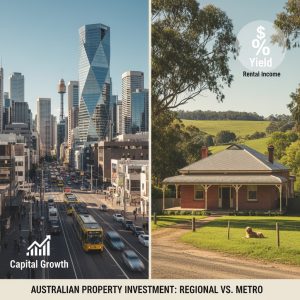
Regional vs Metropolitan Property Investment: Which is Right for You?
Key Takeaways Regional properties in Australia typically offer higher rental yields (around 5-7%) compared to metropolitan areas (3-4%),...
When it comes to building a successful property portfolio in Australia, one of the biggest choices is between regional and metropolitan property investment. This decision goes beyond simple geography; it involves understanding two distinct investment strategies that can shape your financial future.
If you feel overwhelmed by conflicting property investment advice, you’re not alone. The Australian property market has changed rapidly, and what worked five years ago may not be the best approach today. With city prices rising and regional areas experiencing strong growth, it’s critical to reassess your options and base your strategy on what truly suits your goals.
Choosing wisely could deliver strong rental yields and reliable capital growth. On the other hand, a misaligned strategy can leave you with underperforming assets and financial strain.
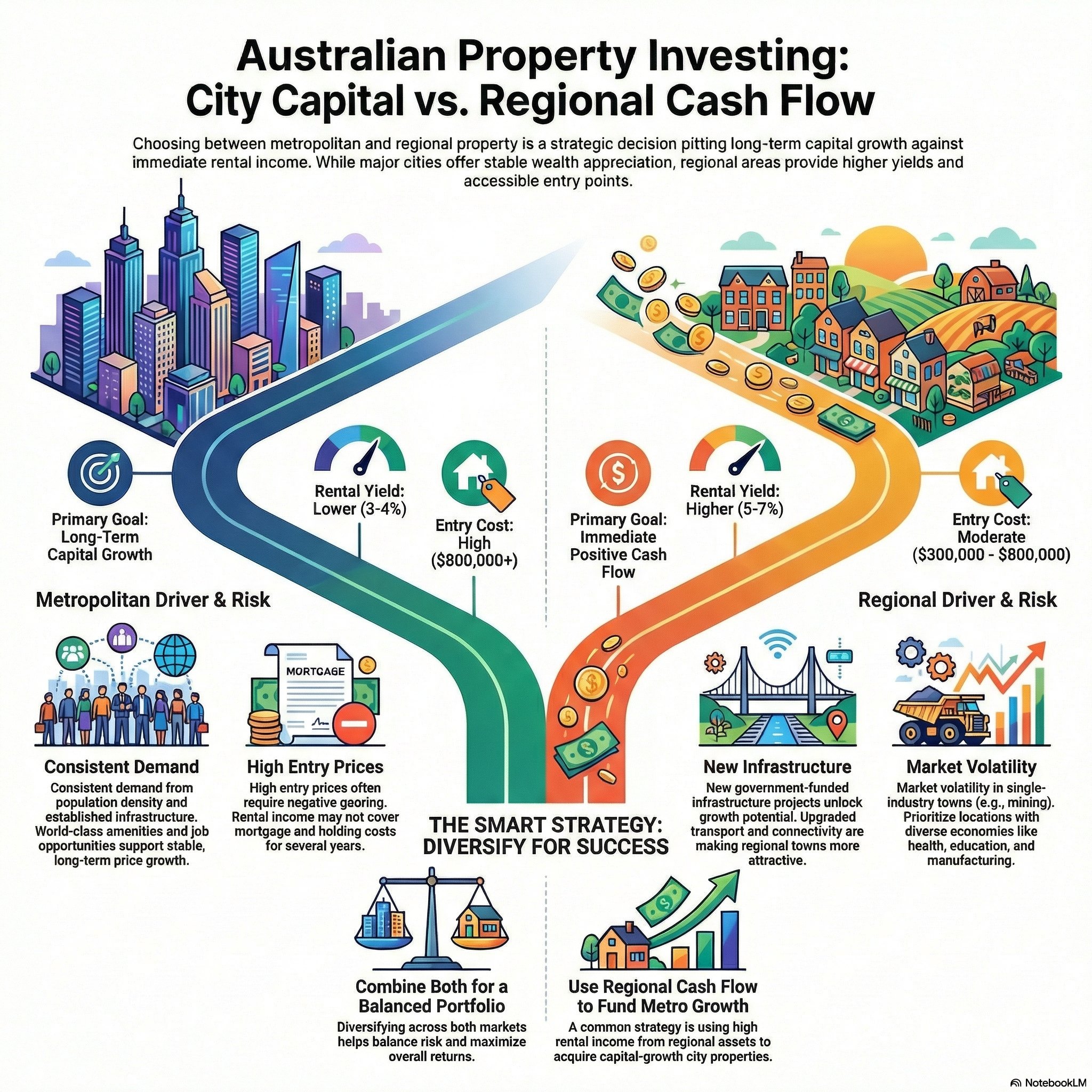
Metropolitan property investment has traditionally been the benchmark in Australian real estate. Major cities such as Sydney, Melbourne, Brisbane, Perth and Adelaide offer consistent capital growth, supported by population density, abundant job opportunities, and extensive infrastructure.
Cities like Sydney and Melbourne have demonstrated superior long-term capital growth. Properties within 10-15km of the CBD benefit from the ripple effect—price growth in inner suburbs spreads outward. This capital appreciation has built generational wealth for early investors.
Metropolitan areas benefit from world-class infrastructure, including advanced hospitals, universities, and transport networks. These amenities attract both renters and buyers, supporting sustained demand and property value stability.
Capital city property markets provide greater liquidity, meaning properties generally sell faster due to larger pools of buyers and well-established sales processes. This makes it easier to adapt your investment strategy as your goals evolve.
Entry prices in Sydney and Melbourne now exceed $1.8 million and $1.2 million respectively. This results in modest rental yields (around 2.8-3.5%), which often fail to cover mortgage interest and other holding costs.
Moreover, competition among investors for well-located metropolitan properties can push prices beyond fundamentals. Negative gearing is common, making you reliant on ongoing financial contributions to cover shortfalls between rent and expenses.
If you’re a first or even second-time investor, these high barriers to entry may limit your access to viable metropolitan opportunities.
Regional property investment has dramatically evolved. Once viewed as a niche or high-risk choice, the regions are now attracting seasoned investors in search of higher yields and strong risk-adjusted returns.
Regional properties routinely deliver rental yields between 5% and 7%, compared to 3%-4% in capital cities. This can mean positive cash flow from day one, unlike equivalent investments in the major cities where investors often face years of capital outlays.
Major government infrastructure spending is reshaping regional connectivity. Fast rail and new highways are linking regional towns with capital cities, driving capital growth and making regional locations more attractive for both employment and lifestyle.
This focus on committed infrastructure is often the key to unlocking the true potential of regional markets, something I learned very early in my investing journey.
I remember the nervous energy surrounding my first regional purchase. All my friends and even some older advisors were telling me to stick to Sydney, where the growth was ‘guaranteed.’ But I couldn’t ignore the superior cash flow a regional property offered. What really convinced me wasn’t just the higher rental yield, though—it was discovering a committed, funded infrastructure project: a new transport hub planned for the town’s edge. Three years later, that hub had not only stabilised the local economy but dramatically improved my property’s value and rental demand. It taught me that while the emotional pull of the city is strong, the tangible impact of government-backed regional infrastructure is often the secret ingredient to strong risk-adjusted returns.
With property prices generally ranging from $300,000 to $800,000, regional property remains within reach for a wider range of investors. This enables you to diversify your portfolio and manage debt levels more effectively.
Queensland towns like Toowoomba, Bundaberg, and Mackay benefit from infrastructure upgrades and population inflows. Here, investors can achieve yields of 5-6% and experience extremely low vacancy rates, sometimes below 2%.
WA regions such as Geraldton, Albany, and Bunbury are currently producing yields over 6%, with vacancy rates below 1% due to ongoing resource industry demand.
Ballarat, Bendigo, and Geelong offer proximity to Melbourne, affordable median prices ($380,000-$650,000), and robust tenant demand stemming from both professionals and students.
Despite the advantages, regional investment is not risk-free. Single-industry towns—especially those reliant on mining or tourism—can experience volatile cycles. Economic downturns or shifts in commodity prices can trigger major market corrections or high vacancy rates.
Diversification within the regional sectors is essential. Prioritise locations with varied industries such as health, education, and manufacturing to provide more stable, long-term returns.
There is no universal right or wrong in the regional vs metropolitan property debate. The best choice always depends on your unique situation and goals.
Many sophisticated investors combine both approaches—starting with regional cash flow, then moving to metropolitan assets. This strategy enables portfolio growth while optimising both income and long-term gains.
Today’s property market is more complex than ever. Expert advice can help you navigate volatile conditions, accurately identify opportunities, and structure loans for maximum tax and cash flow benefit. An experienced mortgage broker or property advisor will ensure your strategy matches your financial situation and investment aims.
Your long-term wealth isn’t determined by simply choosing regional or metropolitan property. It comes from carefully matching your investment strategy to your objectives and executing that strategy with confidence and discipline.
The regional vs metropolitan property investment debate is really about clarifying what matters most for your wealth creation journey. Both approaches can work if executed with the right research, risk management and advice.
Many investors succeed by combining the strengths of both, using regional income to support capital city acquisitions and spreading risk between market types.
Book a mortgage review call today to explore which strategy (or combination of both) will help you achieve your unique property investment goals and optimise your finance for long-term success.
Are regional properties more risky than metropolitan properties?
Regional properties involve specific risks—including greater economic concentration and sometimes reduced liquidity—but these can be managed with careful research. Focus on areas with diverse industries and proven growth to minimise potential downsides.
What rental yield can investors expect from regional vs metropolitan markets?
Regional investments usually offer 5-7% rental yields, while metropolitan properties average around 3-4%. These yields will vary based on the specific location and the condition of each property.
What research methods best suit regional property investing?
Effective regional market research includes analysing population growth, unemployment rates, economic diversification, vacancy rates, and tracking large-scale infrastructure investments. Use reliable sources such as local councils, state governments, and property market reports.
Can a property portfolio benefit from a mix of regional and metropolitan assets?
Absolutely. Combining both types allows you to balance cash flow and capital growth, which helps spread risk and support a sustainable investment strategy as your wealth grows.
Key Takeaways Regional properties in Australia typically offer higher rental yields (around 5-7%) compared to metropolitan areas (3-4%),...

Key Takeaways CommBank raised fixed home loan rates in January 2026, anticipating potential RBA rate hikes. Banks typically adjust fixed...