

Should I Buy One Expensive Property or Multiple Affordable Ones?
Key Takeaways Multiple affordable properties provide greater diversification and higher rental yields than investing in one expensive...
Picture this: You’re sitting at your kitchen table, browsing property listings. Your heart skips a beat at the sight of a beautiful $1.2 million home in a prestigious suburb. Then you spot two modest homes for $450,000 each in promising growth areas. You’re not alone if you’re torn between these options – it’s a common dilemma for savvy Australian investors aiming to maximise their wealth.
This is exactly the decision facing Rita, a 45-year-old investor whose mortgage is nearly paid off and whose children are now independent. For her, choosing the right investment strategy could determine whether she retires comfortably and explores the world, or has to work for another decade.
If you’re experiencing similar uncertainty, you’re in the right place. The debate between purchasing one expensive property or spreading investments across multiple affordable ones is one of the most significant considerations for Australians seeking long-term property wealth. Let’s explore the facts, figures, and strategies to support you in making the best choice for your circumstances.
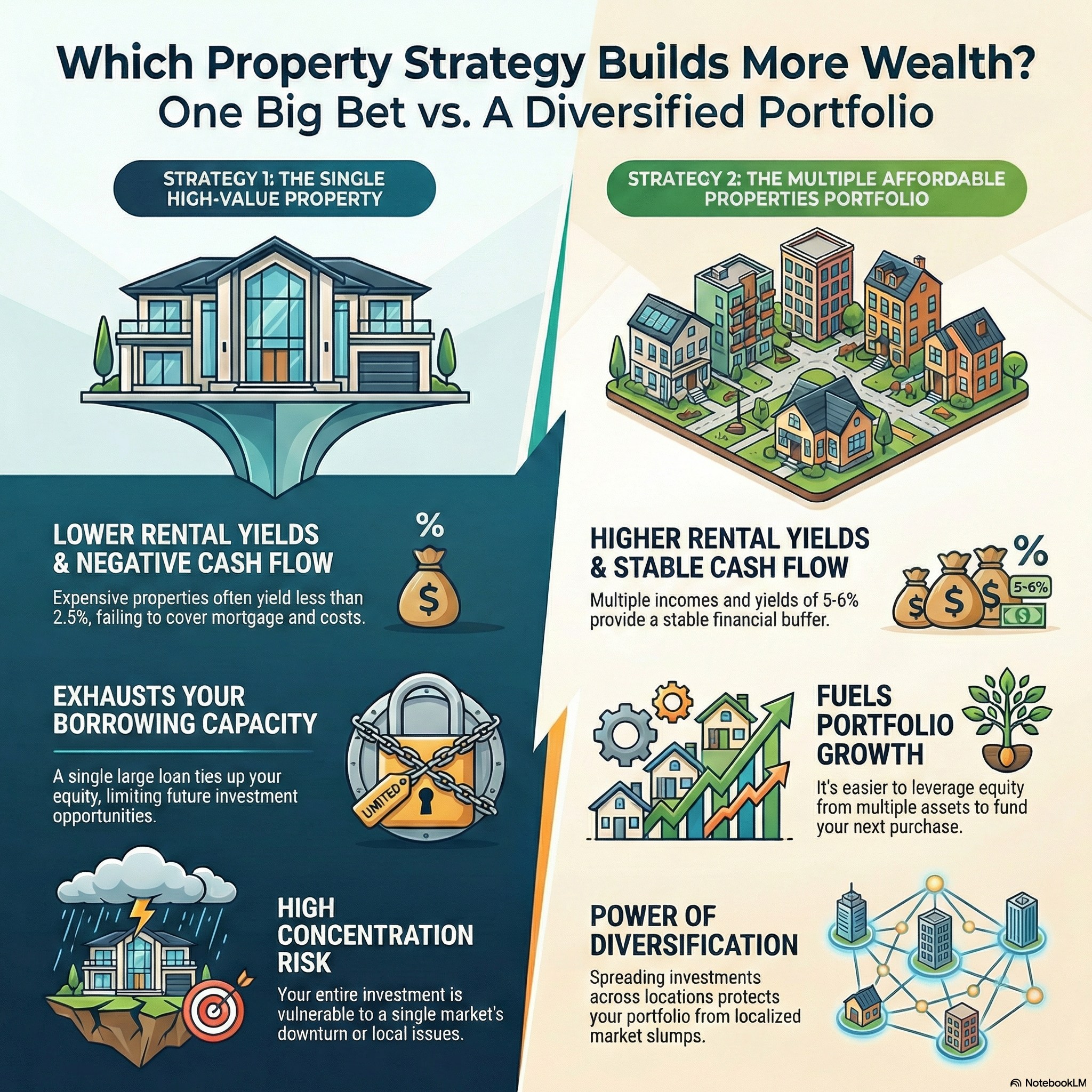
Choosing to invest in a single, high-value property often means using up your entire borrowing capacity in one go. In Sydney, where the median house price hovers around $1.47 million, obtaining one prestigious property can leave you with little room to manoeuvre for future investments. Your equity becomes tied up, unable to work as leverage for future portfolio growth.
This borrowing limit can feel like a financial prison. While others continue growing their portfolios, you may be relegated to the sidelines, missing out on new opportunities as the market evolves. I learned this lesson the hard way early in my career, sitting in what I thought was my first ‘dream asset.’ Years ago, I bought the single most expensive city terrace I could barely afford, convinced that a prime inner-city location would guarantee success. The reality was a sinking feeling every month. Every single one of my savings was tied up, and the costs regularly outstripped the rent, creating stressful negative cash flow. I watched as friends who’d bought two or three smaller, more affordable properties in emerging suburbs easily absorbed the cost of a vacant unit because their other rental streams covered the payments. I was locked out of new investments until my equity eventually caught up—by then, several growth cycles had passed me by. That experience taught me that diversification isn’t just about protection; it’s about giving yourself choices, financial resilience, and multiple chances to grow security and freedom, not just banking on a postcode.
Expensive properties in top suburbs regularly return weaker rental yields – often less than 2.5%. For example, a $1.5 million property may only produce $45,000 in rental income each year, which may not be enough to cover mortgage repayments, ongoing fees, and maintenance. This negative cash flow could mean you end up subsidising the investment from your own pocket, year after year.
Putting your entire investment capital into a single property amplifies risk. Any local economic downturn, demographic shift or infrastructure issue can significantly impact your property’s value and rental income. Additionally, luxury properties may sit on the market longer if you need to sell during a downturn, potentially increasing your holding costs.
Investing in a range of more affordable properties enables you to diversify geographically. For instance, you might acquire one property in Brisbane’s booming corridor and another in Adelaide’s up-and-coming suburb. This diversification safeguards you against localised downturns, smoothing your portfolio’s overall performance.
Recent market fluctuations have shown that while some suburbs slow down, others continue to grow – diversification helps capture those gains.
Owning several properties also means receiving multiple rental incomes. This provides stability – if one property is vacant, others often remain tenanted, helping cover your financial commitments.
Regional markets, such as Ballarat and Toowoomba, offer rental yields around 5-6%, compared to lower yields in top city suburbs. Two properties generating a 5.5% yield each can generate significantly higher total income than a single high-value property in the city.
Smaller, individual loans are easier to manage and often more attractive to lenders. As your portfolio grows, you can more easily access equity to fund further investment – a key principle of successful property wealth creation.
Banks often look more favourably at diversified holdings, giving you greater flexibility to expand or adjust your strategy as your financial situation changes.
Affordable properties appeal to a wider range of tenants – including working families, young professionals and couples – increasing your chances of steady, reliable rental income. Expensive homes often attract a smaller, more niche tenant market, increasing the risk of longer vacancies during economic or market changes.
High-income earners may be attracted to expensive properties for their potential capital growth, but they should be cautious of stretching their finances. Most moderate-income investors find better results by building a portfolio of affordable homes, which are often easier to manage on an ongoing basis.
Ask yourself: can you comfortably support several smaller loans, or would one larger debt overextend your finances?
If you’re a long-term investor willing to ride out short-term volatility, a high-value property may suit you. However, affordable properties often yield positive returns sooner, making them attractive for short- to medium-term goals.
Owning multiple properties can also make it easier to sell off assets selectively, rather than being forced into an all-or-nothing decision with a single property.
Investors with lower risk tolerance – such as those approaching retirement – generally benefit from the stability and diversification offered by multiple affordable properties. More aggressive investors may accept the risks associated with owning a single, high-value asset, hoping for strong capital gains.
Choose the strategy that best matches your current life stage and future plans.
City properties tend to offer higher capital growth potential but at the expense of yield and investment entry cost. Regional properties are often more affordable and generate better rental income, although capital gains may be slower.
Consider your own financial goals: do you prioritise immediate cash flow, or are you willing to sacrifice short-term income for possible long-term growth?
Both high-end and affordable strategies benefit from investing in areas with future growth potential. Look at factors such as planned infrastructure, employment growth, and changing demographics to identify locations likely to outperform.
Owning several affordable properties allows you to test different growth areas, spreading your risk while opening up the potential for higher returns.
Ultimately, the decision between buying one expensive property or several affordable ones comes down to what best supports your financial future. Many successful Australian investors eventually expand into portfolios of affordable properties, enjoying stronger cash flow, better diversification, and more opportunities for long-term wealth creation.
However, personal circumstances – such as your income, risk profile, capital available, and time horizon – should dictate your approach. Remember, there is no single solution that fits everyone. What’s most important is that you start your investment journey informed and ready to take action.
Property markets reward knowledgeable, proactive investors. Start by assessing your own goals and financial situation. Expert guidance is a key part of any successful investment strategy.
Ready to transform your property investment plan and secure your financial future? Book a mortgage review call today and let’s match your goals with the investment strategy best suited to you.
How much deposit do I need for multiple affordable properties compared to one expensive property?
Generally, multiple affordable properties require smaller individual deposits, making them more manageable for investors with limited upfront capital. In contrast, a single expensive property demands a larger deposit, but may offer more favourable loan-to-value ratios. Evaluate your total deposit and determine how it aligns with your investment strategy.
Are there any tax advantages to one strategy over the other?
Both strategies provide opportunities to claim tax deductions on loan interest, maintenance and depreciation. Purchasing several newer, affordable properties may provide greater depreciation benefits, while premium properties may offer enhanced negative gearing advantages. Seeking advice from a tax professional is highly recommended.
What are the typical ongoing costs for each approach?
Managing multiple properties involves higher total administrative costs, like multiple insurance policies and management fees, but these are often offset by stronger rental returns. A single expensive property usually means less administration but higher maintenance and insurance costs due to property value.
How can I finance multiple property purchases successfully?
Start by purchasing an initial property, and as its value and your equity grow, use this as leverage for your next investment. Refinancing and equity releases are common, and working closely with an experienced mortgage broker can help you structure your portfolio for maximum growth and flexibility.
Key Takeaways Multiple affordable properties provide greater diversification and higher rental yields than investing in one expensive...

Disclaimer: These are generated via AI – please note that you need to do your own due diligence and read the report yourself to make your own...