

Mortgage pre-approval in Australia typically lasts 90 days, though some lenders extend it up to six months depending on your circumstances and how stable your financial position remains. Pre-approval is a snapshot of your finances at a single point in time – your income, your debts, your credit score – so if anything material changes within that window, the lender may reassess. Most buyers do not realise the clock starts ticking the moment they receive conditional approval, which means the window to find, make an offer on, and exchange contracts for a property is tighter than many expect.
Key Takeaways
- Most Australian lenders honour a mortgage pre-approval for around 90 days, with some extending it to six months.
- Pre-approval is based on a snapshot of your financial position – changes to income, debts, or credit can trigger a reassessment.
- If your pre-approval is approaching expiry, you can request an extension, but lenders will typically require updated financial documents.
- Rate rises, job changes, and new credit commitments are the most common reasons pre-approvals are revised or withdrawn before formal approval.
- Once you have made an offer and it is accepted, you move into formal (unconditional) approval – a separate, more thorough process.
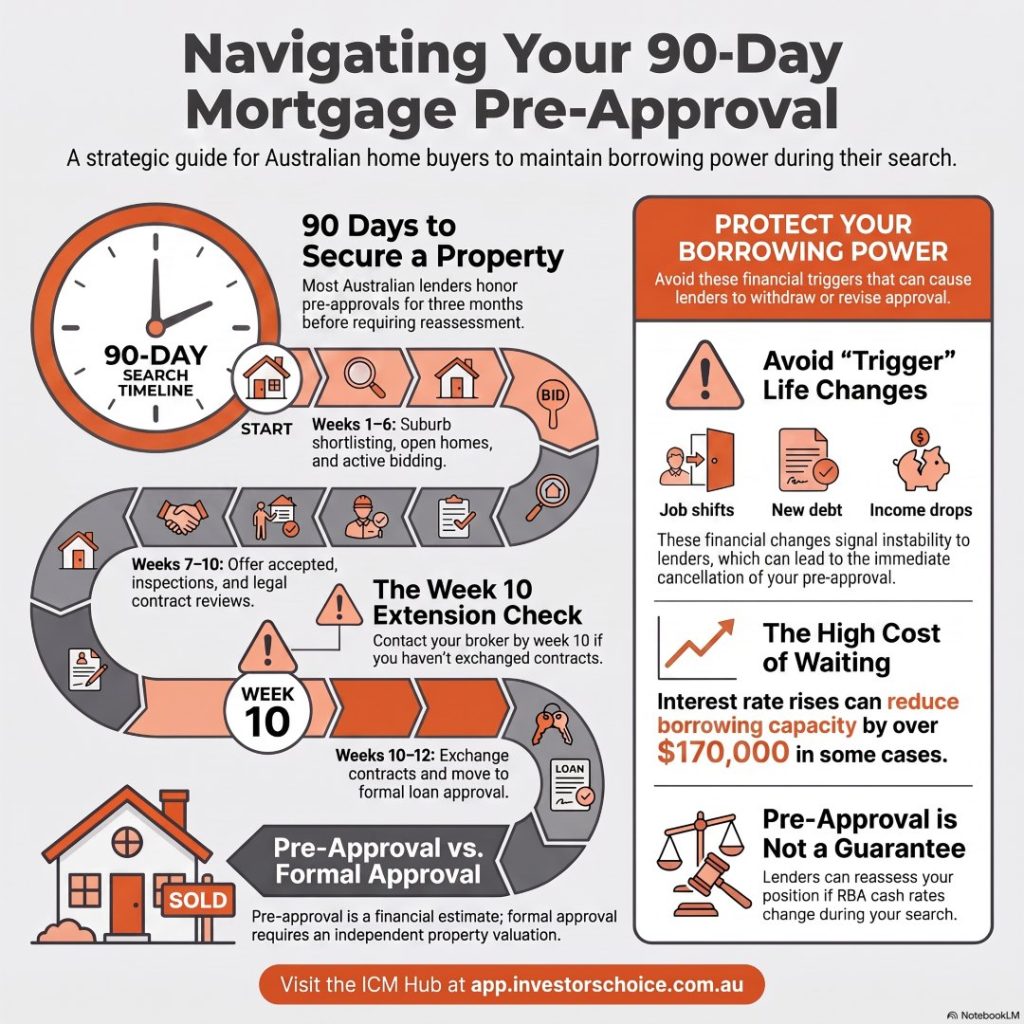
Why Your Mortgage Pre-Approval Has an Expiry Date
Think of home loan pre-approval as a green light based on today’s traffic conditions. The lender is saying: “Based on what we can see right now, we are comfortable lending you this amount.” But lending conditions change. Interest rates shift. Your income situation can evolve. Property valuations fluctuate. That is precisely why lenders attach a time limit to their pre-approval decisions.
The pre-approval validity period in Australia is generally set at 90 days, which translates to roughly three months of active searching. Some lenders – particularly those with a stronger relationship focus – will extend this to five or six months, but only if your financial circumstances have remained stable and you can provide updated documentation to support that.
This matters practically. If you receive conditional approval and then spend eight weeks travelling, another month deliberating, and a few weeks negotiating, you may find yourself running right up against that expiry date. At that point, lenders are not obligated to honour the original terms, and a lot can change between your pre-approval assessment and your formal application.
What Can Cause Your Pre-Approval to Be Revised or Withdrawn?
The most anxiety-inducing discovery for many buyers is that pre-approval is not a guarantee of finance. It is an indication – sometimes called “conditional approval home loan” – that the lender is willing to lend to you under the conditions that existed at the time of assessment.
Four specific triggers commonly cause lenders to reassess:
1. Interest rate changes If RBA raises the cash rate after your pre-approval is issued, your lender’s serviceability calculation changes. A higher rate means a higher repayment, which may reduce the amount they are prepared to lend. This is less of a concern in a falling rate environment, but it is a real risk when rates are climbing.
2. A change in employment Lenders are particularly cautious about employment stability. If you move from permanent employment to contract or casual work – or change industries entirely – the lender may need to reassess your income security. If you are thinking about changing jobs while house-hunting, read our guide on how changing jobs affects your mortgage before making any moves.
3. Taking on new debt A new car loan, an increase to your credit card limit, or even a buy-now-pay-later account can reduce your assessed borrowing capacity. Lenders run a hard credit enquiry during formal approval, and any new financial commitments that appeared after pre-approval will be scrutinised.
4. A significant drop in income This might include losing overtime, transitioning to part-time hours, or a business income that has softened. Your pre-approval was based on the income figure documented at the time – if that figure can no longer be verified at formal application, the lender will recalculate.
Pre-Approval vs Formal Approval: What Is the Difference?
Understanding this distinction saves buyers a great deal of confusion and stress.
Pre-approval (conditional approval) is an assessment of your financial situation. The lender reviews your income, liabilities, credit history, and deposit to give you a borrowing limit. No specific property is involved at this stage.
Formal approval (unconditional approval) is what happens after you have found a property, made an offer, and the lender has:
- Conducted an independent valuation of the property
- Confirmed all supporting documents are current and accurate
- Run final credit and serviceability checks
The formal approval stage is where your loan becomes binding. Until that point, pre-approval is better understood as a well-informed estimate rather than a locked-in commitment.
For first home buyers navigating the first home buyer pre-approval process for the first time, our article on how the first home buyer mortgage process actually works breaks it down step by step.
What to Do When Your Mortgage Pre-Approval Expiry Is Approaching
In over 17 years of running a mortgage broking business, I have watched this scenario play out more times than I care to count – and in recent years, rate rises have made it particularly costly. I had a client come back to me after letting her pre-approval lapse, thinking she had more time. When we went back through the process, rate rises had changed the serviceability calculation and she now qualified for $780,000. When we first got her approved, she could buy at $950,000. That is a $170,000 difference – enough to take entire suburbs off the table. She had not changed jobs. She had not taken on new debt. She had simply waited too long, and the market had shifted beneath her. The 90-day window is not a bureaucratic formality. It is a real constraint, and the buyers who treat it seriously are the ones who end up in the home they actually wanted.
This situation is more common than most buyers anticipate, particularly in competitive markets where properties move quickly or where buyers are searching across multiple suburbs. If your pre-approval expiry date is approaching and you have not yet found the right property, you have two practical options:
Request an extension from your lender. Most lenders will consider extending your pre-approval for a further 30 to 90 days, but they will ask for updated supporting documents – current payslips, bank statements, and sometimes an updated credit check. This is a straightforward conversation to have with your broker, and it is far less time-consuming than starting the process from scratch. To extend mortgage pre-approval in Australia, simply contact your broker before the expiry date rather than waiting for it to lapse.
Reassess your financial position before reapplying. If more than six months have passed since your original pre-approval, or if your circumstances have changed meaningfully, it is often worth going back through the full pre-approval process. This gives you an accurate, current picture of your borrowing capacity – and may even reveal that it has improved.
Improving your borrowing capacity before reapplying can make a meaningful difference to the loan amount available to you.
A Practical Timeline for Using Your 90-Day Pre-Approval Window
If you receive pre-approval with a standard 90-day validity, here is how experienced buyers typically use that window:
| Week | Action |
| 1-2 | Shortlist suburbs, attend open homes, set search criteria |
| 3-6 | Active bidding or negotiation on shortlisted properties |
| 7-10 | Offer accepted, pest and building inspections, legal review |
| 10-12 | Exchange contracts, move to formal approval |
| Buffer | Contact broker in week 10 if formal approval not yet finalised |
The key is to start searching immediately after pre-approval is issued – not weeks later. Every day you wait is a day off your validity period. If you are approaching the end of that window without a result, contacting your broker at the 10-week mark (not the 13th) gives you enough runway to extend without any gaps in your financing position.
For a deeper understanding of what pre-approval looks like as part of the broader home loan journey, our guide to approval in principle covers the terminology and process in plain language
Should You Get Pre-Approval Before You Start Searching?
Yes – and the reasoning is straightforward. Pre-approval gives you a realistic budget ceiling, which means you are not wasting time inspecting properties you cannot actually finance. It also signals to sellers and agents that you are a serious buyer, which can give you an edge in competitive conditions.
That said, getting pre-approval too early – say, six months before you plan to actively search – can mean your approval expires before you are ready to move. The sweet spot is to have pre-approval in hand two to four weeks before you start attending open homes, not months in advance.
Conclusion: Get Your Home Loan Pre-Approval Right the First Time
Navigating mortgage pre-approval in Australia, understanding what can invalidate it, and structuring your loan to perform well under rate changes is genuinely complex – and the stakes are high. An experienced mortgage broker does not just help you get pre-approved. They help you structure the loan so it works for your cash flow, stress-test it against rate movements, and stay alongside you from first inspection to settlement day.
Visit the Investors Choice Mortgages Hub to access free tools, or speak with our team to arrange a complimentary consultation. We can walk you through pre-approval, loan structuring, and exactly what to expect at every step after.
The ICM Hub brings together smart tools, calculators, and expert broker support to help you make confident, informed decisions at every stage of your property journey – including a Mortgage Stress Test calculator that shows exactly how rate changes could affect your repayments.
Frequently Asked Questions
How long does mortgage pre-approval last in Australia?
Most Australian lenders issue pre-approval for 90 days, though some will extend this to five or six months depending on your financial stability and the lender’s own policies. The 90-day window starts from the date the conditional approval is issued, not from when you begin actively searching.
Can I extend my mortgage pre-approval if it expires before I find a property?
Yes. You can ask your lender or broker to extend your pre-approval, typically for a further 30 to 90 days. The lender will generally request updated payslips, bank statements, and may run a new credit check. It is a straightforward process but is easier to organise before expiry than after.
What happens if interest rates rise after my pre-approval is issued?
A rate rise can reduce the amount your lender is prepared to lend you, because higher repayments change the serviceability calculation. If rates have moved significantly since your pre-approval, your lender may revise the approved borrowing limit when you reach formal approval. A mortgage broker can help you stress-test your position and identify which loan products offer more rate resilience.
Can my pre-approval expire before settlement if the process takes longer than expected?
Yes – this is a real risk, particularly if there are delays in the conveyancing process, building inspection issues, or extended settlement periods. Pre-approval covers you up to formal (unconditional) approval, not through to settlement. Once formal approval is granted and the loan contract is signed, your financing is secured regardless of pre-approval expiry.