
More New Homes Being Built — Does That Mean Prices Will Drop?
The instinct makes perfect sense. You see government targets for 1.2 million new homes, headlines about record building approvals, and your first...
The instinct makes perfect sense. You see government targets for 1.2 million new homes, headlines about record building approvals, and your first thought is: “More supply equals lower prices. I’ll wait it out.” That logic – borrowed straight from Economics 101 – feels airtight. But when applied to the real Australian property market, it tells only half the story, and acting on the wrong half is a costly mistake. Does building more houses lower prices? Not immediately, and the timing gap between those two realities is exactly what most buyers and investors get wrong.
Most buyers who decide to wait for housing supply to push prices down are working from a reasonable-sounding but incomplete model of how property markets operate.
Here is what that model gets right: when more homes are built, more supply competes for the same pool of buyers, sellers have less pricing power, and prices should moderate. In a perfectly efficient, frictionless market, that would happen almost instantly.
But the Australian property market is not that. It is a market where building approvals, construction timelines, labour shortages, materials constraints, and planning delays all create a substantial lag between the decision to build and the moment a completed home is ready to purchase.
That lag is not a minor detail. It is the entire mechanism that makes the “wait for supply” strategy so costly.
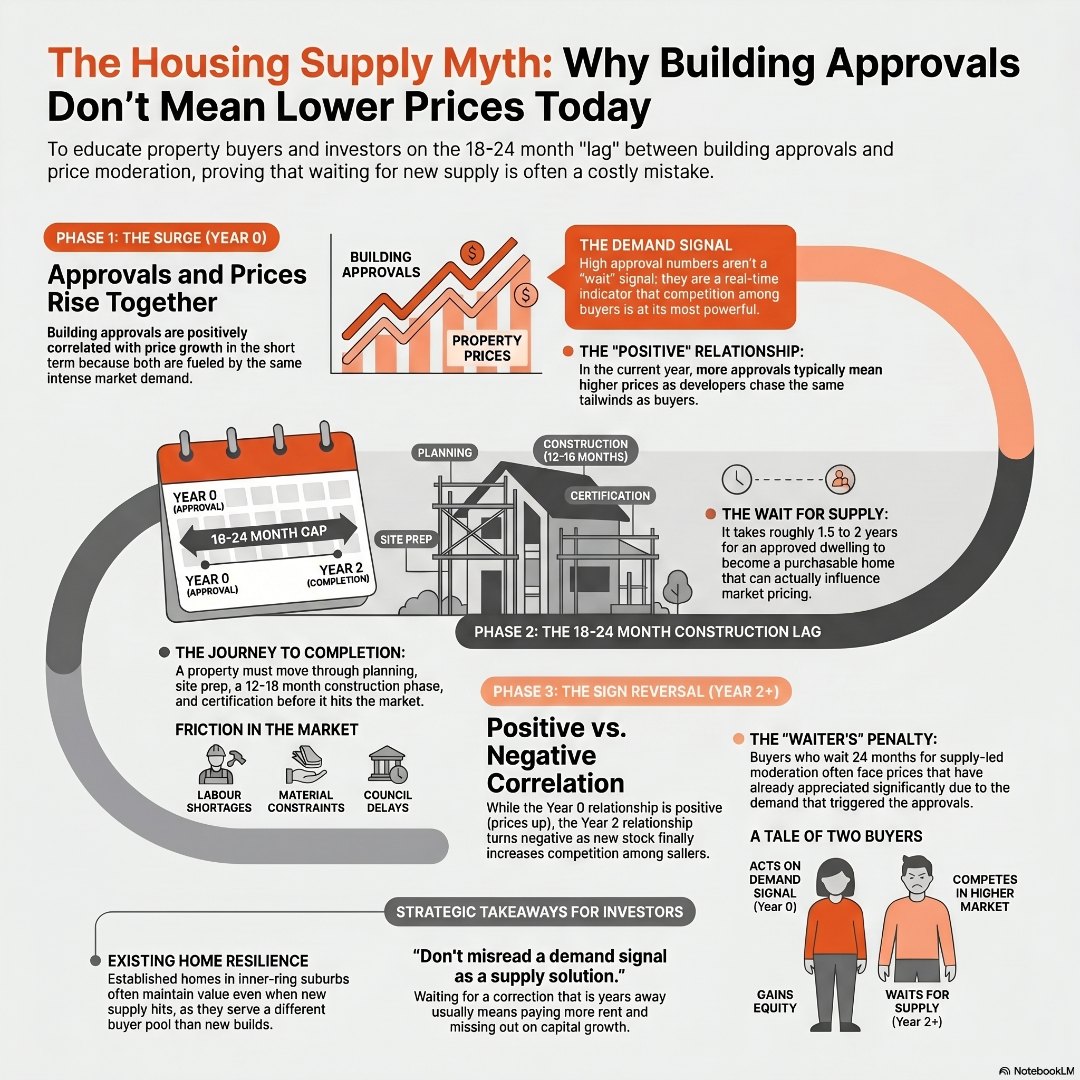
Here is the counterintuitive finding that rigorous Australian property market research has surfaced: building approvals are positively correlated with price growth in the short term.
Read that again, because it upends the narrative most buyers are working from.
When developers submit large volumes of building approvals, they are not responding to a hypothetical future market. They are responding to conditions that already exist right now. Prices are rising. Demand is strong. Competition among buyers is intense. Developers are chasing the same tailwinds simultaneously pushing buyers into the market.
So in the year building approvals surge, prices tend to surge alongside them – not because approvals cause price growth, but because both are driven by the same underlying demand conditions. The signal most buyers read as “supply is coming, relax” is actually a real-time indicator that demand is at its most powerful.
For a deeper look at the demand-side forces that move prices, our article on what drives property prices in Australia breaks down the real mechanisms behind price growth with two decades of data behind it.
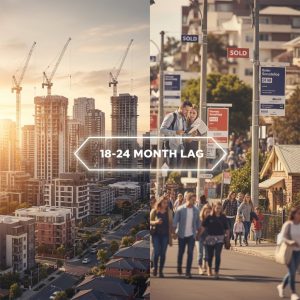
The supply-side effect – the actual moderation of prices as new stock enters the market – only materialises roughly 18 to 24 months later, when those approved dwellings are completed and listed for sale. That is a year and a half to two years of continued price pressure before supply begins to act as any meaningful brake on values.
This time delay is not a quirk or an exception. It is the structural reality of how housing construction works in Australia.
From the moment a developer submits a building approval to the moment a buyer can settle on a finished property, the typical journey involves:
Labour shortages, supply chain pressures, and council processing delays all extend that timeline further. The homes appearing in today’s approval numbers will not appear as purchasable stock for well over a year – and in many cases, longer.
What this means in practice: if you are watching building approval headlines and deciding to delay your purchase, you are acting on supply that has not arrived, will not arrive for 18 to 24 months, and in the meantime the demand conditions that generated those approvals are still very much active in the market.
Understanding where you sit within the property cycle is essential context here. Our guide on timing the market and the property cycle explains how different phases interact with buyer decisions – and why entry timing matters more than most people realise.
Economic modelling across Australian residential markets shows a clear sign reversal in the relationship between building approvals and prices across different time horizons.
In the current year, the relationship between building approvals and price movements is positive. More approvals, higher prices – because demand is driving both.
Two years out, that same relationship turns negative. Supply finally hits the market, competition among sellers increases, and prices moderate as that stock is absorbed.
Consider two buyers in the same suburb. One reads about surging building approvals and waits 12 months for prices to drop. The other understands the lag and buys now, with the approval surge confirming the strength of current demand. Two years later, when supply finally enters the market, Buyer 2 has already experienced the price appreciation that preceded it. Buyer 1 is now competing in a market with more supply – but also with 18 to 24 months of price movement already behind them.
For existing homeowners and investors in established suburbs, the concern about new developments nearby is understandable. Will a major subdivision pull down the value of your home?
The short answer: it depends, and it is rarely as severe as feared.
New builds and established homes serve somewhat different buyer pools. Many purchasing new construction are drawn by depreciation benefits, first home buyer incentives, or the appeal of a blank canvas. Established homes – particularly in inner and middle-ring suburbs with limited land supply – tend to maintain or grow their value even as greenfield developments expand on the urban fringe.
The impact of housing market oversupply on existing values is most meaningful when:
In most Australian capital city markets with strong migration and population growth, these conditions rarely occur simultaneously. Demand continues to absorb new supply as it arrives.
If you are assessing whether an investment property location is exposed to supply risk, understanding strategies to improve your borrowing capacity for property investment is equally important – because your ability to act when the time is right matters just as much as identifying the right market.
The practical implication of the housing supply and demand lag is straightforward, even if counterintuitive.
Do not let today’s building approval numbers talk you out of a purchase decision.
The supply that will eventually moderate prices is still 18 to 24 months away from hitting the market. The demand pressures driving those approvals are real and present right now. Using approval headlines as a reason to wait systematically advantages sellers over buyers.
For investors, the approval surge period is arguably the strongest signal to act – not pause. Demand is confirmed. Market conditions are compelling. And the competition you will eventually face from new supply is still far enough away to allow for meaningful capital growth in the interim.
For owner-occupiers, the calculus is similar. If you find the right property at a price that works for your borrowing capacity, waiting for a supply-led correction that is 18 to 24 months away at best means paying rent for another two years while market conditions remain strong.
The numbers are compelling, but sometimes the most powerful lesson comes from watching someone else live it out in real time. Years ago, I met a woman who had just been through a significant separation. She had the deposit, she had the means – there was a property in Sydney she could have bought for $600,000 in 2006. But the headlines were noisy, her confidence was shaken, and she decided to wait for prices to drop before she committed. By 2015, she was still waiting. The Sydney median had climbed past $1.6 million. That $600,000 property was never coming back. What she had been treating as patience was actually paralysis – and the market had moved right past her while she stood on the sideline watching. I grew up in Dubbo, and the approach I learnt from my own early investing was simpler than any economic model: buy the best property you can afford, in the best location you can access, when you have the means to do it. Not when the headlines say so. Not when supply finally catches up. Now. That principle has held up through every cycle I have watched – and the data on building approvals tells exactly the same story. The supply that might eventually soften prices is still 18 to 24 months away. The demand pushing the market right now is not.
The relationship between new housing supply and property prices is real – but it operates on a delay most buyers never account for. Building approvals signal strong demand right now. They are confirmation the market is moving, not a warning to hold off. The price-moderating effect of that supply arrives well over a year later, long after the demand wave has already pushed values higher.
The most expensive mistake you can make is to misread a demand signal as a supply solution and sit on the sidelines while the market moves past you.
If this kind of data-backed thinking is what you are looking for, it is exactly what the team at Investors Choice Mortgages brings to every client conversation. Ready to turn market signals into a clear, personalised strategy? Visit the Investors Choice Mortgages Hub to connect with a broker who can show you what the numbers mean for your specific situation.
Does building more houses lower prices in Australia?
Not in the short term. Building approvals are positively correlated with price growth because both are driven by strong underlying demand conditions. The supply-dampening effect on prices typically only materialises 18 to 24 months after approvals are issued, once homes are completed and available for sale. Waiting for new supply to bring prices down means sitting through the period of strongest demand pressure in the market.
Will house prices drop when housing inventory increases?
Prices can moderate when a significant volume of new stock enters the market simultaneously in a given area. However, in most Australian capital city markets with ongoing population and migration growth, new supply tends to be absorbed before it creates meaningful downward pressure on established property values. The effect is most pronounced where supply significantly outpaces local demand – which is the exception, not the rule.
What is the impact of new construction on existing home values?
New construction can moderate prices in directly comparable, adjacent markets – but its impact on established homes in desirable suburbs is typically limited. Existing properties in inner and middle-ring suburbs with constrained land supply tend to maintain value even as new developments expand on the urban fringe, because they serve a different buyer profile with different motivations.
Is an oversupply of homes actually coming to the Australian market?
Australia has a structural housing undersupply, with demand consistently outpacing completions due to strong migration, population growth, and labour and materials constraints on construction. While government targets aim to increase supply significantly, the timeline to deliver those homes at scale means undersupply is likely to persist for several years. True housing market oversupply in major markets remains unlikely in the near term.
All market data and research referenced in these articles is sourced from HTAG Analytics’ April 2026 research report: “A Forced Autoregressive Model of Australian Residential Property Price Dynamics: Credit, Migration, Monetary Policy, and Supply Interactions 2003–2026” by Alex Fedoseev and Dr. Matija Djolic, HTAG Analytics.
Investors Choice Mortgages acknowledges HTAG Analytics as an industry-leading source of Australian property market intelligence.
The instinct makes perfect sense. You see government targets for 1.2 million new homes, headlines about record building approvals, and your first...
The 2021 Australian property boom was not a mystery. But most of the commentary at the time got it wrong - chalking it up to pandemic psychology,...