
Are Mortgage Calculators Accurate?
https://vimeo.com/1186811137/1b4b319ef3 Most Australians start their property journey on an online mortgage calculator. The maths it returns...
While interest-only loans typically offer lower monthly repayments and better cash flow in the short term, principal & interest loans build equity faster and provide more stability over the long haul. However, the “best” choice depends entirely on your investment strategy, borrowing capacity, risk tolerance, and timeline. Understanding the true costs and benefits of each approach beyond just the monthly repayment difference is crucial for making an informed decision that aligns with your wealth-building goals.
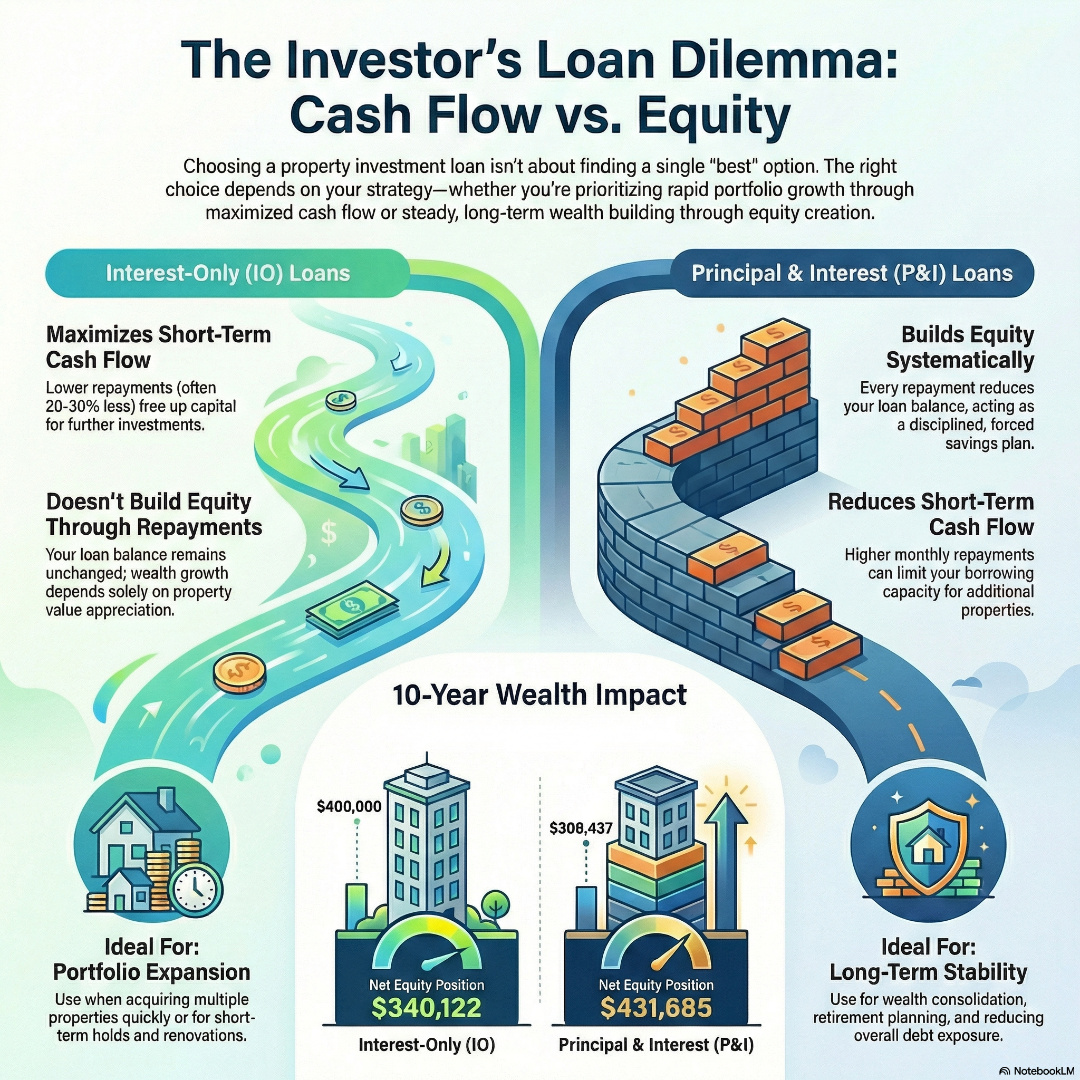
Interest-only loans allow you to pay just the interest component for an agreed period, typically between one and ten years. For a $500,000 loan at 6% interest, your monthly repayment would be approximately $2,500 on interest-only, compared to around $3,000 on a 30-year principal & interest structure.
This $500 monthly difference might seem straightforward, but the real implications go much deeper. During the interest-only period, your loan balance remains at $500,000, meaning you’re not building any equity through repayments. All equity growth comes from property value increases and any capital improvements you make.
The cash flow advantage can be powerful for investors building a portfolio. That extra $500 monthly across multiple properties could fund your next deposit, cover maintenance costs, or provide a buffer during vacancy periods. Many successful investors use strategic approaches to improve their borrowing capacity to scale their portfolio faster with interest-only structures.
It’s this exact strategic use of cash flow that differentiates an average investor from a truly successful one. For me, interest-only loans were never just about maximising cash flow; they were about minimising risk. I personally have used interest-only structures on every investment property I’ve bought. My core strategy is built around building up a substantial offset account and a cash buffer. This acts as my ultimate safety net, protecting me against unexpected interest rate hikes, prolonged vacancy periods, or personal circumstances changing. By maintaining that extra liquidity, I wasn’t just maximizing my borrowing capacity—I was actively managing my fear and building the confidence that I could weather any storm the market threw at me. This proactive approach is exactly what helped 62 of my clients when lending tightened a few years ago; by personally negotiating with lenders, we ensured their interest-only periods could be extended, protecting them from a sudden, disastrous repayment shock.
However, interest-only loans often carry higher interest rates, typically 0.2% to 0.5% more than equivalent principal & interest loans. Banks view them as higher risk, and some lenders have stricter lending criteria including higher deposit requirements or lower loan-to-value ratios.
The most significant hidden cost is the repayment shock when the interest-only period ends. That $2,500 monthly repayment could jump to $3,200 or more, depending on interest rates at the time. Without proper planning, this transition can force investors to sell properties or face serious cash flow stress.
Principal & interest loans require you to pay both the interest and a portion of the loan balance each month. While this means higher repayments, it also means you’re systematically building equity through forced savings. On that same $500,000 loan, you’d typically pay off around $50,000-$60,000 in principal over the first five years.
This approach provides several strategic advantages for long-term wealth building. As you reduce your loan balance, your loan-to-value ratio improves, potentially giving you access to better interest rates when you refinance. This equity can also be accessed through effective offset account strategies or refinancing for future investments.
The equity build-up acts as a hedge against property market fluctuations. If property values remain flat or even decline temporarily, you’re still increasing your net worth through loan reduction. This psychological benefit shouldn’t be underestimated – many investors sleep better knowing they’re building tangible wealth even if their properties aren’t appreciating rapidly.
Principal & interest loans also offer more loan product options and typically qualify for the best available interest rates. Lenders generally view these borrowers as lower risk, which can translate to more favourable terms and conditions.
The main challenge is cash flow management, particularly for negatively geared properties. Higher repayments mean larger out-of-pocket expenses each month, which can limit your ability to hold multiple properties or weather unexpected costs like major repairs or vacancy periods.
Interest-only structures work best when your primary goal is portfolio expansion and cash flow optimisation. If you’re in the accumulation phase of investing and want to acquire multiple properties quickly, the lower repayments can significantly improve your borrowing capacity for subsequent purchases.
Consider this scenario: Rita, a 45-year-old professional, wants to build a three-property portfolio before retirement. With $150,000 available for deposits, she could purchase three properties worth $500,000 each using interest-only loans, keeping her monthly repayments around $7,500 total. The same properties on principal & interest loans would cost approximately $9,000 monthly – a difference that could impact her borrowing capacity for the third property.
Interest-only loans also make sense for properties you plan to hold short-term or those requiring significant renovations. If you’re planning to sell within five years or add substantial value through improvements, paying down principal during this period might not be the most efficient use of your cash flow.
High-income earners in top tax brackets often prefer interest-only structures because the entire payment is tax-deductible, whereas principal repayments provide no immediate tax benefit. This can create substantial tax savings that effectively subsidise the higher interest rates typically associated with interest-only loans.
Properties in high-growth areas where capital appreciation is the primary return mechanism also suit interest-only structures. If your property is gaining $50,000 annually in value, paying off $10,000 in principal becomes less significant compared to optimising your cash position for the next opportunity.
Principal & interest loans excel when your focus shifts from acquisition to consolidation and wealth preservation. If you’ve reached your target number of properties or your borrowing capacity limit, switching to principal & interest can accelerate your journey to debt-free property ownership.
The psychological benefits extend beyond just numbers. Many investors report feeling more confident and secure knowing they’re actively reducing their debt exposure. This confidence can lead to better decision-making and reduced stress during market downturns or personal financial challenges.
For properties you intend to hold long-term – particularly those likely to become part of your retirement income strategy – principal & interest structures provide more predictable outcomes. You can calculate exactly when each property will be debt-free and plan your retirement income accordingly.
The forced savings aspect becomes particularly valuable for investors who struggle with discipline around reinvestment. Instead of having extra cash flow that might be spent on lifestyle expenses or less strategic investments, principal repayments automatically build wealth within your property portfolio.
Principal & interest loans also provide better protection against interest rate rises. While your repayments will increase with rate rises, you’re simultaneously reducing your loan balance, which helps offset some of the impact over time.
Let’s examine a realistic scenario comparing both approaches over a 10-year investment period. Assume a $500,000 property purchased with a $400,000 loan at 6% interest, with property values growing at 4% annually.
The principal & interest approach builds an additional $91,563 in equity over the decade, despite paying only $47,760 more in total repayments. This demonstrates the power of compound equity building, where reduced debt amplifies your net worth growth alongside property appreciation.
However, this analysis assumes both investors could comfortably afford the higher principal & interest repayments. If the extra $398 monthly prevented the investor from purchasing additional properties or caused cash flow stress, the interest-only approach might still be superior despite the lower equity position on this single property.
The most sophisticated investors don’t choose one approach universally – they tailor their loan structure to each property’s role within their broader investment strategy. This might mean using interest-only loans for their first few properties to maximise acquisition speed, then transitioning to principal & interest for properties they plan to hold long-term.
A common approach is the “barbell strategy” – using interest-only loans for high-growth properties where capital appreciation is the primary goal, while using principal & interest loans for steady, cash flow-positive properties that form the backbone of your portfolio.
Some investors also use time-based strategies, starting with interest-only loans during their high-earning years when tax deductions provide maximum benefit, then switching to principal & interest as they approach retirement and their focus shifts to debt reduction.
The key is regularly reviewing and adjusting your loan structures as your circumstances change. Professional mortgage refinancing guidance can help optimise your portfolio structure as you progress through different phases of your investment journey.
Consider working with a specialist broker who understands property investment to ensure your loan structures align with your long-term goals rather than just current cash flow requirements.
The choice between interest-only and principal & interest loans isn’t about finding a universally “better” option – it’s about understanding which structure best serves your specific investment strategy, timeline, and financial circumstances. Successful property investors often use both approaches strategically across their portfolio, selecting each structure based on individual property goals and their broader wealth-building objectives.
Whether you prioritise immediate cash flow optimisation for portfolio growth or long-term equity building for retirement security, the key is making an informed decision based on comprehensive analysis of your situation. Consider not just the monthly repayment difference, but the long-term wealth implications, tax benefits, and how each option aligns with your risk tolerance and investment timeline.
Ready to determine the optimal loan structure for your property investment goals? Book a mortgage review call today and get personalised guidance on structuring your loans for maximum wealth building potential.
How much can I save monthly by choosing interest-only over principal & interest loans?
For a $500,000 investment loan, you’ll typically save $400-$600 monthly with interest-only repayments compared to a 30-year principal & interest loan. However, this savings comes at the cost of no equity building through loan reduction.
What happens when my interest-only period ends?
When the interest-only period expires (typically 1-5 years), your loan automatically converts to principal & interest repayments. Your monthly payments will increase significantly – often by 25-40% – as you begin paying off the principal balance that remained unchanged during the interest-only period.
Can I switch from interest-only to principal & interest before the period ends?
Yes, most lenders allow you to switch from interest-only to principal & interest repayments at any time without penalty. This flexibility lets you adjust your strategy as your circumstances change or when you want to start building equity through loan reduction.
Are interest-only loans harder to get approved for investment properties?
Interest-only loans typically have stricter lending criteria, including higher deposit requirements (often 20-30% minimum), stronger income verification, and more conservative debt-to-income ratios. However, specialist investment loan brokers can help navigate these requirements effectively.
Which loan type offers better tax benefits for property investors?
Interest-only loans provide slightly better immediate tax benefits since 100% of your repayment is tax-deductible interest. With principal & interest loans, only the interest portion is tax-deductible, while principal repayments provide no immediate tax benefit but build long-term wealth through equity accumulation.
https://vimeo.com/1186811137/1b4b319ef3 Most Australians start their property journey on an online mortgage calculator. The maths it returns...

The instinct makes perfect sense. You see government targets for 1.2 million new homes, headlines about record building approvals, and your first...