

What Do the 2026 Budget Tax Changes Mean for Your Property Investment Strategy in Australia?
Australia's 2026 Federal Budget has delivered the most significant tax reform for property investors in more than 25 years, reshaping the rules...
Economic uncertainty creates a unique paradox: while most investors freeze in fear, educated investors often find their greatest opportunities. During uncertain times, quality properties can become mispriced as emotion drives market sentiment, creating conditions where strategic buyers with solid foundations and clear plans can build long-term wealth. Success depends not on perfect timing, but on having resilient strategies, adequate buffers, and the courage to act when fundamentals align with your investment criteria.
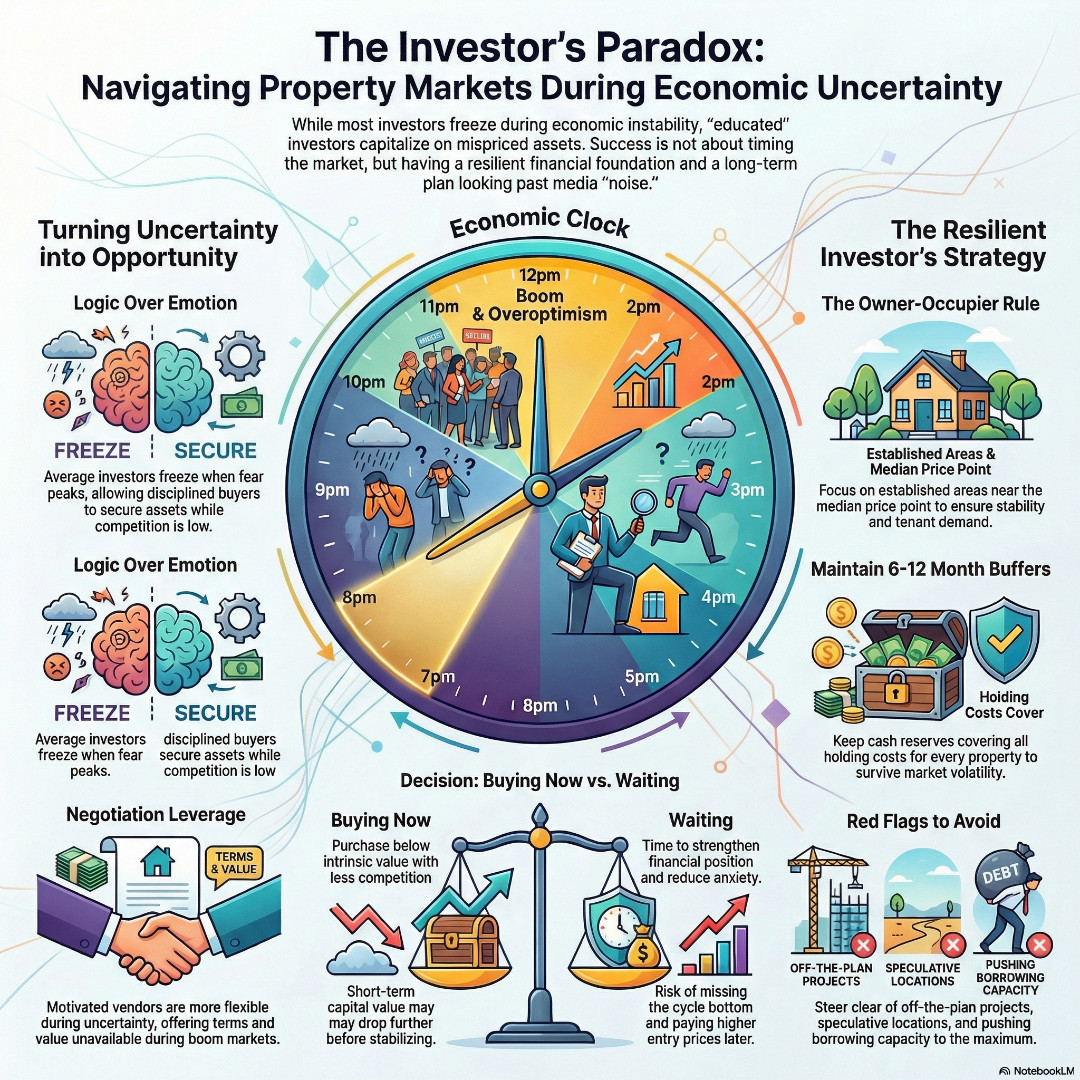
The psychology behind property investment during economic uncertainty presents a fascinating reality: average investors are most likely to freeze just when the best opportunities emerge. Wall-to-wall media headlines can amplify fear, stimulating emotional decisions rather than logical ones. As a result, many investors wait on the sidelines, allowing those who act with discipline to capitalise on mispriced assets.
I know exactly how that paralysis feels because I have lived it. During the 2008 Global Financial Crisis, I stood at an auction for my first investment property with my heart racing and my hands literally trembling as I held my bidder’s card. Every news report suggested I was making a massive mistake, and the temptation to retreat was overwhelming. However, a mentor helped me look past the noise to the underlying value of the asset. I pushed through the fear and made the purchase while others were running for the exits. That property eventually became the foundation of my portfolio, thriving as the market recovered and proving that the best opportunities often hide behind the thickest clouds of uncertainty.
During periods of uncertainty, investors tend to fixate on negative headlines and ignore the underlying fundamentals of the property cycle. The instinct to delay purchases until the “coast is clear” can lead to missed opportunities for building wealth. Educated investors recognise that the biggest openings typically appear when widespread fear drives most people out of the market.
Through understanding property cycles, successful investors separate emotion from evidence. History shows those willing to act during uncertain times often enter the next growth phase in a position of strength.
Property markets naturally operate in cycles – a concept often illustrated by the property economic clock. During uncertain economic periods, the market usually sits between the 6pm and 8pm positions, where fear and pessimism peak. This stage is commonly when rental yields start to improve and the groundwork for the next upswing is quietly being laid.
While the clock does not guarantee perfect timing, it helps investors maintain perspective. When negative headlines dominate and confidence plummets, these are classic signs that the market is approaching its low point. Knowing how to interpret the property economic clock keeps your strategy grounded and responsive.
Rather than waiting for proven trends and perfect timing, successful buyers evaluate whether their property investment plan is robust enough to handle the next decade or more of market changes. Explore our property investment portfolio guide for more on this approach.
In times of uncertainty, direct your focus towards properties with strong owner-occupier appeal at or near the median price point. These properties are favoured by both buyers and tenants, offering more stability and reducing exposure to volatility. Avoid highly specialised assets and properties targeting a niche segment of the market.
Invest in established areas with a track record of growth, diverse economic bases, and reliable infrastructure. Such locations are more resilient than speculative suburbs tied to a single industry. Geographic diversification across multiple markets can also help manage risk.
A prudent approach is essential in volatile times. Maintain conservative loan-to-value (LVR) ratios and keep enough cash reserves to cover at least 6-12 months of holding costs for each property. Use borrowing capacity strategies designed to withstand uncertain conditions.
Uncertainty becomes your ally when three elements align: stable personal finances, approved finance, and ample buffers. During these periods, motivated vendors may be more flexible, offering negotiation advantages and value that don’t exist when markets are booming.
The vital distinction is between overall market uncertainty and your own personal financial instability. If your income is reliable, your borrowing power is confirmed, and you hold strong cash reserves, you may secure excellent opportunities that set you up for long-term capital growth.
Remember, buying quality property below intrinsic value during down markets often translates into superior future returns, once the cycle inevitably turns.
Now is not the time for large-scale developments, off-the-plan purchases, or assets that are heavily exposed to valuation and settlement risks. Should market conditions worsen, these investments may present challenges difficult to manage.
Investing in unproven locations or chasing perceived “bargains” without solid fundamentals increases risk. Instead, focus on properties with clear, reliable demand and broad tenant appeal.
Avoid pushing your borrowing capacity to the maximum, and do not rely solely on interest-only loans, particularly without cash flow or income buffers. During times of market instability, strong balance sheets protect you from forced sales and financial distress.
Seasoned property investors succeed by building wealth over years – not months. This attitude helps weather short-term volatility and capitalises on the market’s historic upward trajectory.
Australia’s property market shows consistent long-term growth, even though short periods of correction or recession are inevitable. Learn how holding over the long term pays off.
If economic uncertainty limits your ability to acquire additional properties, focus on unlocking value in your existing portfolio. Strategic renovations can boost rental returns and build equity, positioning you to capitalise on the next upswing.
Instead of guessing about market timing, use a personalised framework as your compass:
With these building blocks in place, you can make confident decisions aligned with your long-term goals.
Expert advice becomes even more valuable during times of uncertainty. Specialist property advisers and mortgage brokers help you navigate complex lending policies, understand local market dynamics, and keep your investment approach strategic rather than reactive.
Partnering with an experienced professional provides confidence, objectivity, and refined decision-making, so you can focus on fundamentals instead of market “noise.”
Economic uncertainty does not remove investment opportunities but reframes the risk and reward landscape. By building strong foundations, staying patient, and maintaining a disciplined plan, you can set yourself up for lasting wealth – even when others hesitate.
Ready to explore opportunities created by economic uncertainty? Book a mortgage review call today to discuss your options with property specialists who understand Australia’s market cycles and strategic property investment.
Should I wait for interest rates to fall before buying investment property?
Timing interest rates perfectly is nearly impossible, and waiting often means missing key opportunities. Instead, look for properties that deliver positive cash flow at current rates and ensure you have enough financial buffer for potential rate increases. The right property can perform well in a variety of interest rate environments.
How much cash reserve should investors maintain during uncertain times?
Generally, you should hold six to twelve months’ worth of holding costs (covering home loan repayments, property management fees, and maintenance reserves) for each investment property. On top of this, keep a personal emergency fund covering three to six months of living expenses. These buffers reduce the risk of needing to sell under pressure and provide security if the market turns.
Is it smarter to buy one expensive property or several affordable properties during uncertainty?
Owning multiple affordable properties near the median price can reduce risk, provide greater rental diversification, and offer more flexibility as your portfolio grows. Weigh up your borrowing capacity and management preferences carefully before choosing your strategy.
What property types are most resilient during economic downturns?
Properties with wide owner-occupier appeal in established, well-serviced suburbs – especially three-bedroom homes close to schools, public transport, and employment – tend to hold their value and attract reliable tenants, even in challenging conditions.
Australia's 2026 Federal Budget has delivered the most significant tax reform for property investors in more than 25 years, reshaping the rules...

Regional property markets are outperforming capital cities across Australia right now, with dwelling values rising 3.3% over the three months to...