

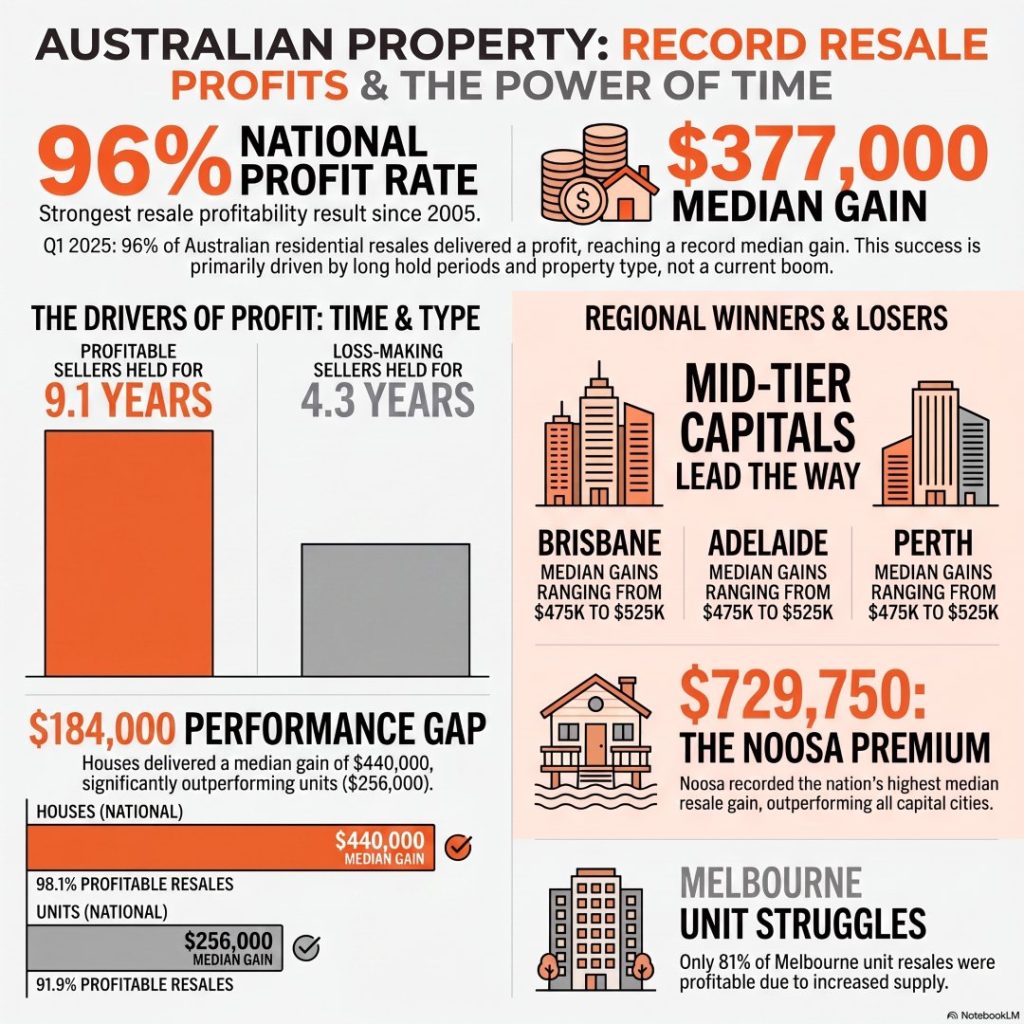
Australian homeowners are achieving record property resale profit in 2025, with 96% of all residential resales in the March quarter delivering a nominal gain – the highest profitability rate since 2005 – and a median gain of $377,000, according to the latest national resale analysis. These results are not a product of today’s market momentum, but rather the compounding effect of years of accumulated value growth built across multiple property cycles. The gap between those profiting and those not is almost entirely explained by one variable: how long they held the property. Those who sold at a profit held for an average of 9.1 years, while loss-making sellers had held for just 4.3 years – many of them catching the 2021-2022 peak on the way in.
Key Takeaways
- 96% of Australian residential resales delivered a profit in Q1 2025 – the strongest result in over two decades.
- The median resale gain hit a record $377,000, while the median loss held steady at $45,000.
- Time in the market is the single biggest driver of outcome – profitable sellers held for 9.1 years on average versus 4.3 years for loss-makers.
- Houses significantly outperformed units: median gains of $440,000 for houses versus $256,000 for units nationally.
- Brisbane, Adelaide and Perth led all capital cities with median gains of $525,190, $477,000 and $475,000 respectively.
Why Are So Many Australian Homeowners Making a Profit Right Now?
Here is the short answer: they bought years ago, held on through rate cycles, price corrections and uncertainty, and they are now selling into a market where values are substantially higher than when they purchased.
The latest national resale data analysed close to 101,000 residential resales and found the profitability rate climbed to 96.0%, up from 95.9% in the December quarter. More striking still was the median gain – at $377,000, it is the highest on record.
This is not a story about a booming market in 2025. National home values showed no growth in May, and conditions vary considerably across cities and property types. What the data is really reflecting is the homeowner equity gains built quietly and steadily during the strong growth years of the pandemic and post-pandemic period – particularly between 2020 and 2023.
For homeowners who held through those years, the reward is now appearing at settlement. For those thinking about what to do with that equity, the question is no longer academic.
Which Cities Are Delivering the Biggest Property Resale Gains?
The mid-tier capitals have been the standout story of this cycle, and the resale data confirms it.
Brisbane recorded the highest share of profitable resales of any capital city – 99.8% – with a median gain of $525,190. Strong interstate migration, a sustained housing shortage and a decade of comparatively affordable pricing created the conditions for exceptional Brisbane property gains. Sellers who bought before the post-pandemic surge are now realising results that would have seemed extraordinary just five years ago.
Adelaide followed closely, with 99.3% of resales delivering a profit and a median gain of $477,000. Perth was not far behind, with 98.9% of resales generating a gain and a median profit of $475,000.
The common thread across all three cities is population growth, tight supply and demand that consistently outpaced available housing. Many owners bought during a period of affordability and low interest rates and are now selling into markets where values have risen substantially.
At the opposite end, Melbourne’s unit market continues to struggle. Just 81% of Melbourne apartment resales delivered a profit – one of the weakest results in the country. Increased supply in established apartment precincts has limited capital growth and pushed up the incidence of loss-making sales.
Understanding how local market conditions, property type and purchase timing intersect is critical. If you want to see how this plays out in your suburb specifically, the why national property data fails at the suburb level article shows exactly why city-wide averages often hide the real picture.
Houses vs Units Investment Australia: What the Gap Really Tells You
The performance gap between houses and units in this cycle is wider than many expected, and it carries a direct message for anyone choosing between property types.
Nationally, 98.1% of house resales recorded a profit in Q1 2025, compared to 91.9% of units. The size of the gain is even more telling – houses delivered a median gain of $440,000 while units returned $256,000. That is a $184,000 difference in median outcome on assets that may not have been vastly different in purchase price for many buyers a decade ago.
In markets like Melbourne and parts of Sydney, apartment supply has grown faster than demand. More stock for buyers to choose from means less upward price pressure – and in some cases, sustained downward pressure on resale values. Houses, by contrast, sit on land that cannot be replicated, in suburbs with finite supply.
For investors building a portfolio with long-term capital growth in mind, this data reinforces the strategic argument covered in how to build a profitable investment property portfolio – particularly the role that land content and location play in compounding gains over time.
| Property Type | Profitable Resales | Median Gain |
| Houses (National) | 98.1% | $440,000 |
| Units (National) | 91.9% | $256,000 |
| Melbourne Units | 81.0% | Below median |
| Brisbane (All) | 99.8% | $525,190 |
What Does a 9.1-Year Hold Period Tell You About Buy and Hold Property Strategy?
This is perhaps the most important number in the entire data set, and it is the one most people overlook.
Sellers who made a profit in Q1 2025 had held their property for an average of 9.1 years. Those who sold at a loss had held for an average of 4.3 years – placing many of their original purchases squarely in the 2021-2022 market peak.
This is the fundamental truth of a buy and hold property strategy playing out in the data. Property markets move in cycles. Prices rise, plateau, soften and rise again. The sellers absorbing losses today are not necessarily people who made poor decisions – many bought in strong markets with good intentions. But they ran out of time. Life circumstances, financial pressure or changing plans forced a sale before the market had an opportunity to recover and grow beyond their purchase price.
The sellers realising $377,000 median gains did not have a crystal ball. They simply stayed the course. They held through the rate rises, the media headlines and the uncertainty – and time did what it reliably does with quality Australian property.
I saw this play out in a way I will never forget. Back in 2009, a single mum came to me as a mortgage client. She had a limited borrowing capacity and no grand investing strategy – just the hope that property might one day give her family a different kind of life. During our strategy call, I guided her toward a suburb that matched her budget and showed genuine long-term fundamentals. She bought. She held. She did not sell during the rate rises or the media-driven panic cycles that followed. Years later, I received an email from her. She had sold her property for $1.96 million – having bought it for $760,000. Over $1 million in wealth created, from one decision, one suburb, and the patience to stay the course. She wrote that it had changed her family’s life. That email is the reason I do what I do.
For homeowners who purchased in the last two to three years and are wondering whether they are exposed, the honest answer is: it depends. Location, property type and the strength of the underlying suburb fundamentals matter enormously.
To understand how that long-term perspective has played out across Australian history, the 100 years of Australian property growth data provides compelling context.
Lifestyle Markets That Are Outperforming the Capitals
Beyond the capital cities, coastal lifestyle markets continued to dominate Australia’s strongest-performing resale regions.
Noosa recorded the nation’s highest median resale gain at $729,750. Sustained long-term demand from interstate and international buyers, combined with geographically limited supply, created conditions that are difficult to replicate elsewhere.
Five Western Australian local government areas – including Melville, Joondalup, Nedlands, East Fremantle and Chittering – also ranked among the nation’s top 10 regions for resale profits. The Byron Shire in northern NSW joined the list, reflecting years of demand consistently outpacing available housing.
These markets share a common characteristic: they are places people genuinely want to live, in limited supply, with a buyer pool that has only widened over time.
Should I Sell My Property Now or Hold On?
Reasons to Consider Selling Now
- Many sellers are sitting on record homeowner equity gains built over multiple years.
- Capital can be reallocated to higher-performing markets, cleared debt or new investment.
- Market conditions in some cities are softening, suggesting current sale prices may not hold indefinitely.
Reasons to Reconsider Selling Now
- Capital gains tax obligations will apply in most investment scenarios.
- Re-entry into the market after selling can be expensive and competitive.
- Selling interrupts the compounding effect that time has on property wealth.
Reasons to Keep Holding Your Property
- Time continues to work in your favour if the fundamentals of your market are sound.
- Equity growth can be accessed without selling through strategic refinancing or equity release.
- Rental income, tax deductions and compounding growth continue uninterrupted.
Reasons Holding May Not Be the Right Move
- Short-term purchasers in weaker markets – particularly Melbourne units – may face a longer recovery horizon.
- Holding costs increase if the property is negatively geared with limited near-term value growth.
- Opportunity cost rises if equity is locked in a low-growth asset.
Is It Too Late to Get Into the Market and Build These Kinds of Gains?
It is a question many people are asking right now – particularly those watching the resale data and wondering if they missed the window.
The honest answer is that the window has not closed. It has shifted. The extraordinary uniform growth of 2020-2023 is unlikely to repeat across all markets simultaneously. But property markets are local, and strong performing pockets – mid-tier capitals, tightly held coastal markets and suburbs with genuine demand drivers – continue to offer real opportunity for buyers with a long enough time horizon.
This is exactly the scenario explored in depth for clients who are new to investing or who feel they have started later than they would have liked. The guide on property investing at 45 addresses this question directly and is worth reading if that concern resonates with you.
What Should You Do With This Information?
The data tells a clear story: property, held for long enough, in the right location, in the right property type, continues to generate extraordinary wealth for Australian homeowners.
Your outcome depends entirely on when you bought, where you bought and what you bought. A $377,000 median gain is a national average – your position may be very different. It also depends on what you do next.
If you are sitting on equity you have built over the years and wondering how to use it – whether to refinance, invest, sell or simply understand your current position – that is a conversation worth having sooner rather than later.
Visit the Investors Choice Mortgages Hub to connect with a broker who can show you what the numbers mean for your specific situation. Whether you are weighing up a sale, considering your first investment property or looking to leverage existing equity, the right guidance at the right moment makes an enormous difference to your long-term outcome.
Frequently Asked Questions
How much profit does the average Australian homeowner make when they sell their property?
The median resale gain for Australian homeowners reached a record $377,000 in Q1 2025, based on analysis of close to 101,000 residential resales. This figure reflects nominal profit above the original purchase price and varies significantly by city, property type and how long the seller has held the property.
Why are 96% of Australian homeowners making a profit when they sell in 2025?
The high profitability rate reflects value growth accumulated over many years rather than current market strength. Most sellers profiting now bought before or during the early part of the 2020-2023 growth cycle and have benefited from holding through multiple growth phases. The national profitability rate of 96% is the highest since 2005.
How long should you hold a property in Australia before selling?
The data suggests that holding a property for at least nine years significantly improves the likelihood of a profitable sale. Properties sold at a profit in Q1 2025 had an average hold period of 9.1 years, compared to 4.3 years for those sold at a loss. Time remains one of the most reliable tools for absorbing market cycles and building equity.
Are houses or apartments a better investment in Australia for long-term capital growth?
In the current cycle, houses have significantly outperformed units. Nationally, 98.1% of house resales delivered a profit with a median gain of $440,000, compared to 91.9% of unit resales with a median gain of $256,000. Melbourne’s unit market in particular has been affected by increased supply, with only 81% of apartment resales generating a profit. For long-term capital growth, houses with strong land content in high-demand suburbs have consistently proven the stronger performer.