

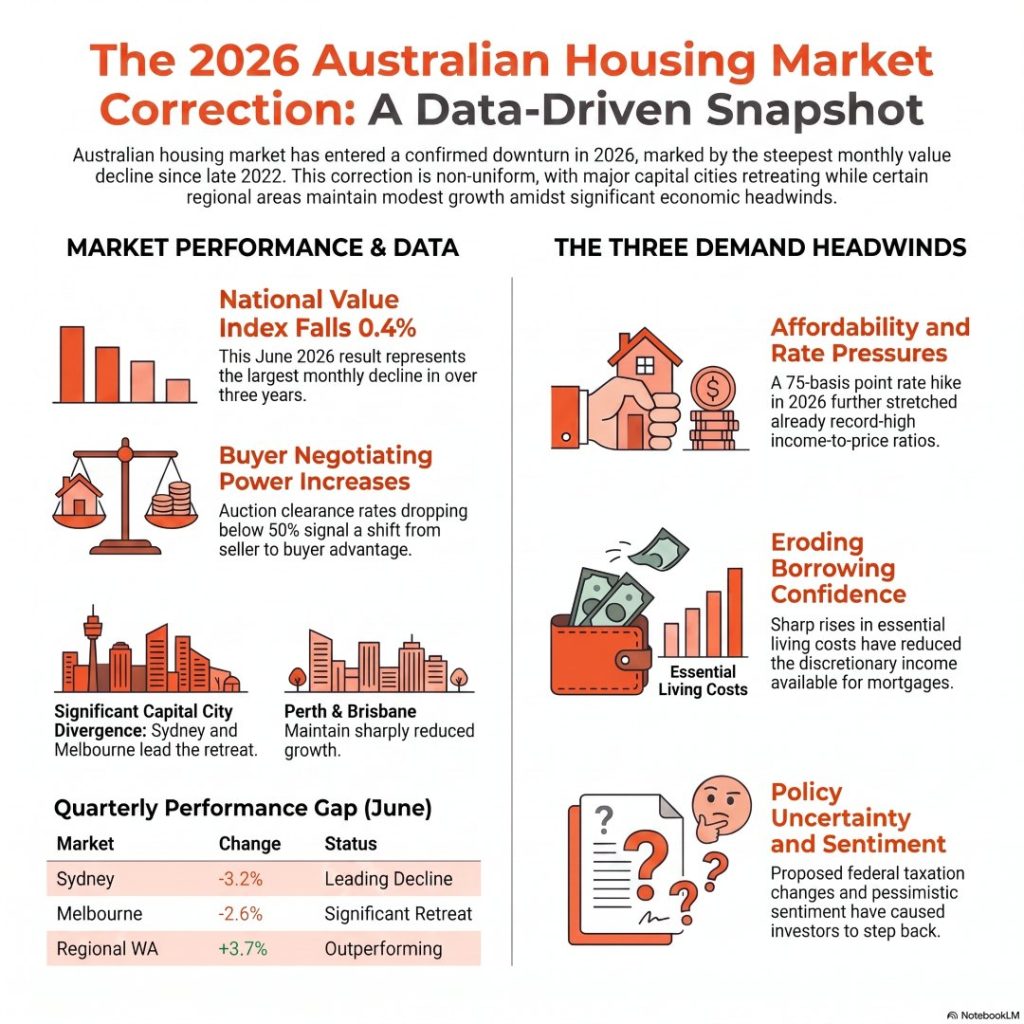
Yes, the Australian housing market downturn of 2026 is real, confirmed, and accelerating. The national Home Value Index fell 0.4% in June – the largest monthly decline since December 2022 – with capital city values down 1.3% for the quarter. Sydney has led the retreat at -3.2% for the quarter, followed by Melbourne at -2.6%, while auction clearance rates across the combined capitals have dropped below 50% for the first time since May. The picture is not uniform across the country, and understanding what is driving this property market correction matters enormously if you hold an investment property, are weighing up whether to refinance, or are considering your first purchase.
Key Takeaways
- The national Home Value Index fell 0.4% in June 2026, the steepest monthly fall since December 2022, confirming the Australian housing market downturn is accelerating.
- Sydney values are down 3.2% and Melbourne values are down 2.6% for the June quarter, while Brisbane (+0.3%) and Perth (+0.7%) continue to grow at a sharply reduced pace.
- Auction clearance rates have held below 50% since late May, signalling that buyers now hold more negotiating power than at any point in recent years.
- Multiple demand headwinds are stacking up simultaneously: affordability pressures, higher cost of living, deeply pessimistic consumer sentiment, and new property taxation changes from the federal budget.
- Regional markets are outperforming capital cities overall, with the combined regional index up 1.1% for the quarter – though the pace of gains is also slowing.
What the Data Is Really Telling Us About Property Prices Right Now
Picture Rita. She is 45, her mortgage is nearly paid off, her kids have left home, and she has been building toward her first investment property for two years. She watched property values surge through 2024 and early 2025, felt priced out, and decided to wait. Now the headlines are full of falling prices, and she is asking the obvious question: is this a genuine buying opportunity, or is it the beginning of something much worse?
The June 2026 data gives us a clear starting point, but the story is more nuanced than the headlines suggest.
The national Home Value Index falling 0.4% in a single month sounds modest in isolation. Context matters. June’s update revised May’s figures lower, and the national measure now shows values peaked in March. The market has been correcting for longer than the most recent numbers initially indicated. Perth and Brisbane, which were posting average monthly gains of 2.5% and 1.9% respectively through the March quarter, have seen those gains virtually disappear. That is a rapid deceleration.
Sydney’s June quarter result of -3.2% is particularly significant. At that rate of decline, a $1.2 million home loses roughly $38,400 in value over three months. Melbourne’s -2.6% quarterly fall tells a similar story. For existing owners with sufficient equity, these numbers are uncomfortable but manageable. For anyone who purchased at or near the peak with a small deposit, the situation warrants genuine attention.
What Is Causing the Housing Demand Headwinds in 2026?
This property market correction is not the result of one trigger. Several pressures have arrived simultaneously, and their combined weight is creating the most pronounced market shift in more than three years.
Housing affordability was already stretched before rates moved. Even before the Reserve Bank raised rates by a further 75 basis points in 2026, the ratio of household income to property prices in Sydney and Melbourne had reached levels that made buying deeply difficult for most working Australians. First-home buyers faced a paradox: rates had eased slightly, but prices had risen so far that savings still could not keep pace.
Cost-of-living pressures have eroded borrowing confidence. Groceries, energy, insurance, and school fees have all risen sharply over the past two years. Households that technically qualify for a mortgage are choosing not to take on maximum debt when their discretionary income is under pressure. Lenders are observing this in serviceability stress tests – the gap between what someone can borrow and what they feel comfortable borrowing has widened considerably.
Consumer sentiment has turned deeply pessimistic. Open home attendance has fallen, auction registration numbers are down, and the urgency that defined markets in 2023 and 2024 has evaporated. Buyers who waited previously now feel vindicated by falling prices, and many are choosing to wait further, creating a self-reinforcing cycle of reduced demand.
Federal budget property taxation changes have dampened investor appetite. Proposed changes to negative gearing arrangements and capital gains tax concessions – even at the discussion stage – have created significant anxiety among property investors. When policy uncertainty enters the market, a segment of buyers who were planning to act simply steps back.
The result of all four mortgage demand headwinds converging is visible in the sales data. Capital city home sales over the three months to June are estimated to be 16.2% below the same period last year, and 14.5% below the five-year average for this time of year.
How the Property Market Correction Varies by City and Region
One of the most important things to understand about this downturn is how unevenly it is distributed. The national figure of -0.4% for June masks dramatic variation between cities and between capital and regional markets.
| Market | June Monthly Change | June Quarter Change |
| Sydney | -1.2% | -3.2% |
| Melbourne | -1.0% | -2.6% |
| ACT | -0.6% | -1.3% |
| Adelaide | 0.0% | Flat |
| Brisbane | +0.3% | Modest growth |
| Perth | +0.7% | Modest growth |
| Regional WA | – | +3.7% |
| Combined Regional | +0.3% | +1.1% |
This divergence is critical for investors thinking about strategy. Regional WA has returned 3.7% for the quarter. Adelaide is holding flat. Perth and Brisbane are still producing positive returns, even if much softer than their March quarter pace.
For investors like Rita researching where to place capital, this data reinforces something experienced property investors always emphasise: national headlines do not tell the local story. Understanding the difference between reading national data and identifying suburb-level opportunity is what separates informed decisions from reactive ones. Our guide on why national property data fails at the suburb level explores exactly this point.
What Auction Clearance Rates Below 50% Mean for Buyers and Sellers
Auction clearance rates have held below 50% across the combined capitals since the last week of May 2026, with results dropping into the low 40% range through late June.
For buyers, this is a material shift in negotiating power. When clearance rates sit above 70%, sellers hold the advantage – competition is fierce, prices are bid up, and buyers often feel pressured to decide quickly. Below 50%, the dynamic flips. Buyers can inspect more properties, negotiate more firmly, and in many cases avoid the stress of a competitive auction environment altogether.
Stock on market has risen not because a wave of distressed sellers is flooding the market. It is because properties are simply taking longer to sell. Buyer demand has softened, so unsold stock accumulates over time. That gives buyers more choice and less urgency – exactly the conditions that disciplined, well-prepared investors have historically used to their advantage.
Pros and Cons of Buying During a Property Market Correction
Reasons to Buy During the Downturn
- Less competition at auction and during private treaty negotiations
- More time to conduct proper due diligence without being rushed
- Motivated sellers may accept offers below initial asking prices
- Entry point improvements in previously overheated markets like Sydney
Reasons to Be Cautious About Buying Now
- Values may continue falling after purchase, reducing paper equity in the short term
- Negative gearing changes add uncertainty to investor return calculations
- Lender serviceability buffers remain tight, limiting borrowing capacity for some buyers
- It can be emotionally difficult to buy when headlines are consistently negative
Reasons to Wait
- Potentially buying at a lower price if the correction continues
- More policy clarity on taxation changes may emerge over the next six to twelve months
- Time to strengthen your deposit and borrow more conservatively
Reasons Waiting May Cost You
- Missed rental yield income and capital growth from markets still performing (Perth, Regional WA)
- No guarantee conditions will be materially better – demand headwinds may ease sooner than expected
- Continued cost-of-living pressures may make saving harder, not easier, over time
What Should Investors Do Right Now?
This is the question that matters most, and the honest answer is that it depends on your individual financial position, borrowing capacity, and investment goals.
What is clear is that this is not a moment for panic or for paralysis. It is a moment for strategy.
I have been asked this question – in exactly this market mood – more times than I can count. And my honest answer is always the same, because I have lived the version of it myself. I have bought properties right at the peak of the market before. More than once. And I will tell you something: it genuinely did not bother me. Not because I was reckless, but because I had done the work on the fundamentals – the right suburb, the right property type, the right loan structure – and I knew that 10 or 15 years down the track, the market’s short-term swings would be a footnote. The only time the entry price truly matters is if you are forced to sell. That is the real risk to manage. And the way you manage it is not by waiting for conditions to feel comfortable – because they rarely do, and by the time they do, the opportunity has already moved on. It is by making sure your buffers are in place, your loan is structured properly, and your property has the fundamentals to perform across a full cycle. That is exactly what I am focused on helping clients get right right now – because this kind of market, where the noise is loudest and the headlines are most alarming, is precisely when the strategy you have in place either protects you or fails you.
If you hold investment properties already, review your loan structure. Check whether your interest rate is still competitive, whether your offset account is working as hard as it can, and whether your loan structure is appropriate for a period where values may continue to soften.
If you are considering entering the market, focus on markets with genuine fundamentals rather than chasing areas that simply fell the least. Infrastructure investment, employment diversity, population growth, and rental demand are the metrics that determine long-term performance – not last quarter’s headline number.
If you are thinking about refinancing an existing investment loan, speaking to a specialist before rates or credit conditions shift further is a smart first step. Our team at Investors Choice Mortgages works specifically with property investors to ensure your loan structure matches your strategy and risk tolerance, not just your immediate borrowing power.
Conclusion
The Australian housing market downturn of 2026 is real, data-confirmed, and driven by a genuinely unusual combination of affordability pressures, cost-of-living headwinds, consumer sentiment collapse, and policy uncertainty. Sydney and Melbourne are bearing the brunt, while markets like Perth, Brisbane, and regional WA continue to grow – though at a much slower pace.
For investors and prospective buyers, the most important thing right now is clarity: on your own numbers, your borrowing position, and your long-term strategy. Markets that fall also recover. The investors who build wealth through cycles are the ones who act with a clear plan, not those who wait for conditions to feel comfortable.
If you want to understand what this market shift means specifically for your mortgage or investment property loan, we are here to help you think it through.
Visit the Investors Choice Mortgages Hub and connect with a specialist who understands both the market and your individual position.
Frequently Asked Questions
Is the Australian housing market in a downturn in 2026?
Yes. The national Home Value Index fell 0.4% in June 2026, the largest monthly decline since December 2022, with capital city values down 1.3% for the June quarter. Sydney and Melbourne are leading the property market correction, though not all markets are declining – Perth, Brisbane, and regional WA continue to record positive results.
Why are Sydney and Melbourne property values falling so sharply?
A combination of housing affordability constraints, higher interest rates (up 75 basis points in 2026), cost-of-living pressures, deeply pessimistic consumer sentiment, and uncertainty around federal budget property taxation changes have weighed simultaneously on buyer demand. Sydney fell 3.2% and Melbourne 2.6% for the June quarter, making them the most affected capital city markets.
What do auction clearance rates below 50% mean for property buyers?
Clearance rates below 50% signal that buyers hold more negotiating power than sellers. Properties are taking longer to sell, stock is accumulating, and buyers have more choice and less urgency. Historically, these conditions have enabled disciplined investors to negotiate better outcomes than they could during competitive markets with clearance rates above 70%.
Should I buy an investment property during a market downturn?
It depends on your financial position and investment goals. A property market correction can create genuine entry opportunities, particularly in markets with strong fundamentals that have become more accessible. You need a sufficient financial buffer, conservative borrowing, and a long-term perspective. Speaking with a mortgage broker who specialises in investment property loans before making a decision is always a sensible first step.