

Getting an investment property loan in Australia is a different process from simply applying for a home loan – and understanding that difference early can be the gap between approval and rejection. For most Australians, an investment property loan is achievable with the right preparation, the right lender match, and a clear picture of how banks assess investor risk. The key variables are your income, existing debts, deposit size, and whether your loan is structured to support your long-term strategy. When those elements align, building wealth through property becomes a realistic and practical goal.
Key Takeaways
- Investment property loans in Australia are assessed differently to owner-occupier loans – lenders apply stricter serviceability tests and often require a 20% deposit.
- Your borrowing capacity is shaped by income, existing debts, credit card limits, and the rental yield lenders will accept from your proposed property.
- Loan structure matters as much as rate – interest-only versus principal and interest decisions directly affect your cash flow, tax position, and ability to grow your portfolio.
- A specialist mortgage broker who understands investment lending can access lenders and strategies that a bank branch simply cannot offer.
- The Investors Choice Mortgages Hub provides AI-powered tools, calculators, and expert resources to help you understand your position before you apply.
Wondering how to get an investment property loan in Australia? Learn what lenders look for, how to improve your borrowing power, and how a specialist broker helps you succeed.
Why Investment Property Loans Are Not the Same as Home Loans
Imagine you have found the investment property you want. You have done the research, run the numbers, and you are confident it will generate solid rental yield. You head to your bank expecting a straightforward process – only to discover that your home loan experience counts for very little in the investor lending world.
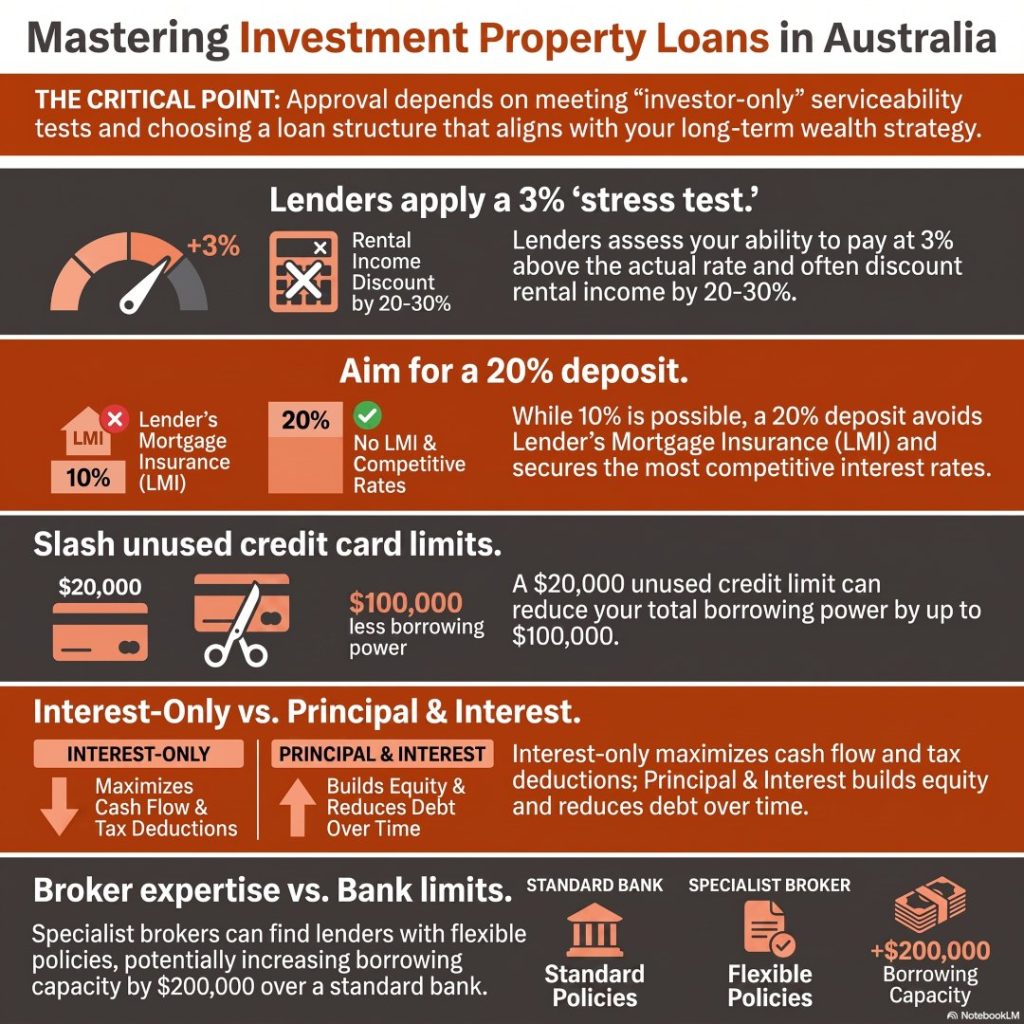
This surprises a lot of people. In Australia, lenders assess investment property loans through a completely different lens. They apply a serviceability buffer – typically 3% above the loan rate – to stress-test whether you could still afford repayments if rates rise. They discount rental income, usually accepting only 70-80% of expected rent as usable income. And unlike an owner-occupier loan where your emotional attachment to your home can sometimes push a deal through, investor applications are purely financial.
That means your debt-to-income ratio, your credit history, your existing liabilities, and your financial structure matter far more than your intentions or enthusiasm.
For a dual-income couple in their mid-40s – with a nearly paid-off home, stable PAYG income, and children who have recently left the nest – this is the exact moment many families look at property investment and wonder whether they can make it work. The good news is that with the right structure, they almost certainly can.
What Lenders Actually Look at When You Apply for an Investment Property Loan
Understanding the lender’s perspective is the single most powerful step you can take before applying for an investment property loan in Australia.
Income and serviceability sit at the top of every assessment. Lenders want to see consistent, verifiable income. PAYG employment is viewed most favourably, but rental income from your existing portfolio, business income (after two years of tax returns), and in some cases other passive income streams can all contribute. Most lenders calculate your maximum loan by working out what monthly repayments you could afford after all existing commitments are met – and after their 3% buffer is applied.
Deposit and loan-to-value ratio (LVR) are the next critical factor. Most investment lenders want a minimum 20% deposit, meaning you avoid lender’s mortgage insurance (LMI) and qualify for more competitive rates. A 10% deposit is possible with some lenders, but LMI costs and rate premiums add up quickly. For a $600,000 investment property, the difference between a 10% and 20% deposit could be $15,000 or more in additional costs over the life of the loan.
Existing debts and credit card limits are often where borrowers unknowingly reduce their capacity. As discussed in our guide on strategies to improve your borrowing capacity for property investment, lenders assess every dollar of your credit card limit as if you are spending it each month. A $20,000 credit card limit you never use can reduce your borrowing power by up to $100,000. That is a significant number for anyone trying to step into the investment market.
Rental yield and property type also affect approval. Lenders apply their own discount to rental income and have restrictions on certain property types – inner-city high-rise apartments, properties in small regional towns, or holiday rentals can all face additional scrutiny or be excluded altogether.
Choosing the Right Loan Structure for Your Investment Goals
Once you know you can borrow, the question becomes: what loan structure actually fits your strategy?
The two primary options are interest-only (IO) and principal and interest (P&I) loans. Neither is universally superior – they suit different phases of an investment journey.
Interest-only loans reduce your monthly repayments by removing the principal component. On a $500,000 loan at 6%, you would pay approximately $2,500 per month on IO compared to around $3,000 on P&I. That $500 monthly difference can meaningfully improve your cash flow, especially if your properties are negatively geared. The entire repayment is also tax-deductible, which creates real savings for higher-income earners. The trade-off is that your loan balance does not reduce during the IO period, meaning you are not building equity through repayments – only through property growth.
Principal and interest loans build wealth more steadily. You are paying down the debt each month, reducing your LVR, and moving closer to owning the property outright. For investors who have reached their target portfolio size and want to shift from accumulation to consolidation, P&I becomes the more logical choice.
A sophisticated approach – one many experienced property investors use – is to hold IO loans during the growth phase when cash flow and borrowing capacity are priorities, then switch to P&I as retirement approaches and income reduction becomes the goal.
Our detailed comparison of interest-only vs principal and interest loans for property investors walks through the real numbers across a 10-year period and shows exactly what each approach builds – and costs.
Pros and Cons of Investment Property Loan Structures
Interest-Only Investment Loans
| Pros | Cons |
|---|---|
| Lower monthly repayments free up cash flow for the next deposit or living costs | Loan balance does not reduce – equity grows only through property value increases |
| Full repayment is tax-deductible for investment properties, maximising your annual tax benefit | Interest rates are typically 0.2-0.5% higher than P&I equivalents |
| Improved borrowing capacity lets you acquire additional properties sooner | Repayment increase when the IO period ends can create significant cash flow pressure |
| More suitable for short-term holds or high-growth properties where capital gains are the priority | Stricter lending criteria apply, including higher minimum deposits |
Principal and Interest Investment Loans
| Pros | Cons |
|---|---|
| Systematic debt reduction builds equity and improves your LVR over time | Higher monthly repayments can reduce cash flow and limit additional borrowing capacity |
| Generally lower interest rates and broader lender options | Principal repayments are not tax-deductible, making it less efficient for negatively geared properties |
| Protects against market downturns by increasing net equity regardless of capital growth | Less suited to investors in a rapid accumulation phase who need maximum borrowing flexibility |
| Ideal for long-term holds and retirement income planning | – |
The Role of a Specialist Investment Mortgage Broker
One of the most consistent mistakes Australian investors make is applying directly to their own bank for an investment property loan – or worse, applying to multiple lenders at once, which can damage their credit score.
Different lenders assess the same application very differently. The gap in borrowing capacity between the most restrictive and most flexible lender for an identical borrower profile can exceed $200,000. I started Investors Choice Mortgages back in 2005 because I genuinely did not trust that walking into a bank would give someone the best outcome. I had seen it too many times – people sitting across from a bank lender, being told “no” or handed a number that felt final, and walking away believing that was the truth. It was not. It was just that one lender’s truth. One of my clients’ daughters experienced this firsthand. Her bank told her she could not borrow enough to buy in the suburb she had her eye on. She came to us deflated, ready to give up on the area entirely. After we ran her application through a lender better suited to her income structure and existing commitments, she discovered she could borrow $200,000 more than the bank had offered. Same borrower, same income, same property goal – different lender, completely different result. That experience is not unusual. It is one of the most common things I see, and it is exactly why choosing where you apply matters as much as what you apply for.
A specialist investment mortgage broker understands those nuances. They know which lenders accept higher rental income assessments, which ones offer more favourable policies for portfolio investors, and how to structure an application so it is presented in the strongest possible light.
Beyond the loan itself, experienced brokers walk you through the full picture – the upfront costs such as stamp duty, conveyancing, and building inspection fees, and the ongoing costs including rates, property management, insurance, and maintenance. Getting into the right investment property loan means understanding all of these moving parts, not just the headline interest rate.
If you are building towards a portfolio of two or three properties – a very realistic goal for a dual-income household in their 40s or 50s – your investment property portfolio strategy and your loan structure need to work together from day one.
If you are building towards a portfolio of two or three properties – a very realistic goal for a dual-income household in their 40s or 50s – your investment property portfolio strategy and your loan structure need to work together from day one.
What to Do Before You Apply for an Investment Property Loan
Before approaching any lender or broker, take these steps:
- Get a clear picture of your borrowing capacity. Use the Investors Choice Mortgages Hub’s Portfolio Profiler and Mortgage Stress Test to see where you stand today.
- Review your credit card limits. Reduce unused limits to free up potential borrowing power.
- Consolidate or pay down personal debts. Car loans, personal loans, and HECS debts all affect serviceability.
- Gather two years of tax returns and payslips. Most lenders require this as a minimum.
- Clarify your investment strategy. Capital growth? Rental yield? A mix of both? Your answer shapes the loan structure that will serve you best.
- Speak to a specialist broker before you make an offer on any property. Pre-approval gives you certainty and negotiating power.
Conclusion
An investment property loan in Australia is not a one-size-fits-all product, and the decisions you make at the start – about structure, lender, deposit, and strategy – will compound over years. The families who build meaningful property portfolios are not necessarily higher earners or better connected. They are better prepared.
Whether you are buying your first investment property or looking to grow an existing portfolio, understanding how investment property loans work in Australia is the foundation everything else is built on. The right loan, matched to the right strategy, with the right professional guidance, is how wealth actually gets built.
Ready to take the next step? Visit the Investors Choice Mortgages Hub to access AI-powered tools, calculators, and expert resources designed specifically for Australian property investors. It is free to use and gives you a genuine advantage before you speak to a single lender.
Frequently Asked Questions
How much deposit do I need for an investment property loan in Australia?
Most lenders require a minimum 20% deposit for an investment property loan in Australia to avoid lender’s mortgage insurance (LMI). Some lenders will approve loans with as little as 10%, but LMI costs and higher interest rates make this significantly more expensive over time. If you already own a home with equity, you may be able to use that equity as your deposit without needing additional cash savings.
Can I use my home equity to buy an investment property in Australia?
Yes. If your home has increased in value and you have paid down a portion of your mortgage, you may be able to access that equity as a deposit for an investment property. Most lenders allow you to borrow up to 80% of your home’s current value (less what you still owe), with the released funds used as your deposit. This is one of the most common pathways for Australian homeowners entering the investment market – and one of the most efficient ways to get started without needing a large cash savings.
Is there a tax advantage to choosing interest-only over principal and interest on an investment loan?
Yes. With an interest-only loan, your entire monthly repayment is tax-deductible because it is all interest. With a principal and interest loan, only the interest portion is deductible – the principal repayments reduce your debt but offer no immediate tax benefit. For negatively geared investors in higher tax brackets, this distinction can mean thousands of dollars of difference in annual tax returns. Always confirm your specific position with a qualified accountant.
How does a mortgage broker help with an investment property loan compared to going directly to a bank?
A specialist mortgage broker accesses dozens of lenders and understands the nuances in how each one assesses investor applications. Because different lenders can produce borrowing capacity differences exceeding $200,000 for the same borrower, broker expertise often means approval where a direct bank application fails – or a significantly better loan structure and rate. Brokers also save you time, protect your credit score by avoiding multiple simultaneous applications, and help you structure your loan for long-term investment success.