
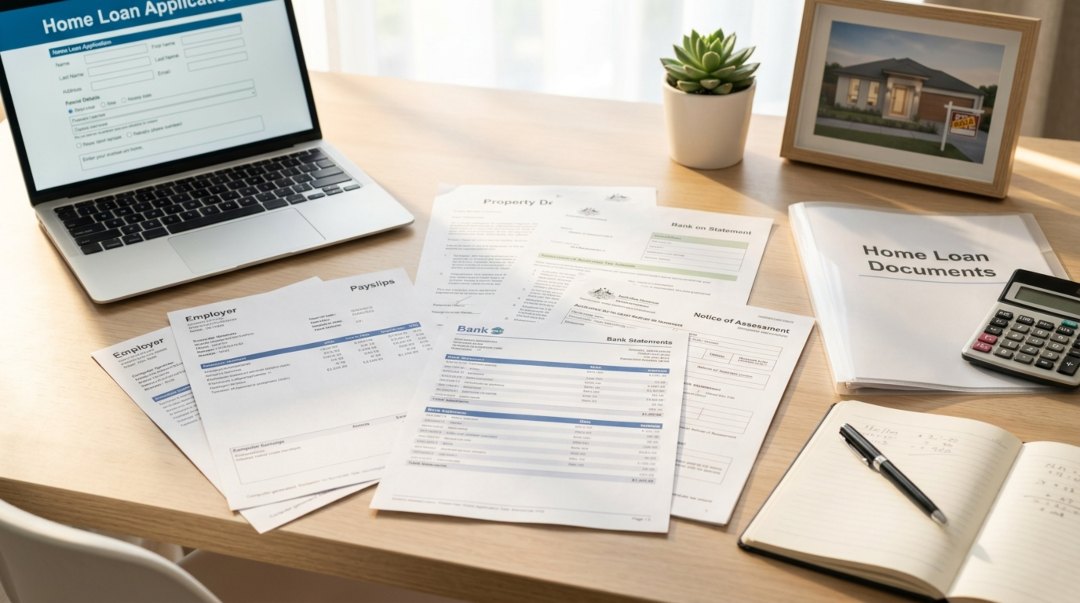
Getting your home loan documents right before you apply is one of the most practical things you can do to avoid delays, frustration, and missed opportunities in Australia’s competitive property market. For most PAYG employees, the core list centres on recent payslips, bank statements, and proof of identity – but the specific rules around what lenders accept (and what they quietly reject) are less obvious than most bank websites suggest. Self-employed borrowers face an entirely different set of requirements, and even small details – like the age of your payslips or the size of your credit card limit – can quietly shrink your borrowing power before you have written a single offer.
Key Takeaways
- Lenders require computer-generated payslips showing your employer’s ABN or ACN, full address, and year-to-date earnings. Handwritten or informal pay confirmations are not accepted.
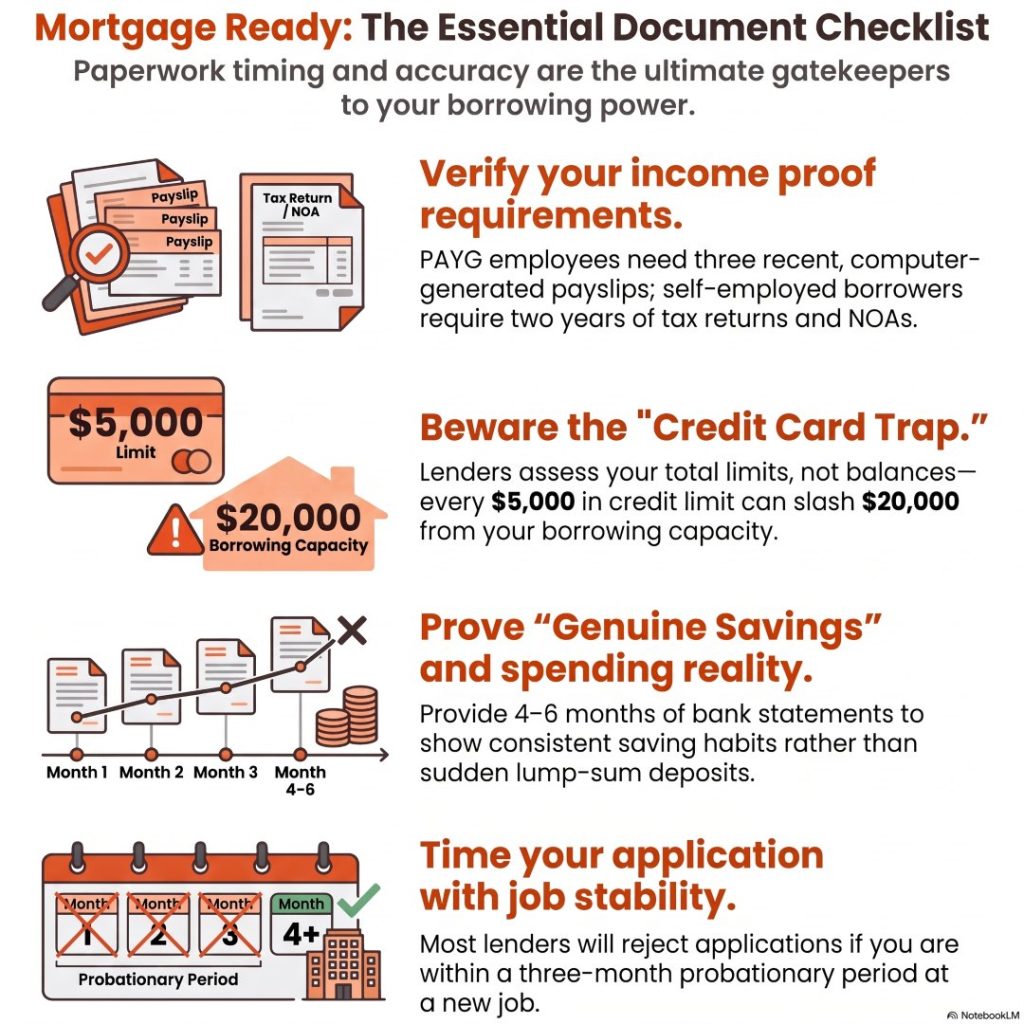
- Credit card limits – not just balances – reduce your borrowing capacity. Every $5,000 in limit can reduce what you can borrow by approximately $20,000.
- Self-employed borrowers need two years of tax returns, two years of Notices of Assessment from the ATO, and typically four BAS statements. A tax return not yet completed for the prior year can become a deal-breaker with some lenders after January.
- Lenders verify your spending reality, not your budget intentions. Going through your bank and credit card statements and listing every expense – including annual ones – is essential preparation.
- If you changed jobs in the past three months, most lenders will not approve your application during a probationary period, regardless of your income level.
Why Most Applications Stall Before They Even Start
Picture this: you have done the research, saved your deposit, and found a property that ticks every box. You approach a lender feeling prepared – only to be told your payslips are out of date, your tax returns are incomplete, or your credit card limits are dragging your borrowing capacity below what you need.
This situation is far more common than most first-time applicants realise. Motivated borrowers who are financially ready in every practical sense can still have their paperwork let them down at the critical moment. A delayed application in a competitive market is not just frustrating – it can mean losing a property entirely while you scramble to gather the right documents.
I have been saying this to clients for years: being mortgage-ready is not just about having your finances in order – it is about having your documents in order before you need them. I have sat with buyers who were financially ready in every sense that mattered. They had the deposit. They had the income. They had done the research. But when an auction was brought forward without warning, or a vendor accepted an early offer over the weekend, they could not move. The payslips were out of date. The tax returns had not been lodged. The pre-approval had lapsed, and by the time we went back to the lender, the borrowing capacity had shifted. I have watched people lose properties they were genuinely ready to buy – not because of their finances, but because of paperwork timing. In a market where a good property can attract three offers before Monday morning, the gap between being document-ready and almost document-ready can cost you the deal entirely. That is not a scare tactic. It is simply what I have seen play out, over and over, across 20 years of sitting at the intersection of property and finance.
The good news is that this is almost entirely avoidable. Understanding exactly what lenders want to see – and why – means you can walk into your application in the strongest possible position.
What Documents Do I Need for a Home Loan? Income and Employment
The first thing a lender wants to confirm is that you earn what you say you earn.
For most salaried employees, this means providing payslips for a home loan in Australia. The rules around payslips are stricter than many people expect. Lenders typically require either:
- Three consecutive payslips, with the oldest no more than one month old at the time of application, or
- A single payslip showing at least three months of year-to-date (YTD) payment history.
Those payslips must be computer-generated – not handwritten or produced in a basic word processor. They need to include your employer’s full name, their ABN or ACN, their business address, and a clear breakdown of your earnings. A casual confirmation letter from your employer will not satisfy most lenders.
Beyond payslips, your lender will contact your employer directly to confirm your employment type (permanent, part-time, casual, or contractor), how long you have been in the role, and your verified earnings.
One critical detail many applicants overlook: if you have recently changed roles, most lenders will not approve your application while you are still within your first three months in a new job. They treat that period as a probationary risk. Some lenders will make exceptions if you have been in a closely related field for more than two years – but that exception is not something to rely on. If you are considering a career move while planning to apply, read our guide on how changing jobs affects your mortgage before making any decisions.
Bank Statements, Spending History, and the Credit Card Trap
Once income is verified, lenders turn their attention to how you spend.
You will need to provide bank statements – typically covering the past two to three months – so the lender can see your actual spending patterns and confirm your savings history. This is not just a formality. Lenders are looking for consistency, genuine savings behaviour, and evidence that your deposit funds have accumulated organically rather than appearing as a single lump-sum transfer right before application.
Before you apply, go through your last two months of bank and credit card statements yourself. List every regular expense – groceries, streaming services, gym memberships, dining out – and do not forget annual costs like car registration, insurance, and council rates. Lenders assess what you actually spend, not what you think you spend.
Here is the point that trips up even financially organised borrowers: lenders assess your credit card limits, not just your current balances. A credit card with a $10,000 limit that you pay off in full every month still counts against you. Lenders assume you could spend the entire limit, calculating that as an ongoing monthly repayment commitment. Every $5,000 of credit card limit reduces your borrowing capacity by approximately $20,000. A borrower carrying $30,000 across three credit cards – even with zero balances – may find their borrowing power reduced by around $120,000.
If you are serious about maximising what you can borrow, review and reduce your credit card limits before applying. Our guide on strategies to improve your borrowing capacity covers this and other practical ways to increase what lenders will approve.
Self-Employed Home Loan Documents Australia: What You Need
Self-employed applicants face a more complex documentation process, and it pays to understand the requirements well in advance – often 12 months or more before you plan to apply.
The core requirements for self-employed borrowers include:
- Last two years of personal tax returns
- Last two years of business tax returns (where applicable)
- Notices of Assessment (NOAs) from the ATO for both years
- Business profit and loss statements
- Last four BAS (Business Activity Statements)
- Evidence that your ABN has been registered for at least two years
- Evidence of GST registration for at least 12 months
There is an income assessment rule that catches many self-employed applicants off guard: most lenders take the lower of your two years’ income to calculate serviceability. They will only average the two years if the difference between them is less than 20 per cent. If your business has grown strongly – say $80,000 in year one and $140,000 in year two – a lender may still use $80,000 as the basis for your borrowing capacity. That reflects how lenders manage risk when income is variable, not a reflection of your current earnings.
There is also a timing issue specific to self-employed borrowers. Some lenders require the previous financial year’s tax return to be lodged by January. If it is February and your accountant is still working on last year’s return, certain lenders will simply decline to proceed – regardless of your income level or credit history. Plan ahead, stay on top of your ATO lodgements, and talk to a broker early.
Identification and Genuine Savings Evidence
Every borrower – regardless of employment type – needs to provide satisfactory identification. Standard requirements include:
- A current passport or Australian driver’s licence (or both, if only one is provided)
- Medicare card or another secondary form of ID
You will also need to demonstrate that your deposit funds are genuine savings. Lenders want to see bank statements covering at least four to six months of savings history, showing funds that accumulated steadily over time. An account showing a sudden injection of $80,000 two weeks before application – even if it is a legitimate gift or asset sale – will require further explanation and supporting documentation.
Home Loan Pre-Approval Documents: What to Prepare
If you are applying for pre-approval before actively searching for a property, you will need the same core documents as a full application. The key difference is that no specific property valuation is required at this stage. Pre-approval gives you a realistic borrowing ceiling and signals to sellers that you are a serious buyer.
Understanding how pre-approval fits into the overall process – including how long it lasts and what can cause it to lapse – is covered in our guide on how long mortgage pre-approval lasts in Australia. If you are a first home buyer navigating this for the first time, our step-by-step article on how the first home buyer mortgage process works walks through the entire journey from initial application to settlement.
Your Home Loan Documents Checklist: Quick Reference
| Category | What You Need |
| Income (PAYG) | 3 consecutive payslips or 1 payslip with 3-month YTD; computer-generated with employer ABN |
| Income (Self-Employed) | 2 years personal and business tax returns, 2 years NOAs, 4 BAS statements, P&L |
| Bank Statements | 2-3 months of transaction history from all accounts |
| Deposit Evidence | 4-6 months of savings history showing genuine accumulation |
| Debts and Liabilities | Statements for all loans, credit cards, buy-now-pay-later accounts |
| Identification | Passport and/or driver’s licence; Medicare card |
| Expenses | Budget listing all regular and annual expenses |
Conclusion
Preparing your home loan documents before you apply is not just about ticking boxes – it is about removing every unnecessary obstacle between where you are now and the property you want to own. The borrowers who move fastest through the approval process are almost always those who arrived prepared: payslips current, savings history documented, credit card limits reviewed, and tax returns in order.
The details that trip people up are rarely dramatic. They are usually small, fixable issues that a good mortgage broker would catch well before they became problems.
That is exactly where Investors Choice Mortgages can help. Visit the Investors Choice Mortgages Hub to access free tools and calculators – including a Mortgage Stress Test and Borrowing Power estimator – or speak with our team directly to review your documents and map out your application strategy before you apply. Getting it right the first time saves weeks, protects your borrowing capacity, and keeps you in the running for the property you actually want.
Frequently Asked Questions
How many payslips do I need for a home loan in Australia?
Most lenders require either three consecutive payslips with the oldest no more than one month old, or a single payslip that shows at least three months of year-to-date earnings. The payslips must be computer-generated and include your employer’s ABN or ACN, full business address, and a clear payment breakdown. Handwritten confirmations or informal letters from your employer are not accepted by mainstream lenders.
Can I get a home loan if I am self-employed in Australia?
Yes, but the documentation requirements are more involved than for PAYG employees. You will typically need two years of personal and business tax returns, two years of ATO Notices of Assessment, four BAS statements, and profit and loss reports. Most lenders require your ABN to have been registered for at least two years and your GST registration for at least 12 months. It is advisable to speak with a mortgage broker well in advance – often 12 months before you plan to apply – to ensure your records are in order.
Do credit card limits affect my home loan application?
Yes – and this is one of the most underestimated issues in home loan applications. Lenders assess your credit card limit, not your current balance. For every $5,000 of credit limit you carry, your borrowing capacity can be reduced by approximately $20,000. A borrower with $25,000 across multiple cards may be borrowing $100,000 less than they otherwise could. Reducing your credit card limits before applying is one of the fastest ways to improve your borrowing power.
What counts as genuine savings for a home loan deposit in Australia?
Genuine savings are funds you have accumulated in a bank account over time – typically demonstrated through four to six months of statements showing steady, consistent saving. Lump-sum transfers, gifts, or proceeds from the sale of assets may require additional documentation and explanation. Lenders want to see a pattern of disciplined saving because it signals financial reliability and the ability to service a loan over the long term.