

Yes, HECS debt affects your home loan because compulsory repayments reduce the income available to service a mortgage. It does not automatically stop you from qualifying, and the effect depends on your income, outstanding balance and the lender’s policy. Recent lending changes may help if your debt will be repaid soon, but most borrowers should expect their HECS-HELP repayments to reduce borrowing power.
For a first home buyer with HECS debt, the right lender and a clear serviceability comparison can make a meaningful difference. Before paying the balance voluntarily, understand how the choice could affect your deposit, cash buffer and home loan options.
Key Takeaways
- HECS-HELP debt can reduce borrowing capacity without preventing home loan approval.
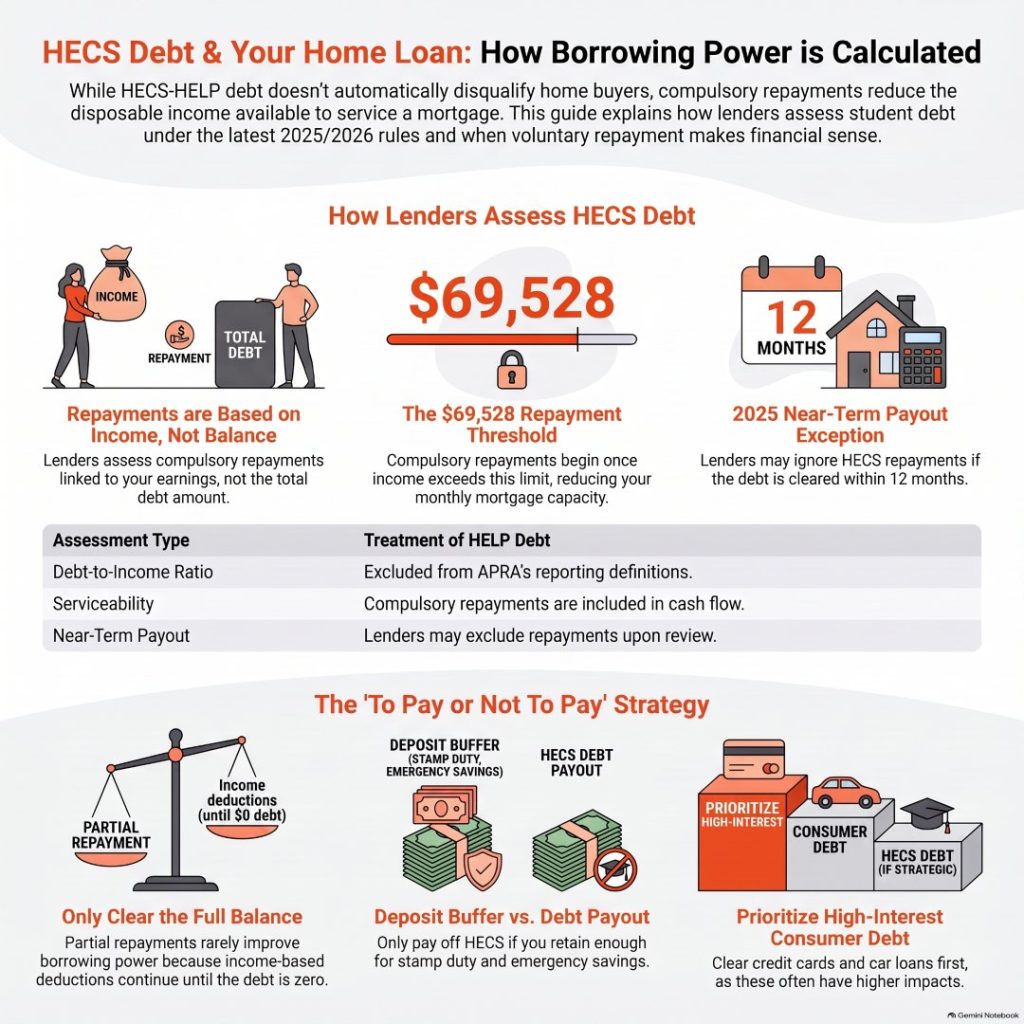
- Lenders generally assess the compulsory repayment linked to your income, not simply the debt balance.
- A smaller balance may not improve serviceability unless the debt will be cleared soon.
- Lenders can exclude repayments in limited near-term payout situations, but this is not automatic.
- Paying off HECS can help, but not if it leaves you without a sufficient deposit or financial buffer.
How Does HECS Debt Reduce Your Home Loan Borrowing Power?
HECS debt borrowing power is affected because lenders assess how much of your income is already committed before approving a mortgage.
Imagine Jess, a 30-year-old professional earning $100,000 while saving for her first home. She has a stable job, a $70,000 deposit and a $50,000 HECS-HELP balance. On paper, she may feel financially ready.
Under the 2026-27 repayment system, compulsory repayments begin when repayment income exceeds $69,528. At $100,000 of repayment income, Jess’s indicative repayment is:
- $100,000 minus $69,528 = $30,472
- $30,472 multiplied by 15% = $4,570.80 annually
- Approximately $380.90 per month
A lender may treat that $380.90 as money unavailable for mortgage repayments. Depending on its policy, assessment rate, loan term and Jess’s other expenses, this could reduce her HECS debt borrowing capacity by tens of thousands of dollars.
This is why a generic HECS debt serviceability calculator or online mortgage calculator can be misleading. Our guide to mortgage calculator accuracy explains why these tools cannot reproduce every lender’s policy.
Importantly, compulsory repayments are based primarily on repayment income. Someone with a $20,000 balance may initially have the same compulsory repayment as a person on the same income with a $50,000 balance.
What Do Lenders Consider When Assessing HECS-HELP Debt?
A HECS-HELP debt home loan assessment may consider:
- Your income and recent payslips
- HELP withholding shown through payroll
- Your outstanding HELP balance
- Whether the debt is likely to be cleared soon
- Credit cards, personal loans and car finance
- Living expenses, dependants and proposed repayments
HELP differs from a personal loan because repayments are income-contingent rather than based on a fixed interest rate and term. However, the compulsory deductions still reduce available cash flow.
HELP is not generally assessed like an ordinary consumer loan on your credit report, but you must disclose it. Lenders may verify the liability through payslips, statements and application documents.
Lender choice therefore matters when applying for a home loan with HECS debt in Australia. One lender may use its standard assessment, while another may consider a near-term payout exception. This is why an accurate borrowing capacity strategy should compare multiple policies.
What Were the HECS Home Loan Changes in 2025?
The HECS home loan changes in 2025 created more flexibility, but they did not allow banks to ignore every HELP debt.
From 30 September 2025, APRA’s revised guidance allowed authorised deposit-taking institutions to consider excluding HELP repayments in limited cases where the debt is expected to be fully repaid in the near term. Twelve months was provided as an example, but each lender still applies its own policy.
| Assessment | How HELP may be treated |
| Debt-to-income reporting | HELP is excluded from APRA’s reporting definition. |
| Home loan serviceability | Compulsory repayments are generally included. |
| Near-term payout | A lender may exclude repayments after reviewing the application. |
This distinction is important when considering the HECS debt debt-to-income ratio for a home loan. Removing HELP from APRA reporting does not automatically remove the repayment from serviceability.
The legislated 20% reduction to eligible student loan balances may shorten the time needed to clear a debt. However, the HECS 20 percent reduction home loan benefit may not appear immediately if the borrower’s compulsory repayment remains unchanged.
Should I Pay Off HECS Before Buying a House?
Paying off HECS can make sense when the balance is small enough to clear completely and removing the repayment materially improves your loan options.
When I bought my first property, I had only a 5% deposit. Waiting until I reached 20% could have delayed me for years, so I accepted lenders mortgage insurance to pursue the bigger goal. It taught me to ask what using this money now might prevent me from doing next.
Suppose Jess uses $50,000 of her $70,000 savings to clear HELP. Her serviceability may improve, but she would have only $20,000 left for her deposit, stamp duty, conveyancing, inspections and emergency savings.
If Jess owes only $6,000, clearing it could remove an assessed monthly commitment once the lender verifies the payout. The serviceability benefit may then outweigh the smaller reduction in her savings.
Ask three questions before paying:
- Will the payment clear the debt completely?
- How much additional borrowing capacity could it create?
- Will enough remain for the deposit, purchasing costs and a safe buffer?
Partial voluntary repayments often provide little immediate mortgage benefit because compulsory repayments remain income-based while the debt exists.
HECS-HELP Versus Other Debts: What Should You Repay First?
High-interest consumer debt often deserves attention before HECS. Credit cards may be assessed using their limits, even when little is owing, while car and personal loans have fixed repayments.
A practical order is:
- Clear overdue debts and protect your credit record.
- Reduce expensive personal loans and credit card debt.
- Review and close unnecessary credit limits.
- Model the effect of fully clearing HECS.
- Preserve an appropriate deposit and emergency buffer.
Read our strategies for improving borrowing capacity for more ways to strengthen your position.
Pros and Cons of Keeping or Paying Off HECS
Pros of Keeping HECS
- You preserve cash for your deposit and purchasing costs.
- Repayments stop if your income falls below the threshold.
- A larger deposit may reduce lenders mortgage insurance.
Cons of Keeping HECS
- Compulsory repayments can reduce serviceability.
- Your maximum purchase budget may be lower.
- Results can vary between lenders.
Pros of Paying Off HECS
- Full repayment may remove the commitment from serviceability.
- Payroll withholding can stop once your details are updated.
- A small payout may unlock a more suitable borrowing range.
Cons of Paying Off HECS
- It can reduce your deposit and emergency savings.
- Partial repayments may not improve borrowing power.
- Money paid towards HELP cannot be recovered for buying costs.
How Can You Find Your Real Borrowing Capacity?
Compare two scenarios: applying with your current HECS balance and applying after a proposed full payout.
A broker can assess both scenarios across lenders, account for current repayment rules and determine whether a near-term payout exception may apply. This gives you a clearer picture than relying on a generic calculator.
Conclusion
HECS-HELP debt does not close the door on home ownership, but it can narrow your borrowing range. Paying it off is usually most useful when you can clear the balance without sacrificing the deposit or financial buffer needed to buy safely.
Before moving your savings, compare the outcome across several lender policies. Visit the Investors Choice Mortgages Hub or book a conversation with us to build a personalised home loan strategy based on your income, HELP balance and goals.
This information is general in nature and does not constitute personal financial, tax or credit advice. Repayment thresholds and lender policies can change.
Frequently Asked Questions
Does HECS debt stop you from getting a home loan?
No. You can qualify for a home loan with HECS-HELP debt if you meet the lender’s serviceability and credit requirements. You must disclose the debt, and its compulsory repayment may reduce the amount you can borrow.
How much does HECS debt reduce your borrowing power?
There is no single figure. The effect depends on your repayment income, expenses, other liabilities, assessed interest rate and lender policy. A personalised serviceability comparison is more reliable than a generic calculator.
Do banks now ignore HECS debt when assessing a mortgage?
Not automatically. Banks generally include compulsory repayments, but some may exclude them when the debt is expected to be cleared in the near term and the application satisfies their policy.
Should I pay off HECS before buying a house?
Consider paying it off when you can clear the full balance, doing so materially improves your borrowing capacity, and you can retain enough money for your deposit, buying costs and emergency buffer.