

Home loan for casual workers can be harder, but casual employment does not automatically prevent you from getting approved. Lenders may look more closely at the stability and consistency of your income, as well as your employment history, industry, deposit size and overall financial position. While many lenders prefer at least 12 months in a casual role, some may consider three or six months, particularly if you have relevant industry experience, stable earnings and a lower loan-to-value ratio. Ultimately, your employment type is only one part of the picture, and the right lender will consider your overall financial circumstances
Key Takeaways
- Casual employment does not automatically prevent home loan approval.
- Many lenders prefer 12 months of casual employment, but exceptions may apply.
- A 20% deposit can reduce lender and mortgage insurer restrictions.
- Qualified workers in stable industries may receive more flexible treatment.
- Contractors can be classified as self-employed even when an agency pays their tax and super.
What Do Lenders Look for When a Casual Worker Applies?
Lenders want confidence that your income can reliably support repayments after settlement. They do not simply reject a casual worker home loan because the word “casual” appears on a payslip.
I understand why the word “casual” can make people nervous. Years ago, I left a secure mining engineering career, where I had worked underground and run open-cut mines, to become a commission-only mortgage broker. A friend was devastated because, from the outside, I was swapping security for uncertainty. But while my employment label and income structure had changed, my experience, discipline and ability to plan had not. That experience shaped how I help people seeking a home loan for a casual employee in Australia. Your label is only one part of your story. The right lender should also consider your work history, qualifications, savings habits, income consistency and industry demand.
Consider Emily, a 29-year-old casual nurse earning an average of $1,750 a week. She has worked at the same hospital for eight months, previously held another nursing position and has saved consistently while renting. Her income varies with weekend shifts, but her annual earnings are stable.
A lender may assess:
- Current and previous employment history
- Weekly hours and income consistency
- Recent payslips and year-to-date earnings
- Overtime, allowances and penalty rates
- Savings, debts, expenses and credit history
- Deposit size and loan-to-value ratio
Policies differ. One lender may require 12 months in the current position, while another may accept six months supported by relevant industry experience.
Before applying, review the factors affecting your borrowing capacity. Credit limits, personal loans and living expenses can reduce how much you qualify to borrow.
How Long Do You Need to Be Casual Before Applying?
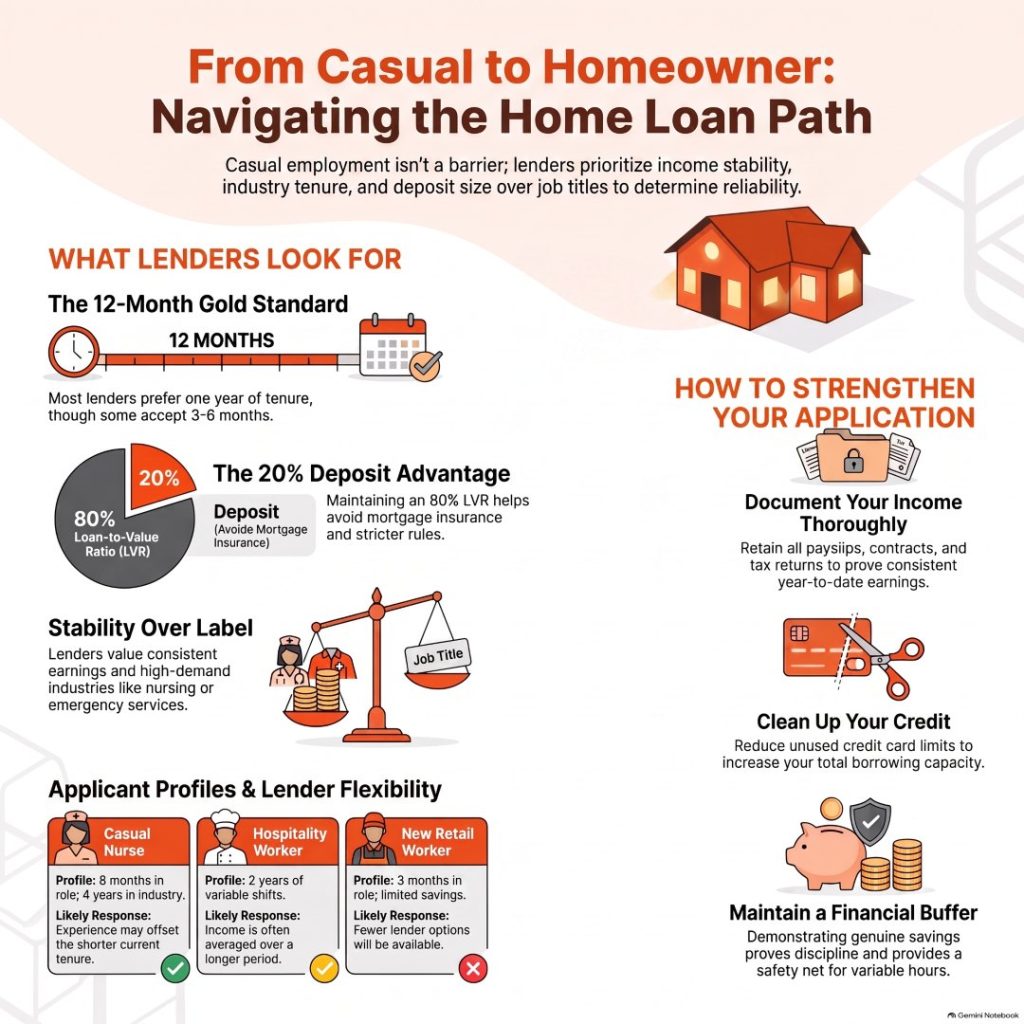
Many lenders prefer at least 12 months of casual employment, but this is not a universal rule. If you are wondering how long a casual job before a home loan application is acceptable, some lenders may consider six months or, in selected circumstances, three months.
Flexibility is more likely when you have:
- Experience in the same profession
- Consistent or increasing earnings
- Strong genuine savings
- Low consumer debt
- A sizeable deposit
- Ongoing demand for your skills
A reasonable career break does not necessarily prevent casual employment home loan approval. Lenders generally consider your complete employment timeline.
Changing employers shortly before applying can still affect the result. Review how changing jobs affects a mortgage application before resigning, reducing hours or changing your employment arrangement.
Does Your Occupation Affect Home Loan Approval?
Yes. A lender may consider your occupation, qualifications and ability to find replacement work.
A qualified nurse, teacher, police officer, firefighter or paramedic may present a stronger case than someone with a short, irregular history in an industry with fluctuating demand. Hospitality and retail workers can still qualify, but may need clearer evidence of recurring hours and income.
| Applicant | Employment profile | Possible lender response |
| Casual nurse | Eight months in role and four years in nursing | Experience may offset shorter tenure |
| Casual teacher | Regular work across several school terms | Holiday periods may affect calculations |
| Hospitality worker | Variable shifts for two years | Income may be averaged over a longer period |
| New retail worker | Three months in role with limited savings | Fewer lender options may be available |
This profession-specific assessment can support a home loan for a casual nurse in Australia, but occupation does not replace serviceability.
Why Does an 80% LVR Matter for Casual Workers?
An 80% loan-to-value ratio, or LVR, means the loan represents 80% of the lender-assessed property value. An LVR for a casual employee mortgage matters because lenders mortgage insurance is generally not required at or below this threshold.
For a $700,000 property:
- Loan amount: $560,000
- Deposit towards the price: $140,000
- LVR: 80%
Purchase costs must also be budgeted for unless concessions or grants apply.
Above 80% LVR, the application may need to satisfy both lender and mortgage insurer requirements. Insurers can apply stricter casual employment policies. A 20% deposit does not guarantee approval, but it may remove an additional assessment layer.
Do not use every dollar merely to reach 80% LVR. Retaining an emergency buffer is particularly important when your income or hours vary.
Are Agency Contractors Treated as Casual Employees?
Not always. An agency contractor may be classified as self-employed, even when the agency processes tax and superannuation.
A lender may examine whether the agency must continue paying you when an assignment ends. If ongoing income is not guaranteed, self-employed policies may apply and require tax returns or additional financial records.
Confirm your classification before applying. Prepare your evidence early with this Australian home loan documents checklist.
How Can You Strengthen Your Application?
1. Keep complete income records
Retain payslips, contracts, bank statements, income statements and tax returns. Lenders may compare year-to-date income with previous earnings.
2. Avoid unnecessary employment changes
Where possible, avoid switching industries or reducing your hours before applying.
3. Reduce unused credit limits
A lender may assess a credit card limit as potential debt, even when the balance is zero.
4. Build genuine savings and retain a buffer
Regular savings demonstrate financial discipline and provide protection if your casual hours temporarily fall.
5. Seek pre-approval before making an offer
Pre-approval can identify policy issues before you commit to a property, although it remains conditional. Avoid delays by understanding the common reasons home loan applications are delayed.
Pros and Cons of a Mortgage for Casual Workers in Australia
Pros of Applying as a Casual Employee
- Many lenders accept regular casual income.
- Industry experience may compensate for shorter tenure.
- Accepted penalty rates and allowances may support borrowing capacity.
- A mortgage broker for casual workers can compare differing lender policies.
Cons of Applying as a Casual Employee
- Some lenders require 12 months in the role.
- Irregular income can be harder to verify.
- Overtime and allowances may be reduced or excluded.
- Fewer suitable lenders may limit product choice.
Conclusion: Your Employment Label Does Not Decide the Outcome
Casual work is not an automatic barrier to home ownership. Your outcome generally depends on income stability, employment history, industry, deposit, debts and the lender assessing your application.
Rather than approaching multiple banks, start with a clear understanding of how lenders may treat your income. Investors Choice Mortgages Hub can help you organise your documents, assess suitable lender options and create a practical application strategy. Arrange a free, no-pressure initial conversation before making an offer or changing jobs.
Frequently Asked Questions
Can casual employees get a home loan with only three months in a job?
Possibly, but lender options are limited. Approval is more likely when you have relevant industry experience, stable earnings, strong savings and a lower LVR. Many lenders still prefer six or 12 months of casual employment.
How do banks calculate casual income for a home loan?
Banks may examine payslips, year-to-date earnings, income statements, bank deposits and tax records. Variable income may be averaged, while irregular overtime or allowances could be reduced or excluded.
How much deposit does a casual worker need for a home loan?
Requirements vary by lender, property and applicant. An 80% LVR can generally avoid lenders mortgage insurance and may provide greater policy flexibility, although eligible applicants may have lower-deposit options.
Can a casual nurse get a home loan in Australia?
Yes. Qualifications, industry demand and previous nursing experience may strengthen the application despite shorter current tenure. Approval still depends on income, expenses, debts, deposit and lender policy.
Am I self-employed if I work as a contractor through an agency?
A lender may classify you as self-employed if your income depends on individual assignments and the agency does not guarantee ongoing pay. Confirming this classification before applying can prevent unexpected documentation requests and delays.