

If overtime, bonuses or commission make up a regular part of your income, you may be wondering whether lenders will count that extra income towards a home loan. The good news is that they often can, but lenders may not count every dollar you earn. Your base salary usually provides the starting point, while overtime, bonuses and commission are assessed based on factors such as consistency, your income history and whether the earnings are likely to continue. How much of this income is accepted can vary between lenders, which can make a meaningful difference to your borrowing capacity.
Key Takeaways
- Regular overtime is more likely to be accepted than occasional overtime.
- Many lenders reduce variable income before calculating serviceability.
- A consistent employment and income history strengthens your application.
- Monthly commission is generally easier to demonstrate than irregular annual payments.
- A broker can compare lender policies before your application is submitted.
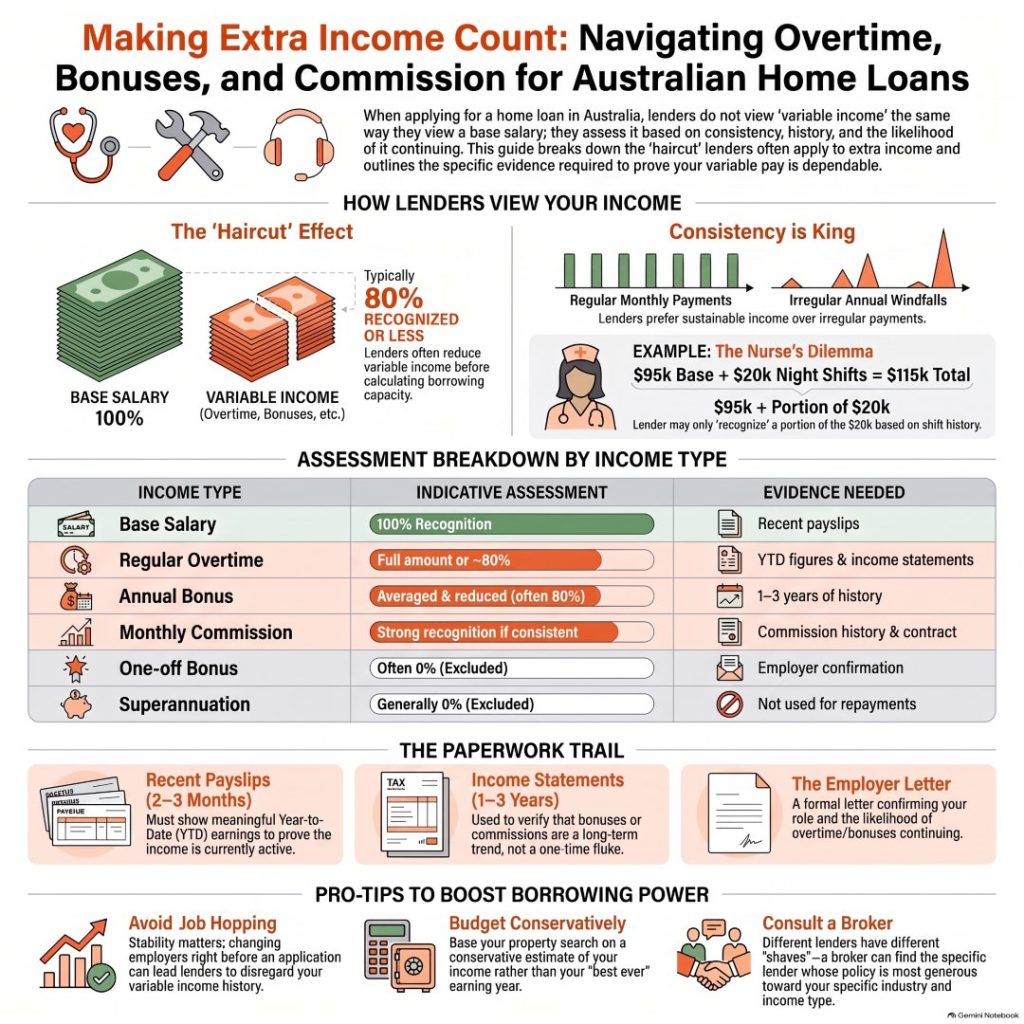
Does Overtime Count Towards Borrowing Capacity?
Overtime can count towards your borrowing capacity when it is regular, sustainable and supported by evidence.
Imagine Sarah, a registered nurse earning a base salary of $95,000. Her weekend and night shifts add approximately $20,000 a year. Sarah knows she earns $115,000, but an online calculator using only her base salary produces a disappointing result.
Lenders do not simply accept the total on her latest payslip. They consider whether the additional income is dependable by reviewing:
- How long Sarah has received overtime.
- Whether overtime is a normal part of her role.
- Whether year-to-date earnings align with previous years.
- Whether her employer expects the overtime to continue.
- Whether staff shortages temporarily increased her shifts.
- Whether she recently changed jobs or industries.
Essential-service employees, including nurses, police officers and paramedics, may present a stronger case when overtime is an established part of their occupation. Some tradespeople and shift workers may also qualify, but acceptance is never automatic.
Learn more about how borrowing capacity works.
What Percentage of Variable Income Will a Lender Use?
There is no standard percentage for every variable income home loan application. Depending on the income type, evidence and lender policy, a lender may use 100 per cent, apply a reduction or exclude the income.
A common approach is to use around 80 per cent of established variable income. A more conservative lender may use only 50 per cent when payments fluctuate significantly or the applicant has a limited history.
| Income type | Indicative assessment | Evidence commonly requested |
| Base salary | Often counted at 100% | Recent payslips and employment details |
| Regular overtime | Full amount or a reduced percentage | Payslips, year-to-date figures and income statements |
| Annual bonus | Often averaged and reduced | One to three years of payment history |
| Monthly commission | May receive stronger treatment when consistent | Payslips, commission history and employment contract |
| Quarterly commission | Often averaged over time | Income statements and payment records |
| One-off bonus | Commonly excluded | Employer confirmation and payment records |
| Employer superannuation | Generally excluded | Not normally available for repayments |
These figures are guides, not guarantees. Policies and serviceability calculations change, and two lenders may assess the same income differently.
In my 17 years running a mortgage business, I have seen a lender’s policy change slash a buyer’s borrowing capacity overnight, even when their income had not changed. I have watched buyers go from being able to purchase a $950,000 home to qualifying for only $780,000 after a pre-approval expired amid interest rate rises. Experiences like these show why accurate documentation and choosing a lender that recognises your overtime, bonuses or commission are so important.
Online calculators should also be treated as estimates. Read are mortgage calculators accurate? to understand their limitations.
How Do Lenders Assess Bonus Income for a Home Loan?
A bonus income home loan application is stronger when bonuses have been paid consistently over several years and are linked to achievable performance measures.
Suppose Mark earns $110,000 and received bonuses of $12,000, $20,000 and $16,000 over three years. A lender might average these payments at $16,000 and use 80 per cent, resulting in $12,800 of assessable bonus income.
Another lender could use the latest year, apply a larger reduction or exclude the bonus if there is insufficient evidence that it will continue.
One-off signing bonuses, retention payments and exceptional project bonuses are less persuasive because they may not be repeated. An annual performance bonus paid under a longstanding arrangement provides stronger evidence of sustainability.
Do not assume a $20,000 bonus will add $20,000 to your assessable income. Use a conservative figure until a lender or broker confirms the assessment.
Can Commission Income Be Used for a Home Loan?
A commission income home loan Australia application may include regular commission, but lenders distinguish between consistent payments and unpredictable sales income.
Alex earns a base salary of $90,000 plus monthly commission averaging $40,000 a year. Because the commission appears regularly on his payslips, it may receive more favourable treatment than an irregular annual payment.
The lender may examine whether:
- Alex has stayed with the same employer or industry.
- His commission is stable, increasing or falling.
- His year-to-date earnings represent a normal period.
- The commission structure recently changed.
- His earnings rely on a temporary sales campaign.
- His base income can support repayments during quieter months.
Commission-only applicants can face greater scrutiny because their entire income fluctuates. Approval may still be possible, but documentation and careful lender selection become particularly important.
What Documents Prove Variable Income?
Strong documentation turns variable earnings into verifiable income. Before seeking pre-approval, prepare:
- Your two or three most recent payslips.
- Payslips showing meaningful year-to-date earnings.
- One to three years of income statements or PAYG summaries.
- Tax returns and notices of assessment if requested.
- Your employment contract and commission structure.
- An employer letter confirming your role, income and whether additional earnings should continue.
- Bank statements showing regular salary deposits if required.
A payslip containing at least three months of year-to-date income may strengthen your application, although it may not replace a longer income history.
Use this home loan documents checklist to organise your records.
How Can You Improve Your Chances?
To improve the likelihood of having extra income counted:
- Avoid changing employers immediately before applying where practical.
- Retain payslips, income statements and bonus letters.
- Ask your employer to explain regular overtime or commission arrangements.
- Check that year-to-date figures are accurate.
- Disclose income fluctuations clearly.
- Base your budget on less than your best earning year.
- Seek an assessment before making an offer.
- Review expenses, credit limits and existing debts.
Higher assessable income may not increase your borrowing power as much as expected if other commitments reduce serviceability. Explore these strategies to improve borrowing capacity.
Pros and Cons of Using Variable Income
Potential Benefits
- Regular overtime can increase assessable income.
- Established shift patterns are easier to verify.
- Consistent bonuses and monthly commission may improve borrowing capacity.
- The right lender may recognise more of your variable earnings.
Potential Limitations
- Occasional overtime and one-off bonuses may be excluded.
- Variable income may be averaged or reduced.
- Temporary earnings can make current income appear inflated.
- Reduced shifts or sales could create future repayment pressure.
Conclusion: Make Your Application Fit Your Real Income
Overtime, bonuses and commission can support a home loan application, but consistency, evidence and lender policy determine how much will count. Avoid building your property plans around 100 per cent of your variable income until you receive a tailored assessment.
Visit the Investors Choice Mortgages Hub to access practical tools, review your borrowing position and make more informed property decisions. You can also speak with the Investors Choice Mortgages team before lodging an application. Comparing suitable lender policies may help you avoid an unnecessary decline and understand what you can comfortably afford.
[NOTE: Variable income percentages and evidence requirements are indicative. Confirm current lender policies before applying.]
Frequently Asked Questions
Does overtime count towards borrowing capacity in Australia?
Yes, regular and ongoing overtime can count towards borrowing capacity. A lender may review your payslips, year-to-date earnings and previous income statements, then use all or a reduced percentage of the verified amount.
How much of my bonus can I use for a home loan?
Some lenders may use around 80 per cent of a consistent bonus, while others may use less or exclude it. The result depends on your payment history, the nature of the bonus and the lender’s current policy.
Do banks accept commission for a mortgage?
Many banks accept commission when it is consistent and adequately documented. Monthly commission with a strong history is generally easier to assess than irregular payments. Commission-only applicants may need additional evidence and careful lender selection.
How many years of variable income history do lenders need?
Requirements vary, but lenders may request one to three years of evidence. A shorter history may be accepted when your variable income is regular, your employment is stable and current year-to-date earnings support the amount claimed.