

Refinancing borrowing power can improve when a new loan releases usable equity, reduces assessed commitments or moves you to a lender whose policies better suit your financial position. However, a lower advertised interest rate does not automatically mean you can borrow more. The real outcome depends on your income, expenses, debts, property valuation, loan structure and the new lender’s serviceability rules. A strategic refinance should improve more than today’s repayment. It should also support your next property plans, preserve flexibility and justify every switching cost. Comparing suitable lenders before applying can help you avoid unnecessary credit enquiries and costly surprises later.
Key Takeaways
- Refinancing may unlock equity for a deposit, renovation or investment purchase.
- A lower interest rate does not guarantee greater borrowing capacity.
- Every lender assesses income, expenses and existing debts differently.
- Switching costs and long-term interest should be compared with the expected benefit.
- The right lender should support your future strategy, not simply offer today’s cheapest rate.
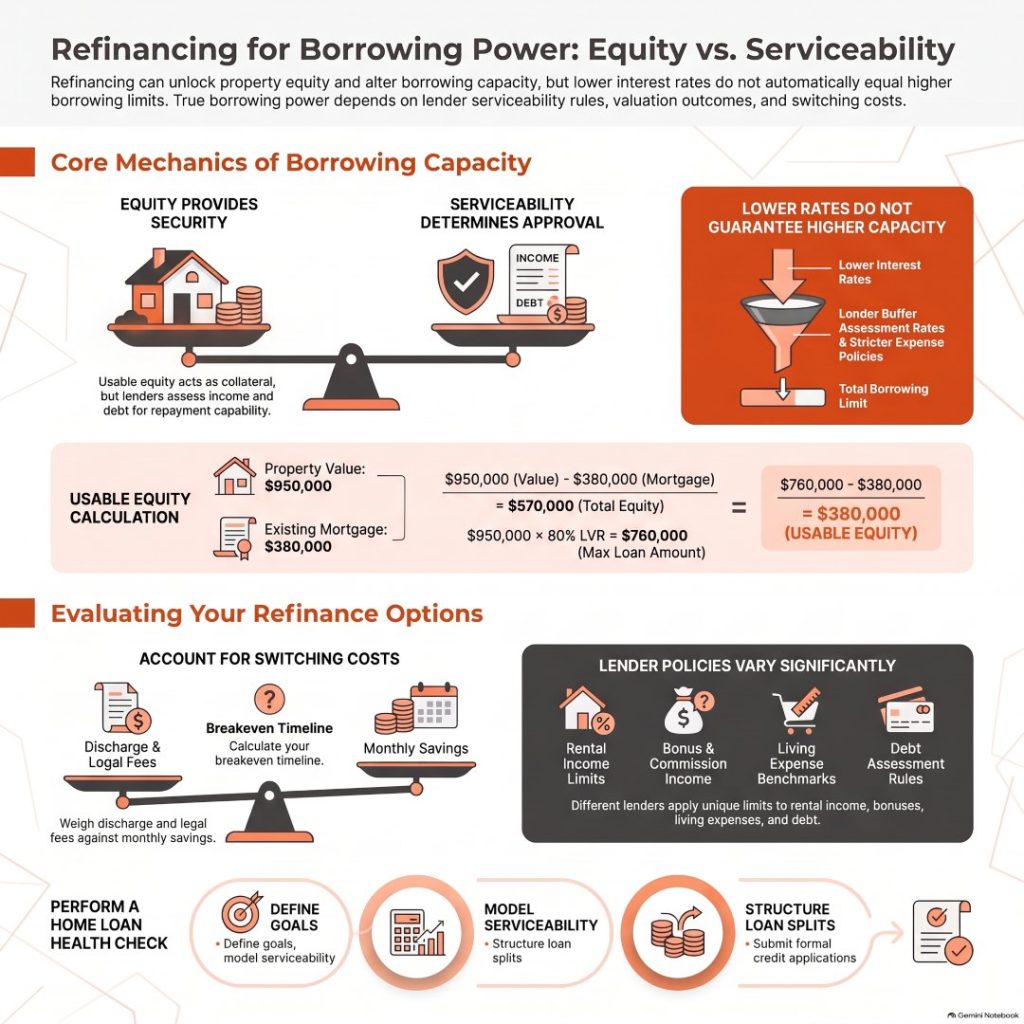
How Can Refinancing Change What You Can Borrow?
Refinancing can change your borrowing capacity in two ways. It may provide access to equity and change how a lender assesses your financial position.
Consider a couple with stable PAYG incomes whose home is worth $950,000, with a remaining mortgage of $380,000. They want to buy an investment property but do not have a large cash deposit.
They have $570,000 in total equity, but not all of it is necessarily usable. If a lender allowed total lending up to 80% of the home’s value:
- 80% of the $950,000 property value: $760,000
- Less the existing mortgage: $380,000
- Potential usable equity before costs and serviceability: $380,000
The lender must still be satisfied that the couple can afford the increased debt. Their approved equity release could therefore be much lower.
The key distinction is simple: equity provides security for another loan, while serviceability determines whether the lender believes you can repay it.
Learn more about how to get cash from home equity before changing your loan structure.
Does Refinancing Improve Borrowing Capacity?
It can, but a lower refinance rate does not always increase refinancing borrowing power.
Lenders generally test affordability using an assessment rate higher than the customer rate. They also apply individual policies to living expenses, rental income, overtime, bonuses, credit limits and existing debts.
A loan with a lower advertised rate could produce a weaker result if the lender:
- Uses a higher assessment rate.
- Accepts less variable or rental income.
- Applies higher benchmark living expenses.
- Treats investment debt less favourably.
- Has stricter debt-to-income or loan-to-value limits.
This is why comparing home loan rates in Australia is only one part of a home loan health check. The cheapest lender today may restrict your next property purchase.
If you want to know how to increase borrowing capacity, compare several appropriate lenders before submitting a formal application. You can also review these strategies to improve borrowing capacity for property investment.
When Can You Refinance to Access Equity?
Refinancing may help when your property has increased in value, you have reduced the principal, or both.
Released equity may potentially fund:
- An investment property deposit and purchase costs.
- Value-adding renovations.
- A separately structured investment loan.
- A buffer for planned property expenses.
Jane’s experience shows how this can become a springboard for the next investment: “I bought my first property for $425,000 with a 5% deposit and used a personal loan for renovations. Nine months later, it was worth $700,000. I refinanced, pulled out the equity and kept going. It was game-changing for my portfolio strategy.”
Separate loan splits can make the purpose of borrowed funds easier to track. Mixing personal and investment spending may create record-keeping complications. Tax treatment depends on how borrowed money is used, not simply which property secures the loan, so obtain qualified tax advice.
Valuation risk also matters. If one lender values your home at $950,000 and another at $900,000, the $50,000 difference could reduce available equity by $40,000 at an 80% loan-to-value ratio.
What Should You Compare Before Refinancing?
The right decision balances immediate savings with your future strategy.
| Decision factor | What to examine |
| Interest cost | Rate, comparison rate and repayments |
| Borrowing capacity | Result under the lender’s servicing model |
| Usable equity | Valuation, proposed limit and acceptable LVR |
| Loan features | Offset, redraw, splits and repayments |
| Switching costs | Discharge, application, legal and government fees |
| Future plans | Renovations, investments or additional dwellings |
| Loan term | Total interest payable over the new term |
If refinancing saves $180 per month but costs $2,700, it takes 15 months to recover the switching costs, assuming the saving continues. Refinancing again or selling before then may reduce the benefit.
Extending the debt over a new 30-year term may also lower repayments while increasing total interest. Better cash flow does not always mean a lower long-term cost.
What Are the Risks of Refinancing for Greater Borrowing Power?
The main risk is choosing a loan for one appealing feature while overlooking your broader strategy.
A lender may offer a competitive rate but:
- Restrict equity releases or cash-out amounts.
- Decline the property type you plan to purchase.
- Recognise less overtime, bonus or rental income.
- Have unsuitable policies for multiple dwellings.
- Leave insufficient capacity for your next investment.
Formal applications may create credit enquiries. Several enquiries within a short period can raise questions with future lenders, even if a declined outcome is not recorded as a simple “declined” label.
Borrowers who cannot meet a new lender’s serviceability requirements are sometimes described as being in “mortgage prison Australia”. If you are experiencing mortgage stress Australia, seek support early rather than submitting multiple applications.
Pros and Cons of Refinancing
Pros of Refinancing
- Access usable equity without saving another cash deposit.
- Potentially reduce repayments and improve cash flow.
- Gain loan features better suited to your needs.
- Move to a lender that supports future purchases.
Cons of Refinancing
- Switching costs may outweigh short-term savings.
- The valuation may be lower than expected.
- A longer loan term may increase total interest.
- Different serviceability policies may reduce borrowing power.
Pros of Staying With Your Current Lender
- Avoid switching charges and an external credit enquiry.
- Request an internal rate review.
- Retain a structure that already supports your strategy.
Cons of Staying With Your Current Lender
- Continue paying an uncompetitive rate.
- Face restrictive equity-release policies.
- Keep features that no longer meet your needs.
What Does a Home Loan Health Check Involve?
A strategic home loan health check should model your next move, not just your current mortgage.
- Define your purpose: Decide whether you need lower repayments, usable equity or capacity for another property.
- Calculate all costs: Include discharge fees, application charges, break costs and possible lenders mortgage insurance.
- Test serviceability: Compare how lenders assess your income, expenses and liabilities.
- Review lender policy: Confirm that the lender supports your future property strategy.
- Structure the lending carefully: Separate borrowing purposes and preserve flexibility.
A borrowing power calculator provides a useful estimate, but it cannot account for every lender policy or personal circumstance.
Conclusion: Make Refinancing Serve Your Next Step
Refinancing is worthwhile when it creates a measurable benefit and supports where you want to go next. The right structure may release equity, reduce interest, improve cash flow or strengthen your future investment strategy.
Instead of asking only, “Which lender has the lowest rate?”, ask, “What do I want my finance to make possible next?”
Use the Investors Choice Mortgages Hub to access practical calculators, review your borrowing position and complete a mortgage stress test. For personalised guidance, contact Investors Choice Mortgages and have your current loan and proposed strategy modelled before you apply.
Frequently Asked Questions
Does refinancing improve borrowing capacity?
It can. Refinancing may reduce assessed commitments, unlock usable equity or move you to a lender with more suitable policies. Stricter serviceability rules could also leave your capacity unchanged or lower.
Can I borrow more if I refinance my home loan?
Potentially, but equity does not guarantee approval. The lender must assess your income, expenses, debts, credit history and ability to afford repayments at its assessment rate.
How much equity do I need to refinance and buy an investment property?
It depends on your property values, existing debts, purchase price, costs and lender requirements. Keeping lending at or below 80% of a property’s value may avoid lenders mortgage insurance, but serviceability still determines approval.
When should I refinance my home loan?
Review your loan when your rate is uncompetitive, your fixed period is ending, your property value has increased or your goals have changed. Refinance only when the benefits justify the costs and the new structure supports your future plans.