
A cashback can be worthwhile when the new loan already offers a competitive rate, suitable features and the flexibility your future plans require. The payment should be treated as a bonus, not the reason for refinancing. Compare the total financial impact over three to five years because a higher rate, annual fee or restrictive lending policy can quietly erase thousands of dollars in upfront value. Before accepting any refinance cashback offer, check the refinancing eligibility criteria, switching costs, repayment difference and whether the lender supports your next property goal. A strong deal should still make sense without the cash incentive.
Key Takeaways
- A $4,000 cashback does not automatically make a home loan competitive.
- Compare rates, fees and repayments over three to five years, not only the first year.
- Refinancing break fees can exceed the value of the cashback.
- Investors should consider future borrowing capacity and equity access before switching.
- Cashback is most valuable when the underlying loan already suits your strategy.
How Does a Home Loan Cashback Offer Work?
A home loan cashback offer is a switching incentive paid after an eligible borrower refinances and settles a loan. In September 2026, advertised mortgage cashback offers in Australia commonly ranged from $2,000 to $4,000, including offers from IMB, ME Bank, Greater Bank, BankVic and BOQ.
Eligibility may require you to:
- Refinance a minimum loan amount, often between $250,000 and $750,000.
- Keep your loan-to-value ratio at or below 80 per cent.
- Select an eligible owner-occupier or investment loan.
- Apply and settle within specified dates.
- Refinance from an external lender.
- Keep the loan open until the cashback is paid.
Payment can take several weeks or months after settlement. If you need the money to cover switching costs, confirm the payment timing first.
[NOTE: Cashback offers, lender participation and refinancing eligibility criteria can change or be withdrawn without notice. Confirm current conditions directly before applying.]
When Is a Refinance Cashback Offer Worth It?
A refinance cashback offer is worth considering when the loan stands on its own merits before the incentive is included.
For example, a couple with a $600,000 mortgage receives a $3,000 offer. The new lender provides a lower rate, useful offset account, reasonable fees and policies supporting their plan to buy an investment property. Their refinancing costs total $1,200, leaving an initial net benefit of $1,800. If their repayments also fall, the cashback adds value to an already sensible decision.
However, the outcome changes if the loan has a higher rate or limits future opportunities. If you plan to renovate, build a granny flat, release equity or purchase another property, the cheapest-looking deal may not support your strategy.
I saw the value of this bigger-picture approach firsthand with a client who was a newly separated single mum. Back in 2009, she was uncertain about what to do next and understandably fearful about making such a significant financial decision. During our mortgage strategy call, I helped her look beyond the immediate pressure and suggested suburbs with strong growth potential. She went on to buy a property for $760,000 and later sold it for $1.96 million, creating around $1 million in wealth for her family. When she sent me a heartfelt note explaining how much this had changed her life, it reinforced why long-term strategy matters far more than any short-term incentive.
Learn more about refinancing for borrowing power before switching.
Cashback vs Lower Interest Rate Mortgage: Which Saves More?
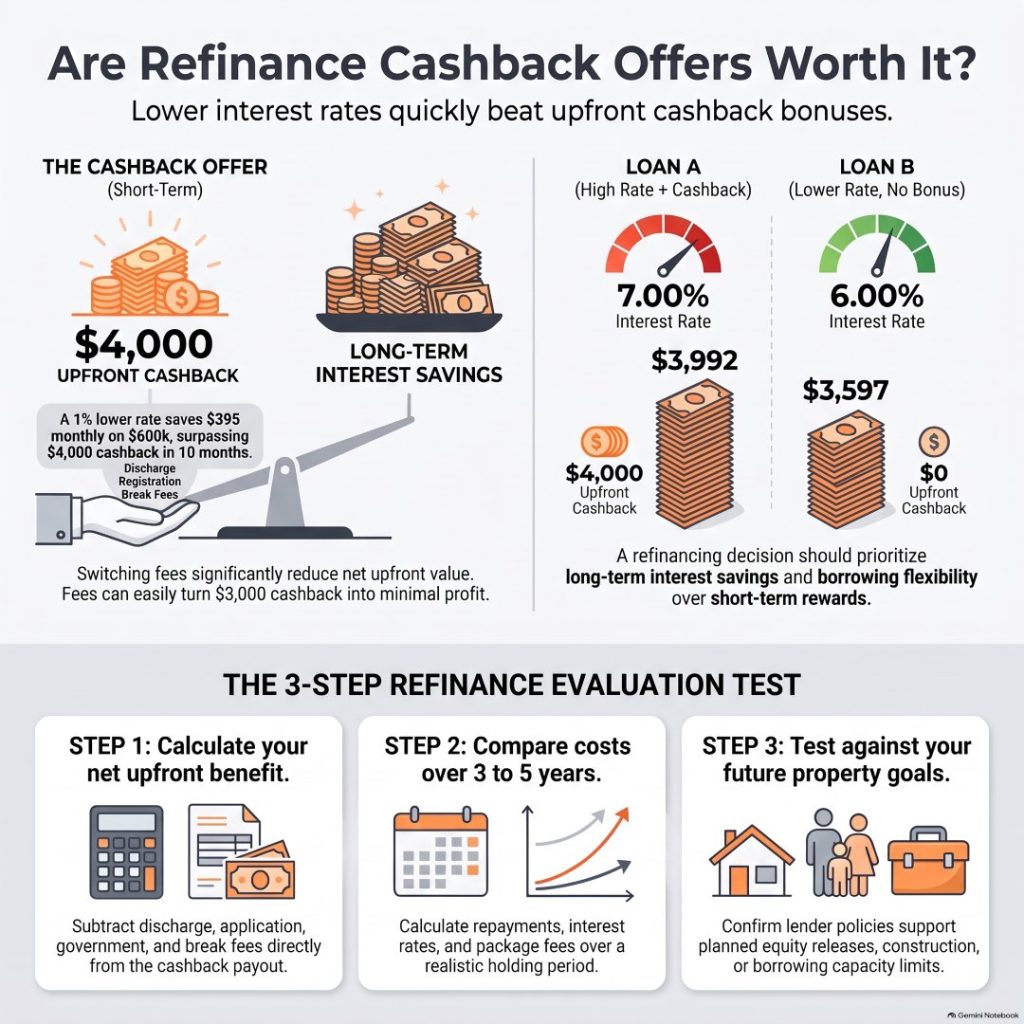
A lower interest rate will usually deliver more value than a one-off cashback when the rate difference is meaningful and you retain the loan for several years.
Consider a $600,000 principal-and-interest loan with 30 years remaining:
| Loan option | Interest rate | Approximate monthly repayment | Upfront cashback |
| Loan A | 7.00% | $3,992 | $4,000 |
| Loan B | 6.00% | $3,597 | $0 |
Loan A provides $4,000 immediately, but its repayments are approximately $395 higher each month. That difference consumes the cashback in just over ten months. If both rates remained unchanged, the repayment difference over 30 years would be approximately $142,000.
This is an illustrative example. Variable rates, loan features and fees can change the result. Compare the advertised rate, comparison rate and personalised costs over your expected holding period.
What Is the Cost of Refinancing a Home Loan?
Refinancing costs in Australia can include:
- Your current lender’s discharge fee.
- Mortgage registration and deregistration charges.
- Application, settlement or valuation fees.
- Package or annual fees.
- Fixed-rate refinancing break fees.
- Lenders mortgage insurance if you have limited equity.
For example, a $3,000 cashback minus $1,300 in switching costs provides a $1,700 upfront benefit. A $395 annual package fee would reduce that benefit to only $120 after four years, before considering interest.
Fixed-rate borrowers should request a current payout figure. Break costs can change according to wholesale rates, the outstanding balance and the remaining fixed term.
If repayments are driving your decision, explore these practical ways to reduce monthly mortgage payments.
What Refinancing Traps Should Property Investors Avoid?
The risks of refinancing a home loan extend beyond its current rate. A lender’s servicing rules, equity-release policies and appetite for investment lending may affect your entire portfolio.
You could receive cashback and lower repayments but later discover that the lender:
- Uses conservative rental-income calculations.
- Restricts cash-out or equity access.
- Does not support your intended property or construction strategy.
- Offers limited interest-only options.
- Assesses existing debts more harshly.
- Reduces your borrowing capacity for another purchase.
For investors, these restrictions may cost more than the cashback. Review these strategies for improving property investment borrowing capacity before choosing a lender.
How to Compare Refinance Home Loans
Use this three-step test before applying.
1. Calculate the net upfront benefit
Cashback – discharge fees – application costs – government charges – break costs = net upfront benefit
If the result is small or negative, the incentive offers limited immediate value.
2. Compare costs over three to five years
Calculate repayments, interest and recurring fees over a realistic period. Include any introductory or revert rate and compare features you will actually use, such as:
- Offset accounts.
- Additional repayments.
- Redraw facilities.
- Loan splits.
- Interest-only periods.
- Portability and equity access.
3. Test the loan against your next move
Consider what you may need within two or three years, including renovating, investing, changing employment, restructuring debt or accessing equity. A suitable refinance should improve your current position without closing the door on future plans.
Pros and Cons of Refinancing for Cashback
Pros of a Home Loan Cashback Offer
- Cashback can offset legitimate refinancing costs.
- A lower rate may reduce repayments and interest.
- Better features can improve cash-flow management.
- Refinancing can correct an unsuitable loan structure.
Cons of a Home Loan Cashback Offer
- A higher rate can erase the incentive quickly.
- Eligibility conditions may prevent payment.
- Annual fees can reduce long-term value.
- Repeated applications may affect your credit profile.
Conclusion: Make the Loan Strategy More Important Than the Reward
Cashback is attractive because it is immediate and easy to understand. The more important costs can be spread across years or hidden within lender policies.
Start with the rate, fees, features, borrowing capacity and future flexibility. If the new loan is already competitive and strategically suitable, cashback can make a good refinance even better.
Before switching, visit the Investors Choice Mortgages Hub. Use its AI-powered resources, practical calculators and Mortgage Stress Test to compare repayments and make a more informed refinancing decision.
Frequently Asked Questions
How much does it cost to refinance a home loan in Australia?
Costs depend on the lender, state, property and loan structure. They can include discharge fees, government registration charges, valuation fees, application costs and fixed-rate break costs. Request written payout and fee figures before calculating your net benefit.
How do I claim cashback when refinancing?
You generally need to apply through an eligible channel, meet the minimum loan and equity requirements, and settle before the deadline. The lender normally pays the cashback into a nominated account after settlement, but timeframes vary.
Can I refinance with less than 20 per cent equity?
It may be possible, but fewer options may be available and lenders mortgage insurance could apply. Limited equity and the new lender’s assessment policies may also affect your future borrowing capacity, so obtain an accurate assessment before applying.
Are refinancing break fees worth paying for cashback?
Only when the broader savings comfortably exceed the break fee and every other refinancing expense. Ask your current lender for an updated break-cost quote because the amount can change with market conditions and the remaining fixed term.