

Refinancing to buy another property can help you unlock usable equity and prepare your finance before the right opportunity appears, but only when the new loan supports your longer-term plan. The lowest advertised rate is not automatically the best choice because lender servicing rules, equity-release policies and ownership structures can affect your next approval. A carefully structured refinance can provide deposit funds and flexibility, while a poorly planned switch may restrict borrowing capacity or force you to refinance again. Planning early also gives you time to compare costs, stress-test repayments and select lending that supports future property investment goals confidently.
Watch Jane explain how refinancing now could help you prepare for your next property purchase (8 min).
Read transcript here
00:00 Welcome to the explainer. Lovely to have you with me. Look, we all know the great Australian dream, right? But these days, it’s not just about paying off the family home. It’s about taking that hardearned nest egg, rolling up your sleeves, and leveraging it to grab an investment property.
00:16 It’s an absolutely brilliant strategy for building long-term wealth. But you’ve got to have a level head and a rockolid plan. So, today we’re unpacking exactly how refinancing can get you primed for your next big property move. Let’s get straight into it. Here’s how we’re going to break it all down today. First, the property expansion dream.
00:35 Second, equity versus borrowing capacity. Third, avoiding the dreaded portfolio trap. Fourth, smart loan structuring. Fifth, weighing up the actual costs. And finally, your refinancing road map. Right, part one, the property expansion dream. Now, we really need to redefine how we think about refinancing. Forget just haggling with the bank to shave a few bucks off your monthly interest.
00:58 When we’re talking about expanding your portfolio, refinancing means restructuring your existing mortgage specifically to release equity. Think of that equity as your foundation. It’s what actually funds your deposit and the purchasing costs for property number two. It’s all about getting your ducks in a row so when that perfect property pops up, you’re ready to pounce.
01:19 Equity versus borrowing capacity. Listen closely to this bit because it’s a distinction that catches out. so many eager investors, you absolutely have to understand the difference between what your home is worth on paper and what the bank will actually let you do with it. Usable equity is the wealth tied up in your bricks and mortar.
01:36 And look, it’s a wonderful feeling knowing your home has gone up in value. But borrowing capacity, that’s your actual ability to repay new debt. At the end of the day, banks care about cash flow. They need to be dead certain that if they lend you a heap more money, your household income can comfortably service that debt, even if interest rates decide to jump up.
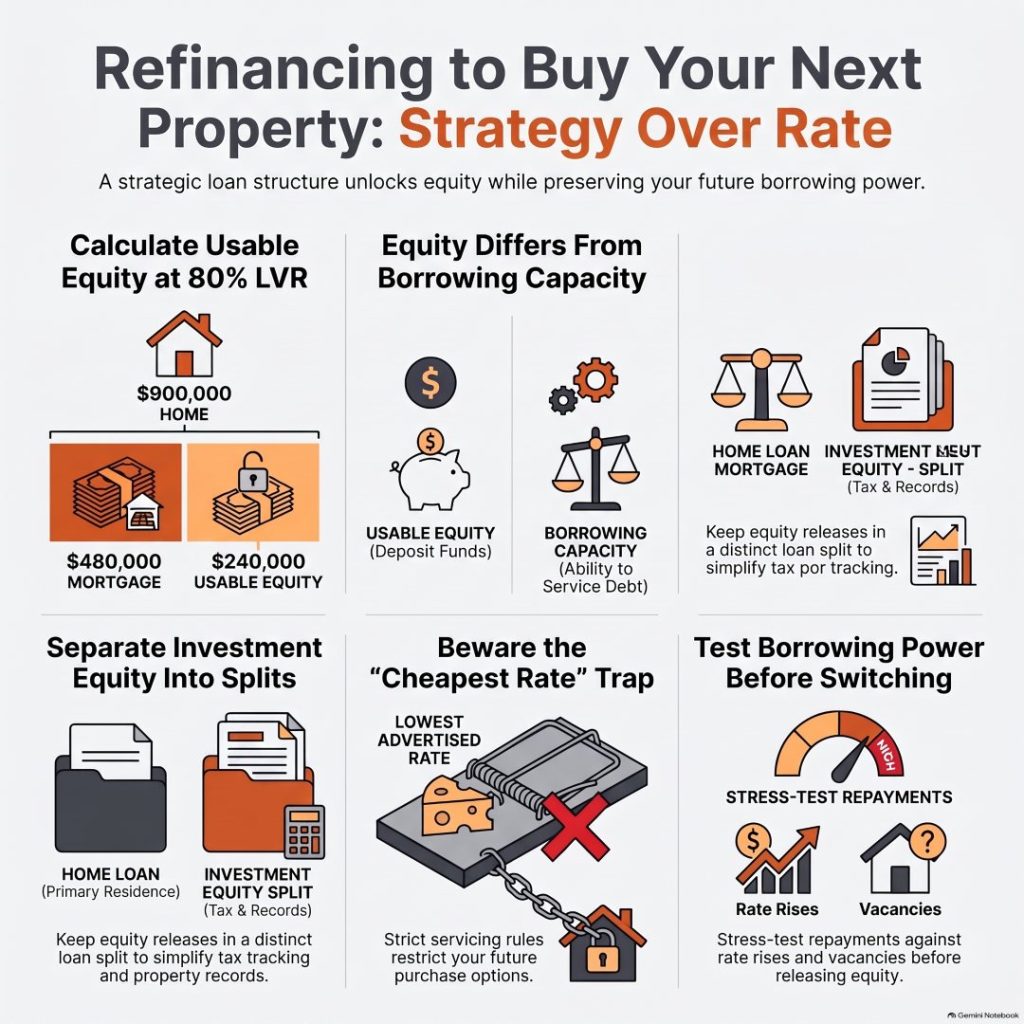
01:54 Let’s put some real numbers to this to see how it works. Say you own a home valued at $900,000. Now, lenders typically let you borrow up to 80% of your property’s value before they hit you with lender’s mortgage insurance. So, 80% of $900,000 is $720,000, but you still owe the bank on your current mortgage.
02:14 Let’s call it $480,000. When we subtract your current mortgage from that $720,000 limit, we’re left with $240,000. That figure right there, that is your potential usable equity. Just because you have $240,000 sitting there doesn’t mean you should drain every last cent of it. No way. If you’re eyeing off a $600,000 investment property, you might only need 120,000.
02:38 That covers your 20% deposit and leaves plenty of room for stamp duty, conveyancing, maybe some building inspections, and most importantly, a healthy cash buffer for unexpected repairs or rate hikes. Taking a smaller slice preserves your equity and keeps your debt at a level you can actually sleep with at night. Okay, part three, the portfolio trap.
02:59 Now, I want you to ask yourself a question. Why can the cheapest interest rate actually turn out to be your most expensive mistake? We are just so conditioned to hunt for the absolute rock bottom rate, aren’t we? But while saving a few dollars today feels great, tying yourself to the wrong lender can severely bottleneck your options down the track.
03:18 And this brings us to the nightmare scenario I call the portfolio trap. Picture this. You switch to a new lender offering a fantastic low rate. They approve your equity release. Brilliant. But then a few months later, you find the perfect investment property and that exact same lender flat out declines your new loan.
03:35 Why does that happen? Well, Australian lenders assess incomes, expenses, bonuses, and rental yields completely differently. You might hit one lender’s servicing limit instantly. So now to actually buy that property, you’re forced into another costly refinance, triggering more fees and potentially paying LMI all over again.
03:54 The right lender is the one who actually supports your broader strategy, not just the one flashing the cheapest rate today. Smart loan structuring. I absolutely love this insight from Jane in our source material. She shared her lived experience, explaining that she always prioritized paying down her own home first simply because that’s non-deductible debt.
04:14 By keeping her home loan interest only, heavily linked to an offset account, she created incredible flexibility. If she ever needed to move or maybe turn her home into an investment down the line, she could optimize her tax position in a heartbeat. That structure gave her valuable freedom and real financial buffers during periods of uncertain income, like maternity leave.
04:33 It’s all about creating safety nets for real life. So, how should you actually structure your equity release? The smartest way, hands down, is through separate loan splits. Please don’t just lump it all into one massive, messy mortgage. Keep split one as your existing $480,000 owner occupied mortgage.
04:53 Then create split 2 as a brand new, completely separate $150,000 loan specifically for your investment deposit and purchasing costs. Why bother? Because the tax treatment of your interest depends entirely on how the borrowed money is used. Carving it out makes your investment funds crystal clear. Trust me, mixing personal and investment funds is a shorefire way to give your accountant an absolute migraine at tax time.
05:16 I also need to give you a very firm caution about a big word you’ll likely hear, cross collateralization. This happens when one lender ties up multiple properties as security for your loans. A bank will make this sound wonderfully convenient, like a nice neat package, but believe me, it can severely restrict your flexibility.
05:35 If you want to sell one property or refinance later on, you’ll find the lender has way too much control over your entire portfolio. As a general rule of thumb, it is always best to keep your property standing on their own two feet. All right, part five. Weighing up the costs. We really have to objectively balance the scales here.
05:54 On the plus side, releasing equity means you can purchase an investment sooner without having to scrape together a massive cash deposit from scratch. You can snag competitive rates, kickstart your portfolio growth, and keep your actual cash savings safely tucked away for a rainy day. But on the downside, you’ve got to be pragmatic. You absolutely must factor in existing lender discharge fees, new application fees, government registrations, and maybe even fixed rate break costs if you’re locked in.
06:20 Plus, borrowing more money naturally exposes you to higher risk if rates rise or your new property sits vacant for a bit. So before you jump in, I highly recommend using a simple mathematical rule of thumb, the break even calculation. Say all those switching and valuation costs add up to say $3,000. And your shiny new loan structure saves you $250 a month.
06:40 Just divide the costs by the savings. 3 grand divided by $250 means it will take you exactly 12 months to break even. If you plan to hold the properties and the loans well past that 12-month mark, then the refinance could absolutely be worth doing. Which brings us to our final section, part six, your refinancing road map.
07:00 Here is your exact chronological order of operations. Step one, define your intended purchase and ownership structure nice and early. Step two, accurately estimate your usable equity and your buying costs. Step three, put your borrowing capacity to the test. And I mean really stress test it against future rate rises. Step four, compare lenders based on their policies and flexibility for investors, not just their interest rates.
07:23 And finally, step five, establish those separate loan splits to protect your tax position. If you stick to this road map, your refinance will be driven by long-term strategy rather than just reacting to today’s market. I want to leave you with this final crucial thought to chew on. Does your current loan structure actively support your next big property move, or is it secretly holding you back? It is so important to stress test your current setup and seek proper professional advice before you make a move. Getting the structure right today
07:50 turns your hard-earned equity into a much clearer, safer plan for tomorrow. Thank you so much for joining me for this explainer. Keep learning, keep planning, and I’ll catch you next time.
Key Takeaways
- Refinancing can convert usable home equity into funds for a deposit and purchasing costs.
- Accessible equity and borrowing capacity are different, and you generally need both.
- The most suitable lender should support your next purchase, not merely offer today’s lowest rate.
- Separate loan splits can make investment borrowing easier to track.
- Break costs, refinancing fees, LMI and future serviceability must be assessed before switching.
Can You Refinance to Buy Another Property?
Yes. Subject to lender approval, refinancing can help you release equity from your existing home to fund the deposit and purchasing costs for another property.
Refinancing replaces or restructures your existing mortgage. It may involve changing lenders, increasing your loan limit, selecting more suitable features or creating a separate equity split. Approval will depend on your property valuation, usable equity, income, expenses, debts and the lender’s serviceability rules.
Consider a homeowner with a property valued at $900,000 and a mortgage balance of $480,000:
| Calculation | Amount |
| Property value | $900,000 |
| 80% of property value | $720,000 |
| Current mortgage | $480,000 |
| Potential usable equity | $240,000 |
This does not mean the homeowner can automatically withdraw $240,000. The lender must accept the valuation and confirm that the borrower can service the additional debt.
The key distinction is that equity represents value held in your property, while borrowing capacity measures your ability to repay debt.
How Much Usable Equity Do You Need?
The amount depends on the next property’s price, your deposit, purchasing costs and whether lenders mortgage insurance applies.
For a $600,000 investment property, your funding requirements could include:
- $120,000 for a 20% deposit
- Stamp duty for the relevant state or territory
- Conveyancing and due diligence costs
- Building and pest inspections
- A buffer for repairs, vacancies and rate movements
Using a smaller deposit may preserve equity, but it can increase your loan-to-value ratio and trigger LMI. Rather than withdrawing every available dollar, consider how much debt your household can manage if interest rates rise, the property is vacant or an unexpected expense occurs.
A mortgage stress test can help you assess these scenarios before you refinance to release equity.
Why the Cheapest Refinance Can Become Expensive
A low interest rate may save money now but reduce your future options.
Australian lenders assess income, expenses, rental income and existing debts differently. One lender may approve an equity release but decline your investment property loan. Another may treat overtime, bonuses or trust income more favourably while charging a slightly higher rate.
This can create a portfolio trap. You may reach one lender’s servicing limit and discover that your next purchase requires another refinance. If your LVR is high, switching again could also produce further costs or another LMI charge.
As Jane explains, “I’ve always recommended paying down your own home first because that is non-deductible debt. My personal strategy was to keep my home loan interest only with an offset account so I had flexibility. If I needed to move or turn my home into an investment, I could access funds more easily and optimise my tax position. That structure also gave me valuable freedom and financial buffers during periods of uncertain income, including maternity leave and career breaks.”
Before refinancing, ask:
- How will this lender assess my proposed next purchase?
- Can I release equity later without refinancing the entire loan?
- How will rental income and investment debt be treated?
- Does the lender support my intended ownership structure?
- Could this loan restrict my future lender choices?
The most suitable home loan refinancing Australia strategy considers the next transaction, not only today’s rate.
How Should an Equity Release Be Structured?
When using equity to buy investment property, a separate loan split can make the borrowed funds easier to trace.
For example:
- Split 1: $480,000 existing owner-occupied mortgage
- Split 2: $150,000 investment deposit and purchasing costs
The tax treatment of interest generally depends on how borrowed money is used, not which property secures the loan. Mixing investment funds with personal spending can therefore create accounting complications.
Seek qualified tax advice before drawing or transferring funds. You should also understand cross-collateralisation, where one lender holds multiple properties as security. While convenient, it can limit flexibility when selling or refinancing.
What Does Refinancing Cost in Australia?
Common refinancing costs Australia homeowners may encounter include:
- Existing lender discharge fees
- New lender application or settlement fees
- Valuation and government registration fees
- Legal or conveyancing costs
- Fixed-rate break costs
- LMI when the new loan exceeds the lender’s threshold
Calculate the break-even period before switching. If refinancing costs $3,000 and saves $250 per month, the simple break-even period is 12 months.
However, the calculation should also consider loan structure, equity access, flexibility and future borrowing capacity. Extending the loan term may reduce monthly repayments while increasing total interest over the life of the loan.
Pros and Cons of Refinancing for a Future Purchase
Pros of Refinancing Your Existing Home Loan
- A competitive rate may reduce interest costs.
- An equity split may fund your next deposit.
- Better features can improve cash-flow management.
- Strategic lender selection may support portfolio growth.
Cons of Refinancing Your Existing Home Loan
- Switching involves fees and another serviceability assessment.
- Extending the term can increase lifetime interest.
- Fixed loans may involve break costs.
- The wrong lender may restrict your next purchase.
Pros of Releasing Equity for Another Property
- You may purchase sooner without saving the full deposit in cash.
- Existing property growth can support another acquisition.
- Savings may remain available as a financial buffer.
- Separate lending can simplify investment record keeping.
Cons of Releasing Equity for Another Property
- Your debt and repayments will increase.
- Falling values can reduce your remaining equity.
- Higher leverage increases exposure to vacancies and rate rises.
- Poor structuring can complicate tax records and refinancing.
Is Refinancing the Right Next Step?
Refinancing may be worth investigating if your property has increased in value, your mortgage balance has fallen and your income can support the additional debt.
It may be better to wait if your employment is changing, expenses have risen, you lack an emergency buffer or the switching costs outweigh the expected benefit.
Follow this order:
- Define the intended purchase and ownership structure.
- Estimate usable equity and purchasing costs.
- Test current and future borrowing capacity.
- Compare lenders on policy, flexibility and total cost.
- Establish separate loan splits and financial buffers.
Conclusion: Turn Today’s Equity Into a Clearer Property Plan
Refinancing to buy another property can provide deposit funds and flexibility, but equity should not be released without planning the next loan. Your valuation, serviceability, ownership structure, costs and lender policy need to work together.
Investors Choice Mortgages takes a strategy-first approach, helping you consider long-term financial security rather than focusing only on the lowest advertised rate.
Book a strategy call with us and visit the Investors Choice Mortgages Hub to understand your position, stress-test repayments and explore whether your current loan can support your next purchase.
Frequently Asked Questions
Can I refinance my home loan to fund an investment property deposit?
Yes, subject to sufficient usable equity, serviceability and lender approval. Keeping released funds in a separate loan split can make the investment purpose easier to track.
How much equity do I need to buy another property in Australia?
It depends on the purchase price, deposit, stamp duty and associated costs. You also need enough borrowing capacity to service the equity release and new property loan.
Does refinancing increase my borrowing power?
Not automatically. Another lender may assess your circumstances more favourably, but refinancing does not remove your existing commitments. Lender policy and loan structure can influence the outcome.
Will I pay lenders mortgage insurance when refinancing?
You may pay LMI if the new loan exceeds the lender’s acceptable LVR and no exemption applies. Compare this cost with the expected savings and strategic benefits before proceeding.