

Choosing to refinance now or wait should be based on your numbers, goals and future plans, not an attempt to predict the next interest rate movement. Refinancing may make sense when the long-term savings exceed the switching costs and the new lender supports your property strategy. Waiting can be the smarter choice when break costs are high, your borrowing position needs work or a cheaper loan would reduce valuable flexibility. This seven-point refinance mortgage checklist helps you compare mortgage refinance rates 2026, calculate the refinance break-even point and decide when to refinance with confidence before submitting a mortgage refinance application.
Watch Jane explain whether refinancing now or waiting could be the better option (9 min).
Read the transcript here
0:00 Good day. Welcome to the explainer.
0:02 Look, I am so glad you’ve tuned in today. If you’ve got a mortgage right now, well, I know exactly how you’re feeling. The cost of living is absolutely biting us all hard, isn’t it?
0:11 And there’s this massive looming question keeping heaps of us awake at night. Should you refinance right now or wait? Let’s just cut straight through
0:19 the headline panic. Grab yourself a cuper, get comfy, and let’s have a proper look at the actual numbers.
0:25 Because honestly, it’s so incredibly easy to get caught up in the FOMO, isn’t it? Every time we switch on the telly, bang, there’s another rate drop
0:32 headline. And it just breeds this creeping anxiety. You start thinking, right, every single month I delay, I’m basically paying a lazy tax, just
0:41 handing over your cold, hard cash to the bank for absolutely nothing. So, the big question staring us down is, do you jump ship to a new lender today or do you
0:50 hold your horses? Now, before we get in too deep, here is our core philosophy for today, and it’s one I really want you to take to heart. Refinancing is a
0:58 financial tool. It is not an interest rate timing game. We are here today to make calculated strategic decisions based on your actual real life numbers.
1:07 We’re not mcking about trying to beat the market with a crystal ball. It’s all about what actually works for your life right now. So, here’s the game plan. We
1:16 are going to tackle this in six simple steps. We’ll look at the interest rate myth, assess your current situation, define your property strategy, calculate
1:24 the true costs, figure out if you’ll actually qualify, and finally make your final decision. Easy, right? Let’s dive
1:32 right into step one, the interest rate myth. There is a massive, massive trap so many of us fall straight into. The
1:41 pressure of these noticeably lower advertised rates pushes people to act way too quickly or funnily enough, wait forever for the absolute perfect deal to
1:49 magically appear. But listen to me, treating your home loan as just a single isolated number is a huge mistake. The
1:57 absolute cheapest advertised rate out there is rarely the most suitable loan for your overall financial health. Often those rock bottom rates, they come with
2:05 hidden fees, shocking customer service, or a total lack of flexibility when life inevitably throws you a curveball. Your mortgage has to fit into your broader
2:13 property strategy. Assess your current situation. Look, before you even think about packing your bags and jumping ship
2:21 to a new bank, you’ve got to understand the loyalty tax. This is that cheeky little premium long-term customers end up paying simply because their lender
2:28 hasn’t automatically moved them to a sharper rate. They just assume you’re too busy to bother leaving. My advice, pick up the phone, ask to speak to their
2:36 retention team, and just ask for a formal pricing review. You would be absolutely shocked at how quickly they can miraculously find a discount when they think you’re walking out the door.
2:45 Doing this little chore could save you thousands in discharge and valuation costs without you having to lift another finger. And going beyond the headline
2:52 rate is absolutely vital. Trust me on this one. Comparing loans purely on the interest rate is downright dangerous. you really need to look at the features.
3:01 Things like a 100% offset account, free redraw facilities, the flexibility to make extra repayments without getting slapped with a penalty, suitable fixed
3:10 and variable splits, and what the actual ongoing package fees are. Because the real value of a loan often lies right here. Having a good offset account, for
3:19 instance, where your savings directly reduce the interest you’re charged daily, well, that can often save you vastly more over the life of the loan than a measly 0.1% drop in the
3:27 advertised rate. Okay, moving on to step three. Define your property strategy. We really need to figure out exactly what
3:36 problem you’re trying to solve by switching lenders. Why are you actually doing this? Maybe you want to drop your monthly repayments or access some usable equity to finally renovate that kitchen.
3:45 Or maybe consolidate some expensive personal debt. Or perhaps you just want to pay the bloody mortgage off sooner and improve your future borrowing
3:52 capacity. Now, here’s something a lot of folks don’t realize. If you plan to buy an investment property in the next couple of years, going with a basic lender offering the lowest rate might
4:01 actually backfire on you. Those cheaper lenders often have incredibly strict serviceability calculators that assess your rental income far too
4:08 conservatively. So sometimes taking a slightly higher rate with the right lender policy preserves significantly better borrowing flexibility for your next big move. Calculate the true costs.
4:19 It’s time to crunch the hard numbers.
4:21 And please do not get blinded by those flashy cashback gimmicks. Switching isn’t free, mate. It can actually be quite expensive. You’ve got your
4:29 existing lender discharge fees, government registration charges, property valuation fees, and potentially brutal fixed rate break costs if you’re
4:37 locked in. But the biggest kicker of the lot is lenders mortgage insurance or LMI. Let me be crystal clear about LMI.
4:44 It protects the bank. It does not protect you. And it is a massive sunk cost. If your home has dropped in value or you’re pulling out equity and your
4:53 new loan ends up being more than 80% of what the place is actually worth, you’ll get hit with LMI. Trust me, that premium will instantly wipe out any modest
5:01 interest savings you thought you were chasing. So, grab a pen because here is how you figure out if it’s actually worth the hassle. We calculate the break
5:08 even point. Step one, add up every single refinance cost. Step two, estimate your actual monthly savings.
5:16 And step three, divide those total costs by your monthly savings. This magical number tells you exactly how many months it takes just to recover your switching
5:24 costs. It is literally the only way to know when you genuinely start putting money back into your own pocket. Let’s put some real numbers to it, shall we?
5:32 Say you have an $1,800 switching cost on a $700,000 loan, and your shiny new loan is going to save you $230 a month. You
5:41 do the math, and that lands you at an 8-month break even point. After 8 months, you are genuinely ahead. Happy days. But what if you plan to sell the
5:50 house or move for work before those 8 months are even up? Well, refinancing just cost you money. This is exactly why knowing your 5-year property plan is
5:58 absolutely critical before you sign any new paperwork. All right, step five.
6:03 Will you actually qualify? We need to bring this right back down to reality because a new lender means a fresh and sometimes brutal look at your finances.
6:12 Lenders use heavy serviceability buffers now. They stress test your ability to repay at rates much higher than what you actually apply for. And here is a real
6:21 trap for young players and older ones, too. Credit card limits. Even if your balance is zero and you pay it off religiously every month, the mere fact
6:29 that you have that $10,000 or $20,000 limit can severely reduce your borrowing capacity in the eyes of a new bank. They look at it as potential debt. So, do
6:38 yourself a favor. Lower those limits or chop up the cards you don’t need before you apply. And whatever you do, avoid making multiple speculative online
6:46 applications just to see what you can get. Each hit on your credit file does way more harm than good. Finally, step
6:53 six, make your final decision. This is where the rubber really meets the road.
6:58 Often, simply renegotiating or splitting your current loan might be vastly superior to a full refinance. I recently looked at some source data on a client who wanted to untangle her properties.
7:08 It’s what the banks call uncross collateralizing, which basically just means separating the loans so one property isn’t securing another. Now, a
7:16 full refinance to a new bank looked really tempting on paper to get this done. But her existing fixed rate was so highly competitive that breaking the contract meant she’d lose significant
7:24 financial benefits. The smart advice was to wait it out and not rush. The big lesson here, have a proper look and get all the facts from your current lender
7:33 before making a major leap. It’s a real balancing act, isn’t it? Acting now gives you that immediate win. You reduce
7:40 your repayment sooner. You can access equity right now. And you fix an unsuitable loan structure today. But on the flip side, strategic patience can be
7:49 incredibly powerful. Waiting allows you to naturally improve your equity and serviceability over time. It helps you avoid harsh fixed rate break costs. And
7:58 hey, you might even secure a much better retention rate from your current lender in a few months when they are desperate to keep your business. When you sit down at the kitchen table to make your
8:06 choice, this is the 3 to 5year comparison you need to do. And I want you to look very closely at the remaining term factor. Please be
8:15 incredibly cautious if a new lender reduces your monthly repayment simply by stretching your 20-year loan back out to a brand new 30-year term. Sure, that
8:24 first year honeymoon rate feels like a massive saving to your monthly cash flow, but extending the debt makes it a total financial trap. you end up paying
8:32 tens of thousands of dollars more in interest to the bank over the long haul.
8:35 Don’t let them trick you into paying for your house twice. So, as we wrap up this explainer, I want to leave you with one final absolutely crucial question to
8:44 chew on. Does this shiny new rate actually support where you want to be in 5 years? Or is it just a distraction?
8:50 Don’t let tomorrow’s flashy headlines push you into a corner. Take a breath, boil the kettle, run your numbers, and make the smartest move for your future.
8:59 Thanks so much for joining me for this explainer. I’ll catch you next time.
Key Takeaways
- Refinancing is a financial tool, not an interest rate timing game.
- Ask your current lender for a better rate before paying to switch.
- Calculate your refinance break-even point using every switching cost.
- The cheapest rate is not always the most suitable loan.
- Compare the total three-to-five-year cost, not only the first-year repayment.
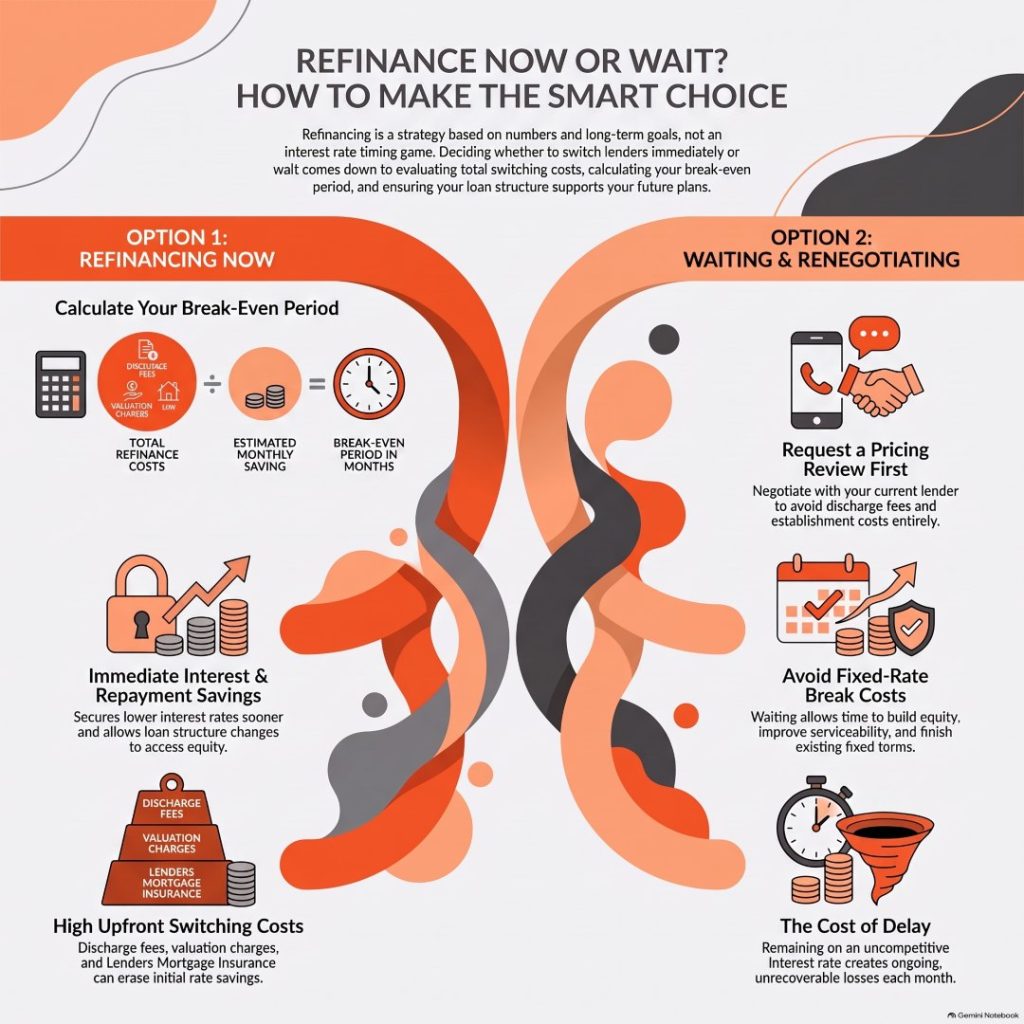
A noticeably lower advertised rate can create pressure to act. Every month you delay may appear to cost money, while headlines suggest rates could move again.
That pressure can lead to two common mistakes: refinancing too quickly or waiting indefinitely for the perfect rate. The better approach is to treat your home loan as part of your broader financial and property strategy.
1. Is Your Current Mortgage Rate and Loan Structure Competitive?
Start by comparing your existing interest rate, fees and features with genuinely comparable loans.
Long-term customers can sometimes pay a loyalty tax because their lender has not automatically moved them to a sharper rate. Before refinancing, ask your lender for a formal pricing review. Providing a comparable offer may help you negotiate a lower rate without paying discharge, valuation or establishment costs.
Do not compare rates alone. Check whether each loan provides:
- An offset account
- Free redraw
- Additional repayment flexibility
- Interest-only options, if relevant
- Suitable fixed and variable splits
- Competitive package or annual fees
Mortgage refinance rates 2026 vary according to the loan-to-value ratio, occupancy type, repayment structure and borrower profile. The advertised rate may not be the rate you receive.
2. What Are You Trying to Achieve by Refinancing?
Mortgage refinance should solve a defined problem. Your objective may be to:
- Reduce monthly repayments
- Pay off your mortgage sooner
- Consolidate expensive personal debt
- Access usable equity
- Build a financial buffer
- Change between fixed and variable repayments
- Improve borrowing capacity for another property
Consider homeowners planning to purchase an investment property within 18 months. The lender with the lowest advertised rate might assess rental income conservatively or restrict a future equity release. A slightly higher rate with a more suitable lending policy may preserve significantly more borrowing flexibility.
If accessing equity is your objective, compare the long-term risks of an equity release or cash-out refinance rather than focusing only on the cash available today.
3. How Much Does It Cost to Refinance a Mortgage?
Refinancing makes financial sense only when the likely benefits outweigh the complete cost of switching.
Australian refinance costs and refinance closing costs may include:
- Existing lender discharge fees
- Government registration charges
- New loan application or settlement fees
- Property valuation fees
- Annual package fees
- Fixed-rate break costs
- Lenders Mortgage Insurance, if required
Lenders Mortgage Insurance may apply when the new loan exceeds 80 per cent of the lender’s property valuation. This cost can erase years of modest interest savings.
Cashback offers may cover some costs, but they should not determine your choice. Compare the loan’s ongoing rate, revert pricing, fees and flexibility after the cashback has been spent.
4. What Is Your Refinance Break-Even Point?
Your refinance break-even point estimates how long it will take for your savings to recover the switching costs.
Use this calculation:
Total refinance costs ÷ estimated monthly saving = break-even period
For example, if refinancing a $700,000 loan could save $230 per month and switching costs total $1,800, the simple break-even period would be approximately eight months.
Also account for:
- Changes to annual fees
- Lost offset benefits
- Cashback conditions
- Fixed-rate break costs
- Changes to the remaining loan term
- Possible future rate movements
Be cautious if a lender reduces your repayment by restarting the loan over 30 years. A lower repayment may feel like a saving while extending your debt and increasing the total interest paid.
5. Will the New Lender Support Your Future Property Strategy?
A competitive rate today may not support what you want to do tomorrow. Lending policies can differ for:
- Investment properties
- Apartments and dual-income homes
- Cash-out and equity releases
- Self-employed income
- Trust or company borrowers
- Interest-only repayments
- Multiple-property portfolios
If your next goal is purchasing an investment property, assess the lender’s policies as carefully as its price. The most appropriate loan should support your next move, not simply win an online rate comparison.
6. Will You Qualify Before You Apply?
Refinancing requires a fresh assessment of your income, expenses, debts, credit history and property value.
Lenders use serviceability buffers and may assess bonuses, overtime, rental income and self-employed earnings differently. Credit card limits can also reduce borrowing capacity, even when the balance is zero.
Avoid making multiple speculative applications because each application may create a credit enquiry. A mortgage broker can compare lending policies and model your serviceability before submitting an application.
7. Is Refinancing Better Than Fixing or Renegotiating?
Changing lenders is not your only option. You may be able to:
- Negotiate a lower rate with your existing lender
- Restructure your current loan
- Fix part or all of the balance
- Use a split loan combining fixed and variable rates
Recently, I helped a client uncross-collateralise her properties and review her refinance options. Although refinancing suited her longer-term strategy, I advised her not to rush because her fixed rate was highly competitive and breaking the contract would mean losing significant financial benefits. It reinforced advice I give clients and follow myself: get all the facts from your lender before making a major change.
A split loan may provide some repayment certainty while retaining features such as an offset account and additional repayments. Compare the potential savings and flexibility before committing to a complete refinance.
Refinancing Now vs Waiting: Pros and Cons
Pros of Refinancing Now
- You may reduce interest and repayments sooner.
- You can replace an unsuitable loan structure.
- You may access equity for a planned investment.
- You can obtain features that support your strategy.
Cons of Refinancing Now
- Switching costs may exceed your savings.
- The new lender may limit future borrowing.
- Extending the term may increase total interest.
- Your application may not satisfy current lending criteria.
Pros of Waiting
- You can improve your equity and serviceability.
- You may avoid substantial fixed-rate break costs.
- Your lender may offer a competitive retention rate.
- You have time to prepare your finances.
Cons of Waiting
- You may continue paying an uncompetitive rate.
- Delayed savings cannot always be recovered.
- Your property value or borrowing position could change.
- Indecision may delay an important financial goal.
Compare the True Cost Over Three to Five Years
Your refinance mortgage checklist should include a three-to-five-year comparison.
| Decision factor | Current loan | Proposed loan |
| Interest rate | Record actual rate | Record approved rate |
| Fees | Include all fees | Include all fees |
| Switching costs | $0 | Include complete costs |
| Remaining term | Confirm years left | Avoid unnecessary extension |
| Loan features | Value what you use | Identify what changes |
| Future flexibility | Review current policy | Test against future goals |
This comparison can expose offers that appear attractive in the first year but become more expensive when introductory pricing ends or valuable features disappear.
Conclusion: Make the Decision With Your Full Strategy in View
Refinancing can be valuable when it creates measurable savings, supports your next property decision and pays for itself within a sensible period. Waiting can also be strategic when the costs, qualification risks or lender restrictions do not stack up.
Before applying, compare both options using your actual balance, remaining term and future goals. You can also use the Investors Choice Mortgages Hub tools, including the Mortgage Stress Test and Fix or Float Assessor, to help assess your options.
If you’re considering refinancing and want to understand which option best supports your financial and property goals, book a strategy call with us.
Frequently Asked Questions
Should I refinance my mortgage if my rate drops by 0.5 per cent?
A 0.5 percentage point reduction may produce meaningful savings on a large balance, but there is no universal refinance trigger. Calculate the monthly saving, deduct every switching cost and confirm that the proposed loan supports your future plans.
How do I calculate my refinance break-even point?
Divide your total switching costs by your expected monthly saving. For example, $2,000 in costs divided by $250 in monthly savings produces an eight-month break-even point. Include annual fees, break costs and the value of any features you may lose.
Is now a good time to refinance my mortgage?
It may be a good time if your existing loan is uncompetitive, you qualify with another lender and the savings exceed the costs within your expected holding period. Your personal numbers and property strategy should carry more weight than market forecasts.
Can I refinance a fixed-rate home loan?
Yes, but your lender may charge a fixed-rate break cost. Request a written estimate before applying elsewhere. Refinancing may also affect your credit score and borrowing capacity because the new lender will reassess your income, expenses, debts and credit history.