

A bank property valuation checks whether a property provides acceptable security for the home loan being requested. During the process, the lender may use property data, comparable sales, an automated valuation model, a desktop valuation, a kerbside review or a full internal inspection before assigning a value. What happens during a bank property valuation can affect your loan-to-value ratio, deposit requirements, lenders mortgage insurance and final loan approval. Understanding how banks assess value, how long a bank valuation takes and what happens if the bank valuation is lower than the purchase price can help you respond and protect your plans.
Key Takeaways
- A bank valuation protects the lender rather than confirming the best possible sale price.
- The valuer considers comparable sales, location, land, condition and marketability.
- The lender may order an automated, desktop, kerbside or full valuation.
- A low result may require a larger deposit, renegotiation or another lending strategy.
- Your mortgage broker can coordinate the process and present relevant supporting evidence.
Buying a home or investment property can feel exciting until your broker says, “The bank needs to value it.”
If you have negotiated a price, signed a contract and imagined receiving the keys, that sentence can create immediate uncertainty. Will someone inspect every room? Could the bank reject the property? What happens if the figure is lower than the price you agreed to pay?
A property valuation for a home loan is a normal part of many applications. Understanding its purpose can help you make informed decisions without unnecessary stress.
Why Does a Bank Value a Property?
A bank values a property to confirm that the asset securing its loan is worth enough to manage its lending risk.
If a borrower cannot make the repayments and the property must be sold, the lender wants reasonable confidence that the sale proceeds could cover the outstanding debt. This is why a bank valuation can be more conservative than an owner’s expectations or a real estate agent’s appraisal.
The valuation does not replace the lender’s assessment of your income, expenses, credit history and borrowing capacity. Two requirements must be satisfied:
- You must demonstrate that you can service the loan.
- The property must provide acceptable security.
If you are still establishing your budget, review how much mortgage you can afford based on your salary.
How Does a Bank Value a Property?
The exact bank property valuation process varies between lenders, properties and applications.
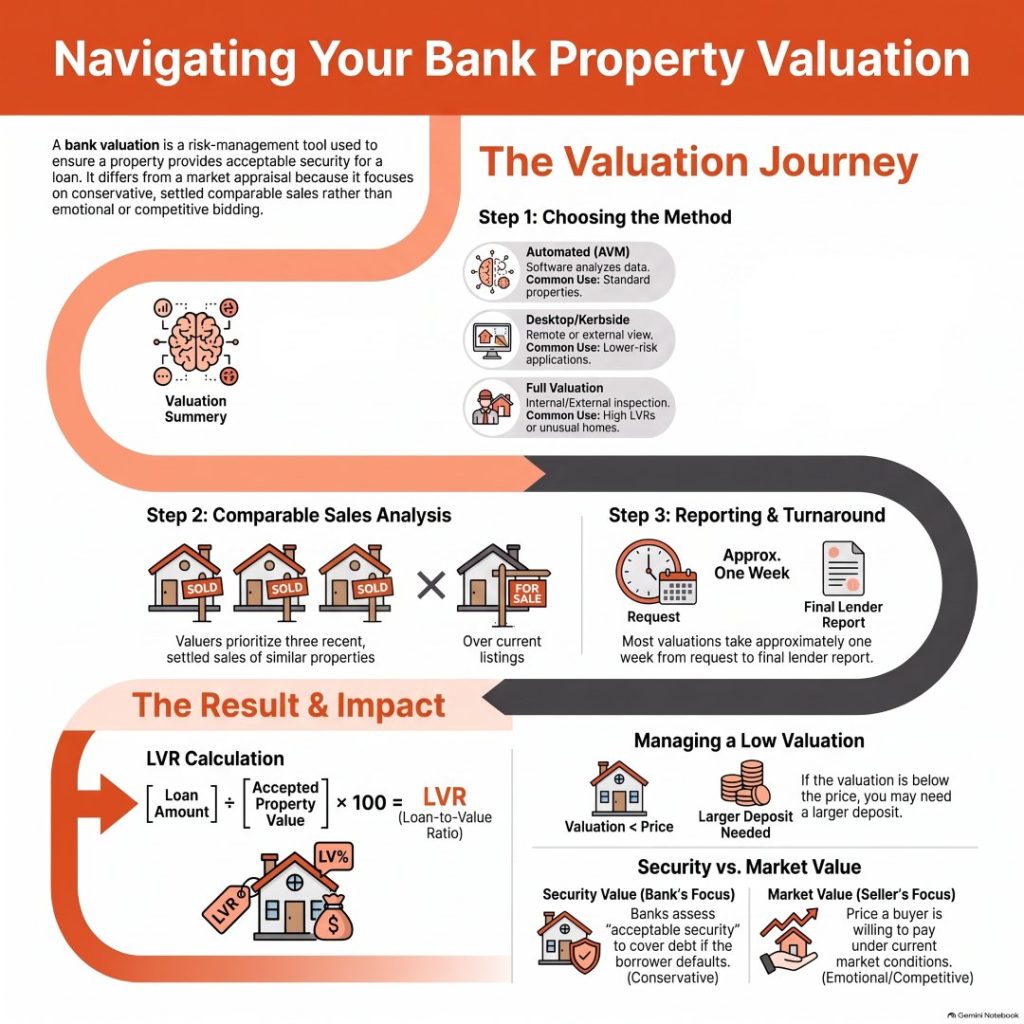
1. The lender reviews the application
The lender considers the purchase price, requested loan amount, location, property type and loan-to-value ratio, commonly called LVR.
Loan amount ÷ accepted property value × 100 = LVR
For a purchase, lenders commonly calculate the available loan against the lower of the contract price or accepted valuation. Policies vary, so your broker should confirm how the chosen lender will assess the transaction.
2. The lender selects a valuation method
A conventional property with a lower LVR may only require an automated or desktop valuation. A higher-risk application, unusual dwelling, limited-sales location or highly leveraged loan may require a physical inspection.
The lender normally appoints an independent valuer who reports to the lender, rather than advocating for the buyer, seller or agent.
3. The valuer researches comparable sales
The valuer examines recent settled sales of similar properties, considering:
- Land and building size
- Property type and accommodation
- Age, condition and renovation standard
- Location and street appeal
- Parking and additional features
- Sale date and current market conditions
4. The property may be inspected
During a full valuation, the valuer confirms the property’s layout, condition, construction, improvements and marketability. They may take photographs and measurements.
This is not a building and pest inspection. The central question is: What would this property reasonably sell for in the current market?
5. The lender receives the report
The report may identify risks such as structural concerns, incomplete construction, zoning issues, unusual improvements or limited buyer demand. The lender can then approve the property, reduce the available loan or request more information.
See the loan process and what to expect for broader context.
Types of Bank Property Valuation
| Valuation type | What happens | Common use |
| Automated valuation model | Software uses property and sales data to estimate value. | Standard properties with reliable data |
| Desktop valuation | A valuer reviews available data without visiting. | Lower-risk applications |
| Kerbside valuation | The valuer views the property externally. | When external confirmation is sufficient |
| Full valuation | The property is inspected internally and externally. | Higher LVRs, unusual properties or limited data |
Borrowing above 80 per cent LVR may lead to closer assessment and could affect lenders mortgage insurance, but it does not automatically determine which valuation method will be used.
Desktop Valuation vs Full Valuation
A desktop valuation can be faster and does not require access, but recent renovations or unusual features may not appear in available data.
A full valuation allows the valuer to verify improvements and internal condition. However, access must be arranged, the process may take longer and an inspection does not guarantee a higher figure.
How Should You Prepare for a Full Valuation?
Present the property as though a genuine buyer were arriving. Good presentation will not manufacture value, but clear access helps the valuer assess the property accurately.
Before the appointment:
- Clean and declutter the property.
- Complete minor unfinished repairs where practical.
- Make every room and outdoor area accessible.
- Prepare a concise list of completed renovations.
- Include approvals for significant structural work.
- Gather recent, genuinely comparable settled sales.
Three strong comparable sales are generally more useful than numerous unrelated listings. Your broker can help provide relevant evidence without turning the inspection into a sales presentation.
Bank Valuation vs Market Value
A bank valuation, sale price and real estate appraisal can differ because they serve different purposes.
An agent may estimate what buyers could pay during a competitive campaign. A buyer may offer more because the property suits their needs or several parties are bidding. A bank valuer takes a risk-focused approach supported primarily by settled comparable sales.
This does not necessarily mean one figure is wrong. Emotion, competition and future expectations may influence the purchase price more than the lender’s security assessment.
What If the Bank Valuation Is Lower Than the Purchase Price?
A bank valuation lower than the purchase price can reduce the amount the lender is prepared to advance.
For example, you agree to pay $800,000 and request an 80 per cent loan of $640,000. If the bank accepts a value of $760,000, an 80 per cent loan would be $608,000. You may need another $32,000, plus purchasing costs.
I remember working on a property purchase in Western Australia where the bank valuation came in $70,000 below the accepted offer. Seeing such a large gap in black and white was confronting for the buyer, especially after they had already become emotionally invested in the property. It was a powerful reminder that an accepted offer and a lender’s valuation are not always the same, and that having a finance clause, a cash buffer and a clear backup plan can make an enormous difference when the numbers do not line up.
Your options may include:
- Checking the report for factual errors.
- Providing stronger recent comparable sales.
- Renegotiating the purchase price.
- Increasing your deposit or using available equity.
- Considering another lender, without assuming its valuation will be higher.
- Relying on a finance clause to withdraw, subject to legal advice.
Pre-approval does not guarantee formal approval because the property must still satisfy the lender. Learn how long mortgage pre-approval lasts in Australia.
How Long Does a Bank Valuation Take?
An automated or desktop assessment may be completed quickly. A physical inspection can take several business days to arrange, with the report sometimes returned within one or two business days after inspection.
Allowing approximately one week is a practical guide, although regional properties, unusual dwellings, access delays and busy periods can extend the bank valuation turnaround time.
Conclusion: Make the Valuation Part of Your Finance Strategy
A bank property valuation can change your LVR, deposit requirement, lenders mortgage insurance and ability to complete a purchase. Understanding your numbers before signing and using suitable contract protections can help you prepare for a conservative result.
For personalised guidance with your loan structure, valuation process and lender options, visit the Investors Choice Mortgages Hub. Our tools and expert support can help you understand the result and identify your next practical step with greater clarity and confidence.
Frequently Asked Questions
How Much Does a Bank Property Valuation Cost in Australia?
Many lenders cover the cost of a standard valuation. Where a fee applies, a property valuation may cost approximately $200 to $600, depending on the property, location and inspection type. Confirm any fee with your lender or broker before proceeding.
How Long Does a Bank Valuation Take After the Inspection?
A straightforward report may be returned within one or two business days after inspection, although the complete process can take approximately one week. Complex properties, access delays or requests for additional evidence may extend the timeframe.
Can I Challenge a Bank Valuation That Is Too Low?
You can request a review, but you will generally need to identify a factual error or provide stronger recent comparable sales. A valuer is not required to change the result simply because the purchase price or owner’s expectation is higher.
Does a Clean House Increase the Bank Valuation?
Cleaning alone is unlikely to increase the underlying value. However, an accessible, well-presented property helps the valuer assess its condition accurately. Completed repairs, approved renovations and documented improvements are generally more relevant than cosmetic styling.