
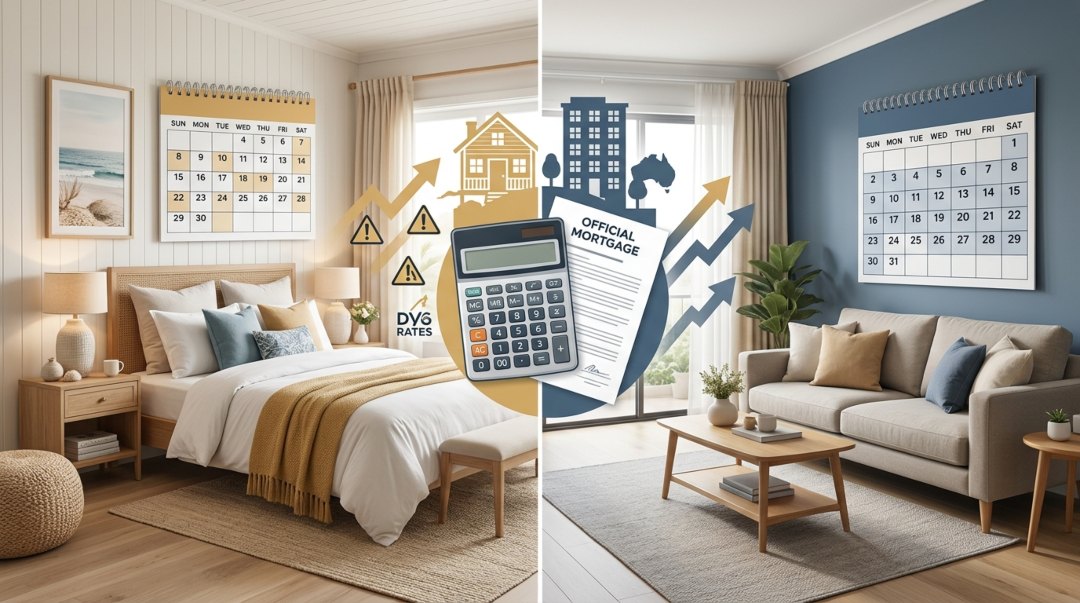
Choosing Airbnb vs long term rental for your investment property is not as simple as the headline income figures suggest. For most Australian investors, a long-term rental delivers more predictable cash flow, simpler management, and – critically – stronger recognition from lenders when assessing your borrowing power. Short-term rentals can outperform on gross income in the right location, but the hidden costs, regulatory pressures, and the way banks treat that income all change the equation. The decision ultimately comes down to your investment strategy, your location, your financial goals, and what you plan to do next with your portfolio.
Key Takeaways
- The average Australian Airbnb host earns around $48,760 gross per year, but average occupancy sits at just 53% – meaning your property could sit empty for almost half the year.
- Short-term rental income is typically assessed at a 30-40% discount by lenders when calculating your borrowing capacity, which can significantly reduce your ability to fund your next property.
- Long-term rentals offer financial stability, lower management costs, and stronger lender recognition – making them the better foundation for portfolio growth.
- Short-term letting works best for well-located holiday properties where demand is consistent and the investor does not rely on that income to qualify for future loans.
- 2026 regulatory changes – including state-based caps, levies, and strata by-law restrictions – are adding new layers of complexity and cost to the short-term rental model.
Is Airbnb Worth It for an Investment Property in Australia?
When Rita and her husband first started thinking seriously about property investment, they did what most people do. They opened up a short-term rental platform, looked at a holiday apartment near a popular coastal town, ran the numbers on potential nightly rates, and thought: this seems obvious.
And on the surface, it does. A beachside property earning $350 a night sounds considerably more attractive than one renting for $550 a week to a long-term tenant. But that surface-level comparison is where a lot of investors go wrong – because the two income streams are not measured the same way, managed the same way, taxed the same way, or treated the same way by banks.
Short-term letting through platforms like Airbnb, Vrbo, and Stayz has transformed property investment in Australia over the past 15 years. There are now between 100,000 and 350,000 short-term rental properties listed across the country, with homes making up around 85% of those listings. That growth tells you there is money to be made. But it also tells you the market has become crowded – and competition, as any investor knows, compresses returns.
Before you list your investment property, here is what the numbers actually look like once all the variables are on the table.
What the Short-Term Rental Income Data Actually Shows
The average annual revenue for Australian Airbnb hosts is approximately $48,760 gross. That is a meaningful passive income figure – but “gross” is doing a lot of heavy lifting in that sentence.
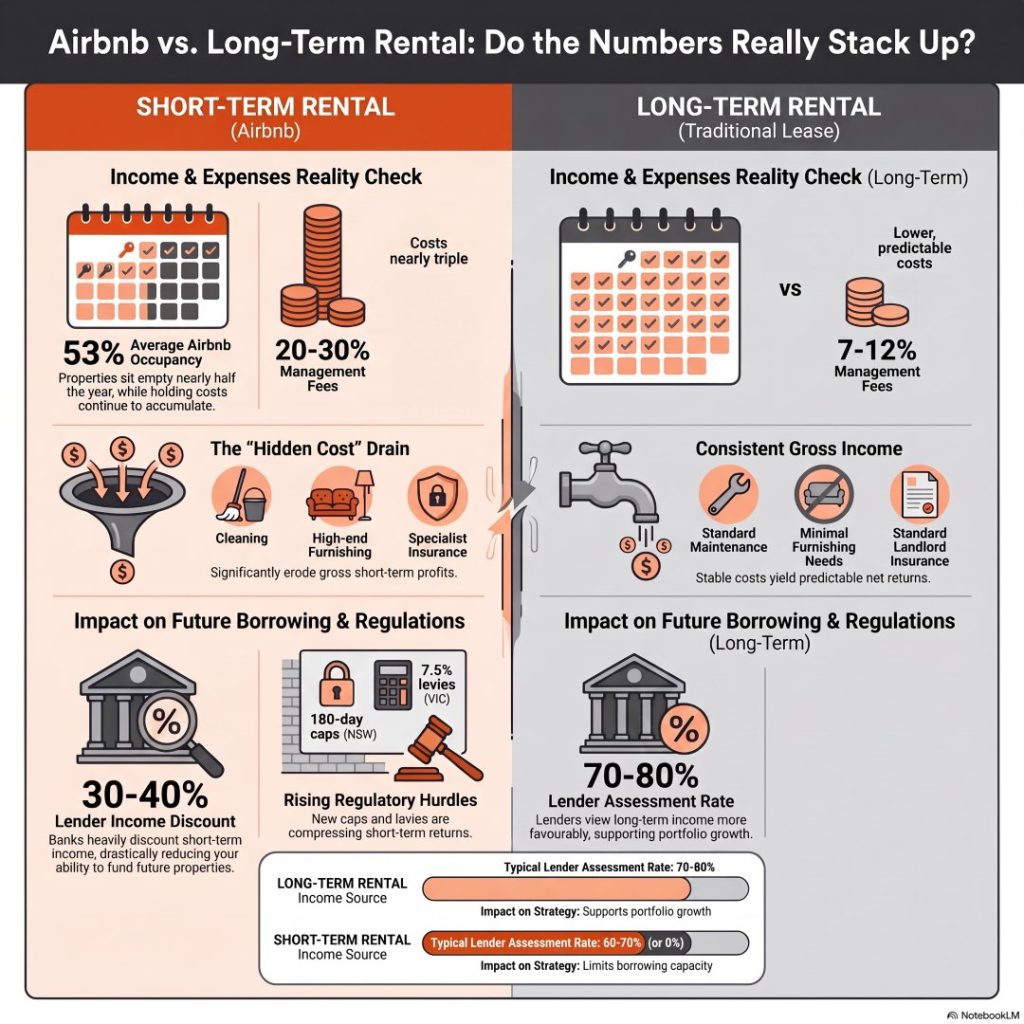
The national average occupancy rate for short-term rentals in Australia sits at around 53%. That means for nearly half the year, your property is vacant and generating nothing, while your mortgage, rates, insurance, and body corporate fees continue to accumulate regardless.
Compare that to a quality long-term rental in a suburb with a tight vacancy rate. Your income is not interrupted by seasonal demand, school holiday calendars, or the fact that a new complex just listed 40 apartments on the same platform at 15% less than you charge per night.
The gross income from short-term letting can absolutely exceed long-term rental income. In some markets – popular coastal locations, inner-city event hubs, high-demand regional towns – it can exceed it significantly. But net income, after all expenses are stripped out, often tells a very different story.
I know this conversation well, because I have had it with myself. A few years ago, I sat down with a specialist short-term rental provider – someone who listed properties across multiple platforms and had the occupancy data to back up every claim – and I seriously considered converting one of my long-term investment units. The income projections looked genuinely compelling. But the moment I started factoring in the cleaning costs after every single turnover, the higher management fee structure, the specialist insurance, and what my lender would actually count as assessable income, the gap between the gross figure and the net reality became very clear, very quickly. What had looked like an upgrade to my yield was, for that particular property – a solid but unremarkable brick unit – closer to a lateral move with significantly more work attached. It actually reminded me of something that happened back in 2002, long before Airbnb existed, when my husband and I furnished one of our Sydney units between tenancies to earn a premium on the rent. It worked brilliantly for that property. When we looked at scaling the idea by taking head leases on other properties and subletting them furnished, we hit an immediate wall – no insurer in Australia would cover a non-owner subletting arrangement. The strategy was innovative. The insurance market had not caught up. That experience taught me something I still apply today: the difference between a strategy that sounds good and one that holds together under the weight of actual costs, actual risk, and actual lender scrutiny is everything.
The Hidden Costs of Airbnb That Eat Into Your Profit
This is the section most comparison articles skip – and it is where short-term letting strategies quietly underperform.
Managing a short-term rental property comes with a category of expenses that long-term landlords rarely encounter:
- Platform commissions: Airbnb typically charges hosts between 3-5% of each booking, with some structures pushing higher.
- Professional cleaning between every stay: A professional clean for a two-bedroom property can cost $120-$250 each time. At reasonable occupancy, that adds up to several thousand dollars annually.
- Higher wear and tear: Guests turning over every few days put more physical stress on appliances, furniture, linen, and fittings than long-term tenants who treat the property as home.
- Furnishing and ongoing replacement costs: Short-term rentals must be fully furnished and styled to a competitive standard. Quality furnishings represent a significant upfront investment and an ongoing replacement cycle.
- Higher insurance premiums: Standard landlord insurance does not cover short-term letting. Specialist short-term rental insurance costs considerably more – and some insurers exclude certain damage scenarios entirely.
- Management fees: If you use a professional property manager for your short-term rental, expect to pay 20-30% of gross revenue, compared to 7-12% for a long-term property management arrangement.
When you add these costs together and subtract them from that $48,760 gross figure, the net rental yield can fall well below what a comparable long-term rental would have produced – with significantly less complexity. Understanding the 3 ways to make money with a property and which costs apply to each strategy is essential before you commit to a direction.
The Borrowing Power Problem Nobody Talks About
This is the factor that separates a sound short-term rental strategy from a strong long-term investment strategy – and it is almost entirely absent from mainstream comparisons.
When you apply for your next investment property loan, your lender will assess your income to determine how much you can borrow. For long-term rental income, most lenders accept 70-80% of the rental amount as assessable income – a reasonable and fairly consistent standard across the market.
For short-term rental income, the assessment is very different. Because it is volatile, seasonal, and unguaranteed, most lenders either discount it heavily – applying a 30-40% reduction on top of their standard assessment – or exclude it from their income calculation altogether.
That distinction has a real impact on your property investment journey. Imagine you are earning $50,000 gross from your Airbnb property. A lender might assess only $30,000-$35,000 of that as usable income. A long-term tenant paying $750 per week would produce $39,000 annually, and a lender might assess $27,000-$31,000 of that. The difference between the two assessable incomes is smaller than the headline figures suggest – and the long-term rental comes with far less operational complexity.
If growing a property portfolio is your goal, the way your income is structured today directly affects how much you can borrow tomorrow. This is a conversation worth having with a specialist mortgage broker before you commit to a rental strategy. You can explore how to improve your borrowing capacity for property investment and understand the full picture of how lenders assess your financial position.
Short-Term Rental Regulations in Australia: The 2026 Reality Check
The regulatory landscape for short-term rentals in Australia has shifted significantly – and it continues to move. Investors who entered the short-term market three or four years ago under one set of rules may find their 2026 position looks quite different.
- NSW has implemented 180-day annual caps on short-term letting in certain areas, which limits the earning window even in strong markets.
- Victoria introduced a 7.5% short-stay levy on short-term rental revenue in 2025, directly reducing net returns.
- Western Australia now requires short-term rental registration, adding administrative obligations.
- Council restrictions are becoming more common nationally, with some local governments moving to cap short-term listings in response to housing affordability concerns.
- Strata by-laws remain one of the most overlooked risks for apartment investors. Owners’ corporations in many buildings have the power to restrict or ban short-term letting entirely – and this can happen after you have already purchased.
Before committing to a short-term rental strategy, verify what applies in your specific location. What is permissible today may be restricted in twelve months.
Airbnb vs Long-Term Rental: When Does Each Strategy Make Sense?
The right answer depends on where your property is, what your goals are, and what your broader financial picture looks like.
Pros of Short-Term Rental (Airbnb, Vrbo, Stayz)
- Higher gross income potential in premium holiday or event locations
- Flexibility to use the property yourself when it is unbooked
- Can outperform long-term yields significantly in high-demand markets
- Potential for strong capital growth in sought-after holiday destinations
Cons of Short-Term Rental
- Seasonal income gaps and an average occupancy rate of just 53%
- Significantly higher ongoing costs (cleaning, management, insurance, furnishings)
- Lender income shading of 30-40% reduces your ability to borrow for future purchases
- Growing regulatory exposure through state levies, council caps, and strata restrictions
- More management-intensive – the opposite of a passive investment
Pros of Long-Term Rental
- Predictable, consistent income that lenders assess more favourably
- Lower management costs, less wear and tear, and simpler oversight
- Stronger borrowing capacity support for portfolio growth
- Less regulatory exposure and better alignment with landlord tenancy protections
Cons of Long-Term Rental
- Lower gross income ceiling compared to well-performing short-term properties
- Less flexibility – a lease locks in your arrangements for 12 months or more
- Subject to vacancy risk if tenants leave and the local market is slow
- Rent increases governed by tenancy legislation, not market demand
How to Choose: Start With Your Investment Strategy
Your property investment strategy should drive the rental decision – not the other way around.
If cash flow is your primary objective, crunch the net numbers honestly. What does your property earn after all short-term expenses are removed? How does that compare to a realistic long-term rental income in the same area? Are you comfortable managing a higher-maintenance asset?
If your goal is to grow a portfolio over time, long-term rental income almost always supports that ambition more effectively. The consistent income, lower costs, and stronger lender recognition give you a better platform to access your next investment property loan in Australia when the opportunity arises.
If capital growth is your focus in a genuine holiday destination, short-term letting may be worth exploring – but complete full due diligence on costs, local regulations, and strata rules before you commit.
Conclusion
The comparison between Airbnb and long-term rental is not really a debate about which earns more per night. It is a question of which strategy actually advances your financial goals when you account for costs, risk, regulation, and your ability to keep building.
For most Australian investors building a property portfolio, long-term rental delivers more predictable returns, stronger lender support, and less operational complexity. Short-term letting has its place – particularly in the right location with the right risk tolerance – but it rarely performs as well as the headline income figures suggest.
Whatever direction you are considering, the smartest first step is understanding your full financial position, including how your rental strategy affects your borrowing power. Visit the Investors Choice Mortgages Hub for tools and resources built for Australian property investors – including AI-powered calculators, a Portfolio Profiler, and expert guidance to support every stage of your property journey. Explore your options, run the numbers, and take the next step with confidence.
Frequently Asked Questions
Is Airbnb more profitable than long-term rental in Australia?
Airbnb can produce higher gross income than long-term rental in well-located markets, but net profitability is often lower once cleaning, management fees, insurance, furnishings, and platform commissions are deducted. The average Australian Airbnb host earns around $48,760 gross annually at an average occupancy of just 53%, which means careful cost analysis is essential before assuming short-term letting is the better option.
Does Airbnb income count towards a mortgage application in Australia?
Yes, but it is assessed differently to long-term rental income. Most Australian lenders apply a significant discount to short-term rental income – typically accepting only 60-70% of what they would accept for a long-term lease – because of its volatility and seasonal nature. Some lenders exclude it from their income assessment altogether. This reduced recognition can meaningfully lower your borrowing capacity when applying for your next investment property loan.
What are the hidden costs of running an Airbnb investment property?
The main hidden costs include professional cleaning after every guest stay, higher property management fees (20-30% of gross revenue versus 7-12% for long-term rentals), specialist short-term insurance, increased wear and tear, ongoing furnishing replacement, and platform commissions. In markets with state levies – such as Victoria’s 7.5% short-stay charge – these costs compound further and can erode the apparent income advantage significantly.
Can strata or council rules stop me from renting my property on Airbnb?
Yes. Owners’ corporations have the power to restrict or ban short-term letting in apartment buildings through by-laws, and many have done so. Local councils in NSW, Victoria, and other states are also introducing caps – such as NSW’s 180-day annual limit in certain areas – that restrict how long you can list a property on short-term platforms. Always verify the rules that apply to your specific property and local council area before committing to a short-term rental strategy.