

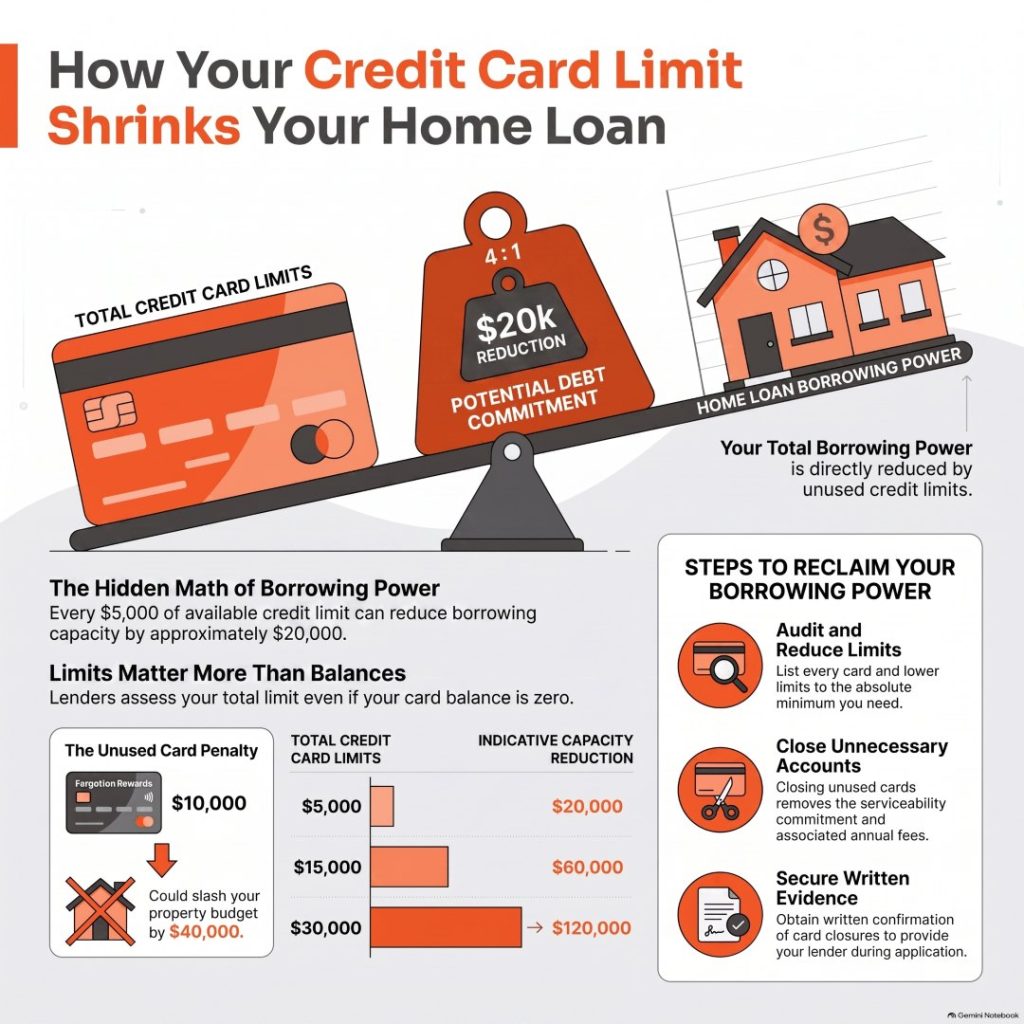
Credit card limits can reduce your home loan borrowing capacity even when the balance is zero. As a general guide, every $5,000 of available credit may reduce borrowing capacity by approximately $20,000, although the result varies between lenders and applicants. Lenders account for the debt you could access, not simply what you owe today. Reducing unnecessary limits before applying can therefore improve your position, but it should form part of a complete serviceability review.
Key Takeaways
- Lenders generally assess your total credit limit, not only your outstanding balance.
- A $5,000 limit may reduce borrowing capacity by approximately $20,000.
- Multiple unused cards can create a significant serviceability commitment.
- Reducing a limit may be enough if you still need a card for essential spending.
- Always confirm the likely result before closing an account or applying for credit.
Why Do Lenders Assess Your Credit Card Limit Instead of Your Balance?
Lenders assess your credit card limit because you could use the available credit after receiving home loan approval.
Imagine you are a first home buyer who pays a card with a $10,000 limit in full every month. From your perspective, you have no credit card debt. From the lender’s perspective, you could spend the entire $10,000 tomorrow and become responsible for another monthly repayment.
That potential repayment affects serviceability. This is the lender’s assessment of whether you can afford the proposed mortgage alongside your existing debts, living expenses and other financial commitments.
A clean balance does not automatically produce the strongest home loan application. Understanding your overall borrowing capacity requires you to consider available credit, personal loans, dependants and living expenses together.
How Much Does a Credit Card Reduce Borrowing Capacity?
As an indicative guide, every $5,000 of credit card limit may reduce your borrowing capacity by approximately $20,000.
This four-to-one relationship is not a universal lender formula. The actual credit card impact on a mortgage application in Australia depends on your income, expenses, existing debts, loan term and the lender’s serviceability policies.
| Total credit card limits | Indicative borrowing capacity reduction |
| $5,000 | $20,000 |
| $10,000 | $40,000 |
| $20,000 | $80,000 |
| $30,000 | $120,000 |
| $80,000 | $320,000 |
For example, a buyer who might otherwise qualify to borrow $600,000 could potentially see that amount fall to around $560,000 because of an unused $10,000 credit card limit.
That $40,000 difference could affect the buyer’s choice of property, ability to cover purchasing costs or readiness to enter the market.
Why Can Several Small Credit Cards Become a Major Problem?
Several small limits are assessed together. This means forgotten or unused cards can quietly weaken an otherwise strong application.
You may have:
- A $6,000 everyday card
- A $4,000 rewards card
- A $3,000 emergency card
- A $2,000 store card
Together, these cards provide a $15,000 limit. Using the indicative guide, they could reduce your borrowing capacity by approximately $60,000.
Buy now, pay later accounts and other revolving credit facilities may also affect credit card debt and home loan approval. Treatment varies between lenders, so disclose every liability accurately.
These commitments will usually appear in your statements or credit report. Completing a home loan documents checklist early can help you identify issues before applying.
I once worked with a family carrying $50,000 in credit card debt. When they came to me, they had lost hope that home ownership was possible. We negotiated settlements, broke their reliance on credit and reset how they managed money. It was not an overnight fix, but they eventually bought a home and later built a multi-million-dollar business. Their journey reinforced a lesson I have seen repeatedly: credit cards are not harmless background paperwork. Whether debt is owing or credit is simply available, each facility can affect the choices a lender believes you can afford.
Should You Reduce or Close Credit Cards Before Applying?
Reducing your credit card limit before a home loan application is often sensible, but the right approach depends on how you use the card.
Review your credit cards step by step
- List every facility. Include unused, store and supplementary cards.
- Add the limits together. Do not focus only on outstanding balances.
- Pay down existing debt. Reducing a limit does not remove money already owed.
- Keep only what you reasonably need. Large emergency limits can reduce serviceability.
- Request written confirmation. Obtain evidence of every reduction or closure.
- Allow time for records to update. Changes may not appear immediately.
- Recalculate your position. Ask a mortgage broker to compare lender assessments.
If you need a card for travel, online purchases or monthly bills, reducing the limit may be more practical than closing it. If a card has no clear purpose, closure may remove both the serviceability commitment and annual fee.
Avoid applying for replacement cards, personal loans or interest-free finance while preparing for pre-approval. A new application may create a credit enquiry and change the position used for your assessment.
You can also explore other strategies to improve your borrowing capacity.
Pros and Cons of Keeping High Credit Card Limits
Pros
- Provides short-term emergency flexibility
- May support necessary travel or business expenses
- Can offer rewards when balances are cleared monthly
- Avoids needing to apply for credit later
Cons
- Can reduce home loan borrowing power
- Creates easy access to expensive unsecured debt
- May attract unnecessary annual fees
- Can reduce your available property budget
Pros and Cons of Reducing or Closing Credit Cards
Pros
- May improve assessed borrowing capacity
- Makes financial management simpler
- Can remove annual fees
- Reduces the risk of overspending
Cons
- Leaves less credit available for emergencies
- Restoring a higher limit may require another application
- Closing a rewards card may remove useful benefits
- Updates may not appear on your credit report immediately
What Else Determines Your Home Loan Borrowing Power?
Credit cards are only one part of a lender’s calculation. Reducing a limit will not guarantee approval or automatically provide the full indicative increase.
Lenders may also consider:
- Salary and acceptable additional income
- Living expenses and dependants
- Personal, car and student loans
- Existing mortgages and rental income
- Loan term and proposed repayment type
- Interest-rate serviceability buffers
- Employment stability and credit conduct
- Individual lender policies
The objective should not be to borrow the maximum possible amount. It should be to establish a comfortable purchasing range with room for rate changes, repairs and unexpected costs.
Once your finances are organised, an approval in principle can provide a more realistic guide before you make an offer.
Conclusion: Take Control Before You Apply
An unused credit card may appear harmless, but its limit could reduce your property budget by tens of thousands of dollars. Review every facility, remove limits you no longer need and assess your position across suitable lenders.
Most importantly, focus on a loan you can comfortably manage over the long term, not simply the highest amount available.
For practical calculators and resources to help you understand your borrowing position, visit the Investors Choice Mortgages Hub before submitting a formal application.
This article provides general information only. Lending outcomes depend on your circumstances and the policies applied at the time of assessment.
Frequently Asked Questions
Does an unused credit card affect my home loan borrowing power?
Yes. Lenders generally include the approved limit in their serviceability assessment, even when the balance is zero, because you could access the credit after approval.
How much does a $10,000 credit card limit reduce borrowing power?
A $10,000 limit may reduce borrowing capacity by approximately $40,000 under the indicative four-to-one guide. The actual result depends on your circumstances and lender.
Should I pay off, reduce or close my credit card before applying for a mortgage?
Paying off the balance can improve cash flow, but the approved limit may still affect borrowing capacity. Reducing the limit may be appropriate if you need the card. Closing an unnecessary card may remove the full commitment.
How long after closing a credit card should I apply for a home loan?
Wait until the provider confirms the closure and your records are updated. Timeframes vary, so retain written evidence and ask your mortgage broker whether the lender will accept it before the credit report changes.