

For many Australian homeowners, refinancing could be worthwhile now, but only when the long-term savings outweigh the costs and the new loan supports their future plans. Whether now is a good time to refinance your home loan depends on your current rate, equity, income, loan structure and financial goals. A lower advertised rate may reduce repayments, but break costs, Lenders Mortgage Insurance and restrictive lending policies can turn an attractive offer into an expensive mistake. The smartest first step may be negotiating with your existing lender before submitting a new application. A structured home loan health check can show whether refinancing offers genuine value.
Key Takeaways
- Compare total loan costs rather than choosing the lowest advertised rate.
- Ask your current lender for a pricing review before paying to switch.
- Calculate the break-even period using all refinancing costs.
- Check whether the new lender supports your future property plans.
- Confirm your eligibility before making multiple credit applications.
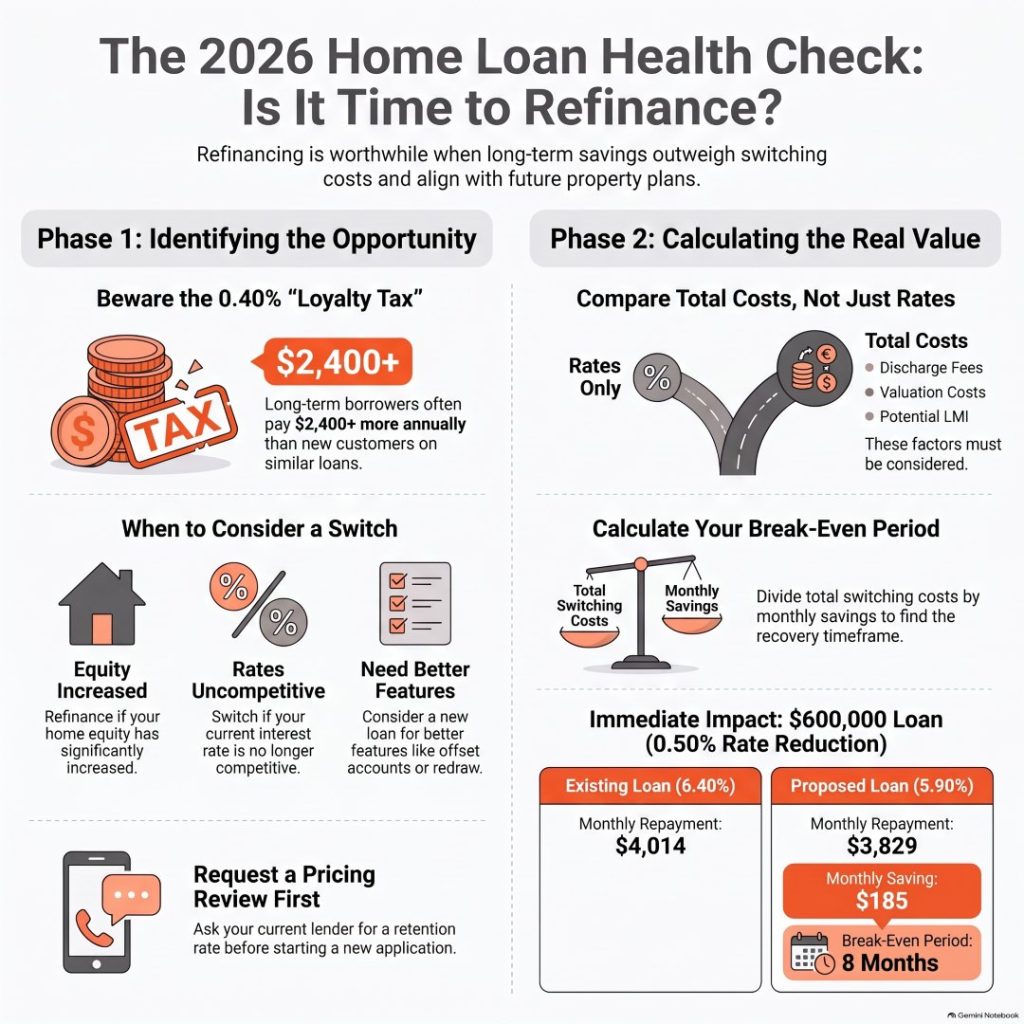
What makes refinancing worthwhile in Australia in 2026?
Home loan refinancing in Australia in 2026 is generally worthwhile when it creates a measurable financial or strategic improvement.
As at 18 September 2026, the Reserve Bank of Australia cash rate is 4.35%, with the next monetary policy update scheduled for 29 September 2026. The cash rate influences mortgage pricing, but an RBA decision should not be your only reason to refinance a home loan.
Waiting for the perfect rate could leave you paying more than necessary. Rushing to switch could also lock you into an unsuitable product. The more useful question is whether your current loan remains competitive today.
Refinancing may make sense if:
- Your interest rate is materially higher than comparable products.
- Your property value has increased and improved your loan-to-value ratio.
- You want an offset account, redraw facility or different repayment structure.
- You need to access equity for renovations or another property.
- You want to consolidate debt using a disciplined repayment plan.
- Your fixed period is ending and the revert rate is uncompetitive.
Understanding how the RBA affects variable mortgage rates can help you interpret an RBA interest rate refinance decision without letting headlines dictate your strategy.
Could you be paying a home loan loyalty tax?
You may be paying a loyalty tax if your lender offers new borrowers a better rate while leaving your existing rate unchanged.
Consider a couple with a $600,000 mortgage and a strong repayment history. If their rate is 0.40 percentage points higher than a comparable offer, that difference represents approximately $2,400 in additional annual interest before allowing for principal reductions.
Before you switch home loan lender, ask your existing lender for a formal pricing review. Have the following information ready:
- Your current rate and remaining loan term.
- Your estimated property value and outstanding balance.
- Comparable rates for similar borrowers.
- Your repayment history and other products held with the bank.
- A clear request for the best retention rate available.
This conversation may produce an immediate saving without discharge paperwork, valuation costs or another credit enquiry.
How much could changing your home loan save?
The potential saving depends on your rate reduction, balance, remaining term, fees and how long you keep the new loan.
Consider this illustrative $600,000 principal-and-interest loan with 25 years remaining:
| Scenario | Existing loan | Proposed loan |
| Interest rate | 6.40% | 5.90% |
| Approximate monthly repayment | $4,014 | $3,829 |
| Approximate monthly saving | $185 | |
| Estimated switching costs | $1,500 | |
| Approximate break-even period | 8 months |
If the borrowers retain the new loan for several years, the change may be worthwhile.
However, extending the term back to 30 years could reduce repayments while increasing lifetime interest. Compare home loan rates over the same remaining term wherever possible. Our guide to reducing monthly mortgage payments explains why a lower repayment does not always mean a cheaper loan.
What does mortgage refinancing cost in Australia?
Mortgage refinancing costs in Australia may include:
- Existing lender discharge fees
- New lender application or establishment fees
- Settlement and legal charges
- Property valuation costs
- Government registration fees
- Fixed-rate break costs
- Package or annual fees
- Lenders Mortgage Insurance
Mortgage break fees in Australia can materially affect the result for fixed-rate borrowers. Request a written break-cost estimate before making a decision.
Lenders Mortgage Insurance may also apply if the new loan exceeds 80% of the property’s value, even if you paid LMI when purchasing the property.
Use this break-even calculation:
Total switching costs ÷ monthly saving = break-even period
For example, if switching costs are $2,000 and the monthly saving is $100, recovering the cost takes 20 months.
A home loan cashback offer or refinance cashback deal may offset part of the expense, but it should not drive your decision. A cashback can quickly lose its value if the loan has a higher rate, annual fees or unsuitable features.
Why the lowest rate may not be the best refinancing deal
The lowest advertised rate may not provide the best long-term outcome because lender policies and product features can affect your future plans.
For example, refinancing might save $150 per month, but the new lender could apply a conservative valuation or restrict access to usable equity. If you plan to purchase an investment property, those restrictions could cost more than the rate saving.
Before switching, ask:
- Will the lender support a future investment purchase?
- How does it assess overtime, bonuses and rental income?
- Can you access equity without refinancing again?
- Does the loan include a genuine 100% offset account?
- Are additional repayments restricted?
- What happens if the property becomes an investment?
If another purchase is part of your plan, assess your property borrowing capacity before choosing a lender. You should also consider whether a fixed vs variable rate home loan supports your preferred certainty, flexibility and future strategy.
Will you qualify under current serviceability rules?
Approval is not guaranteed because you have maintained your existing mortgage. A new lender will assess your income, expenses, debts, credit limits and repayment capacity under its current policies.
A pre-application assessment should review:
- Verifiable income and employment history
- Household expenses and dependants
- Credit card limits, including unused limits
- Personal loans, car finance and buy now, pay later accounts
- Property value and available equity
- The lender’s assessment rate and policy requirements
Avoid lodging several applications in quick succession. A mortgage broker can compare lender policies before submitting an application, helping you avoid approaching a lender that is unlikely to approve your loan.
Pros and cons of refinancing or staying
Pros of refinancing your home loan
- A lower rate may reduce repayments and total interest.
- Better features may improve cash flow.
- Refinancing can provide access to usable equity.
Cons of refinancing your home loan
- Fees and break costs may erase the saving.
- A longer term can increase lifetime interest.
- The new lender may restrict future plans.
Pros of staying with your current lender
- A pricing review may deliver savings without switching costs.
- You avoid a full application and valuation.
- Existing accounts and repayments remain unchanged.
Cons of staying with your current lender
- You may continue paying an uncompetitive loyalty rate.
- Your loan may lack useful features.
- Familiarity can discourage regular reviews.
How to complete a home loan health check
- Define your objective. Identify whether you want lower repayments, less interest, equity access or greater certainty.
- Review your current loan. Record its rate, balance, term, fees and features.
- Request better pricing. Give your existing lender an opportunity to retain your business.
- Compare complete alternatives. Calculate repayments, switching costs and the break-even period.
- Test your future strategy. Confirm that the lender supports your plans for the next three to five years.
Conclusion: make the decision using your numbers
The right time to refinance is when the numbers and your future strategy align. Start with a pricing review, calculate the true switching cost, check your eligibility and make sure the new lender can support your next move.
For tailored tools, calculators and resources, visit the Investors Choice Mortgages Hub. It combines practical mortgage tools with expert resources, giving our clients an unfair advantage when making mortgage and property decisions.
This information is general and does not consider your objectives or financial circumstances. Consider seeking guidance from a trusted mortgage professional before changing your loan.
Frequently Asked Questions
Should I refinance my home loan before the next RBA decision?
Do not refinance solely because an RBA announcement is approaching. Compare your current rate, switching costs, break-even period and loan features. A competitive improvement may be worthwhile whether the next cash rate decision is an increase, decrease or hold.
How much lower should my interest rate be before refinancing?
There is no universal minimum. Even a 0.25 percentage point reduction may be valuable on a large balance, while a larger reduction may not justify substantial fees. Calculate the dollar saving and break-even period.
Do I need to pay Lenders Mortgage Insurance again when refinancing?
You may need to pay Lenders Mortgage Insurance if the new loan exceeds the lender’s acceptable loan-to-value ratio, commonly 80%. A current valuation and lower loan balance may help you remain below that threshold.
Are home loan cashback offers worth it when refinancing?
A cashback offer may help cover switching costs, but it should not determine your choice. Compare the interest rate, comparison rate, annual fees, features and lending policies over the period you expect to keep the loan.