

Deciding whether you should refinance before interest rates rise again comes down to your numbers, loan structure and future plans, not simply predicting the next RBA move. If you are asking, “should I refinance my mortgage?”, a refinance home loan may reduce interest or provide repayment certainty. However, switching costs, restrictive lender policies and a longer loan term can erase the benefit. Before you refinance before rates rise, ask your current lender for a better rate, calculate your break-even period and confirm that any new loan supports your budget, property goals and next financial move with confidence and flexibility intact.
Key Takeaways
- Refinance when the measurable benefit exceeds the total switching cost.
- Ask your current lender for a pricing review before changing banks.
- Fixing can provide certainty but may reduce flexibility and trigger break costs.
- The lowest rate may not support future equity access or property purchases.
- Test your repayments against higher rates before making a decision.
Will refinancing protect you from the next interest rate rise in 2026?
Refinancing can reduce your repayments or exposure to future increases, but it cannot guarantee your new rate will remain competitive.
As at 28 September 2026, the RBA cash rate is 4.35%. The RBA increased the rate three times during 2026, with its next meeting scheduled for 28-29 September. Any RBA cash rate forecast 2026 or home loan interest rate forecast Australia should be treated as a forecast, not a certainty.
For a $600,000 variable mortgage with 25 years remaining, a 0.25 percentage point increase can add about $95 a month to principal-and-interest repayments. Several increases can quickly place pressure on a household budget.
An interest rate rise 2026 creates a reason to review your loan, not to rush an application. Understanding how the RBA affects variable mortgage rates can help you make a measured decision.
When is the best time to refinance a mortgage?
The best time to refinance mortgage debt is when a new loan delivers a clear financial or strategic improvement after every cost is considered.
Refinancing may be suitable when:
- Your rate is materially higher than comparable loans.
- Your fixed-rate period is ending.
- A higher property value has reduced your loan-to-value ratio.
- You need an offset account, loan split or flexible repayments.
- You want to access equity for renovations or another property.
- Your current loan no longer supports your three-to-five-year plan.
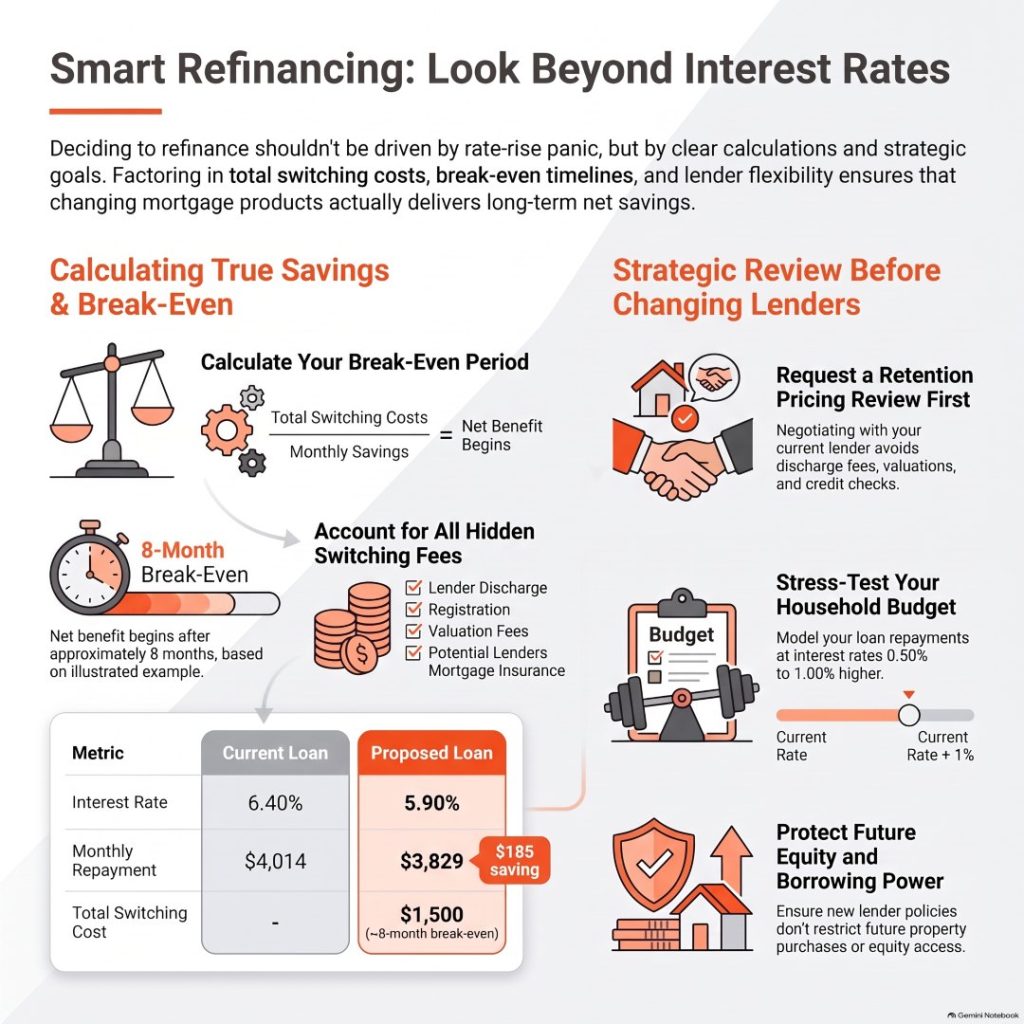
First, ask your lender for a formal pricing review. A competitive retention rate may provide worthwhile savings without discharge fees, valuations, paperwork or another credit enquiry.
How do you calculate whether refinancing will save money?
Compare the repayment difference, total mortgage switching costs Australia and the time needed to recover those costs.
| Comparison | Current loan | Proposed loan |
| Interest rate | 6.40% | 5.90% |
| Approximate monthly repayment | $4,014 | $3,829 |
| Approximate monthly saving | – | $185 |
| Estimated switching costs | – | $1,500 |
| Break-even period | – | About 8 months |
Break-even formula: Total switching costs ÷ monthly saving
In this example, $1,500 ÷ $185 produces a break-even period of just over eight months. Refinancing may be worthwhile if you expect to retain the loan for several years, but not if you plan to sell or refinance again soon.
Avoid restarting a 30-year term merely to reduce repayments. It may improve short-term cash flow while increasing lifetime interest. Consider these ways to reduce monthly mortgage payments first.
What are the true home loan refinancing costs in Australia?
Home loan refinancing costs Australia can include:
- Existing lender discharge fees
- Application or establishment fees
- Settlement and legal charges
- Valuation fees
- Government mortgage registration charges
- Annual package fees
- Fixed-rate break costs
- Lenders Mortgage Insurance
If you break fixed rate loan arrangements early, request a current break-cost quote before applying elsewhere. The amount can change with market conditions and the remaining fixed term.
I recently helped a client work through uncross-collateralising her properties and reviewing her refinancing options. Although refinancing was on the table, I advised her not to rush because her fixed loan rate was highly competitive. Breaking the contract would have meant giving up significant financial benefits. It reinforced the advice I give my clients, and follow myself: do not make a major change until you have all the facts from your lender and understand exactly what it will cost.
Lenders Mortgage Insurance may apply again if the refinanced balance exceeds the new lender’s acceptable loan-to-value ratio, commonly 80%. Insurance paid to your previous lender generally does not transfer.
Refinance home loan cashback offers may offset upfront costs, but should not drive the decision. Compare the ongoing rate, comparison rate, fees, features and lending policies over the period you expect to retain the loan.
Fixed vs variable home loan 2026: which offers greater protection?
A fixed rate may suit borrowers who value repayment certainty. A variable loan generally provides more flexibility.
Fixing all or part of your mortgage may protect your household budget from immediate increases. However, fixed loans can restrict extra repayments, provide limited offset access and impose break costs if you refinance or sell early.
A split loan offers a middle ground. One portion can remain variable for flexibility and offset benefits, while another is fixed for certainty. Read this fixed versus variable home loan comparison before deciding.
Why can the cheapest refinance rate become expensive later?
A low rate can be costly if the lender prevents your next financial move.
Imagine Rita and her husband have stable PAYG incomes, a nearly paid-off home and plans to purchase an investment property within two years. They refinance to save $160 a month, only to discover their new lender uses conservative rental-income calculations and restricts the equity release required for their deposit.
Before changing lenders, ask:
- Can we access equity later without refinancing again?
- Does the lender support investment properties?
- How does it assess overtime, bonuses and rental income?
- Is there a genuine 100% offset account?
- Could its policies reduce our future borrowing capacity?
If another property is part of your plan, understand how refinancing can affect borrowing power.
How should you review your mortgage before rates change?
- Define your objective. Choose between lower interest, certainty, better features or equity access.
- Record your position. Confirm your balance, rate, term, repayment, fees and fixed-rate expiry.
- Stress-test your budget. Model repayments at rates 0.50 to 1 percentage point higher.
- Request better pricing. Give your lender an opportunity to retain your business.
- Compare the complete outcome. Review costs, features, break-even timing and future flexibility.
Avoid lodging multiple applications simply to test which lender will approve you. Unnecessary credit enquiries may complicate future applications.
Conclusion: Make your refinancing decision using strategy, not fear
Refinance when the savings are measurable, the break-even period is acceptable and the new lender supports your future. Sometimes the strongest option is not switching, but negotiating a better rate with your existing lender.
Use the Investors Choice Mortgages Hub to access the Mortgage Stress Test, Fix or Float Assessor and other practical tools. Model different scenarios before discussing your position with a trusted mortgage professional.
This information is general and does not consider your objectives, financial circumstances or needs.
Frequently Asked Questions
Should I refinance my mortgage before the next RBA decision?
Do not refinance solely because an RBA announcement is approaching. Compare your rate, potential savings, switching costs and future plans. A suitable refinance can make sense whether the RBA increases, holds or reduces the cash rate.
How much lower should my interest rate be before refinancing?
There is no universal minimum. A 0.25 percentage point reduction may be meaningful on a large balance, while a greater reduction may still be unsuitable when costs are high. Calculate the dollar saving and break-even period.
Should I fix my home loan rate before rates rise again?
Fixing may suit you when repayment certainty matters more than flexibility. Check extra-repayment limits, offset availability and potential break costs. A split loan may provide a balance between certainty and flexibility.
Do I pay Lenders Mortgage Insurance again when refinancing?
You may pay Lenders Mortgage Insurance if the refinanced balance exceeds the new lender’s acceptable loan-to-value ratio, often 80%. A current valuation and lower loan balance may help you remain below that threshold.