

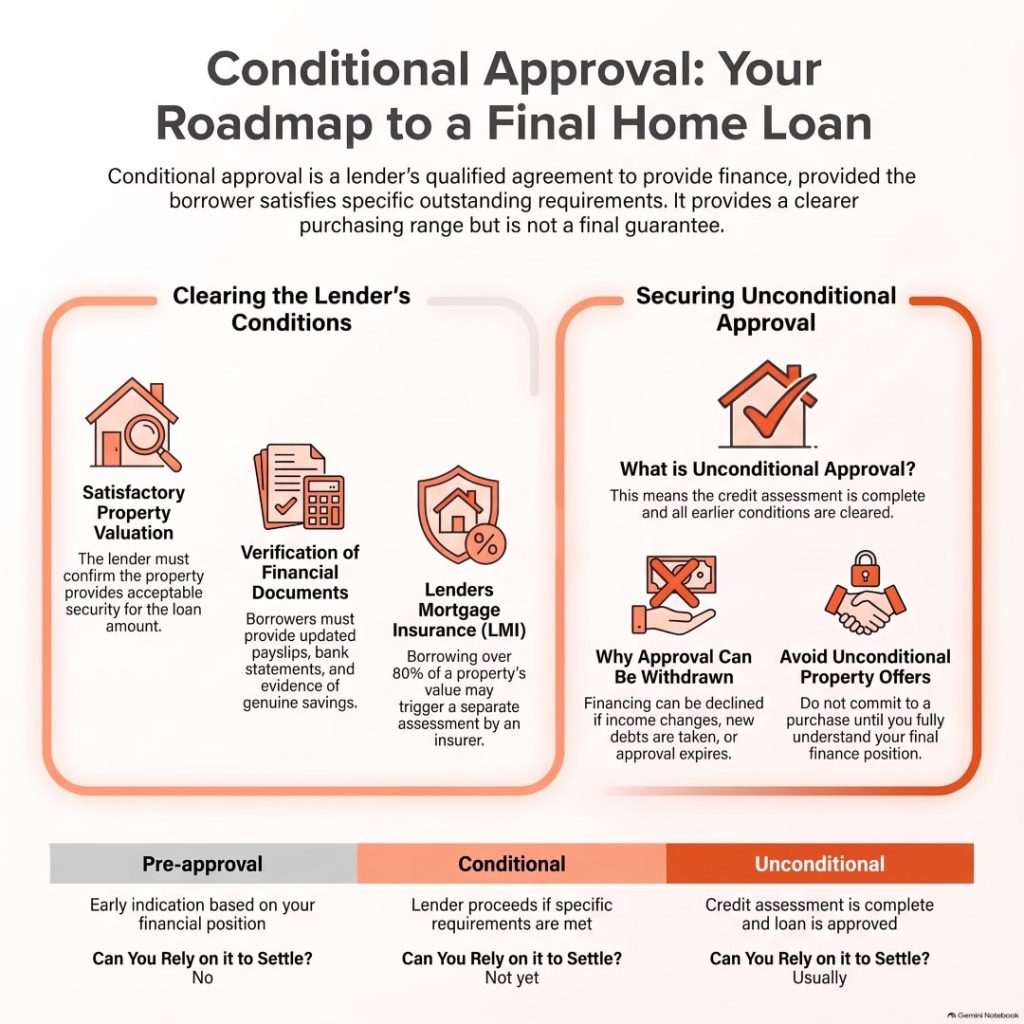
What is conditional approval? It means a lender is prepared to approve your home loan, provided you satisfy specific outstanding requirements. Those requirements may include an acceptable property valuation, updated financial documents or approval from a lenders mortgage insurance provider. It is an encouraging step, but it is not a guarantee that your loan will proceed to unconditional approval. For home buyers, conditional approval can provide a clearer purchasing range and identify what the lender still needs before making its final decision. Understanding each condition and responding quickly can help you move through the home loan underwriting process more confidently.
Key Takeaways
- Conditional approval is a lender’s qualified agreement to provide finance.
- Common conditions include a satisfactory valuation and verification of financial information.
- Buyers borrowing more than 80 per cent of a property’s value may face additional insurer checks.
- Your loan can still be declined if conditions are not met or your circumstances change.
- Avoid making an unconditional property offer until you understand your finance position.
What Does Conditional Approval Mean for a Home Buyer?
Conditional approval means the lender has assessed some or all of your application and is willing to lend a specified amount, subject to listed conditions.
For a first home buyer such as Jess, a 29-year-old professional who has spent years saving while renting, being conditionally approved can feel like a breakthrough. She can attend inspections with a clearer price range and greater confidence.
However, the word that matters most is “conditional”. The lender may not have approved Jess’s chosen property, and it may require more information before making a final credit decision.
Approval terminology varies between lenders. Some use “pre-approval”, “approval in principle” and “conditional approval” interchangeably. Always ask what has been assessed and which conditions remain.
See how this stage fits into the first home buyer mortgage process.
What Conditions Can a Lender Place on a Home Loan?
The conditions depend on your finances, lender and chosen property. Common requirements include:
- A satisfactory property valuation.
- Confirmation that your deposit is available.
- Updated payslips or bank statements.
- Evidence of genuine savings.
- Verification of employment or other income.
- Repayment or closure of a nominated debt.
- Acceptance by a lenders mortgage insurance provider.
- A satisfactory contract of sale.
- Confirmation that the property meets security requirements.
- No material change to your financial circumstances.
Having complete paperwork ready can prevent avoidable delays. Use this Australian home loan documents checklist to organise your evidence.
Why Does the Property Valuation Matter?
The valuation helps the lender decide whether the property provides acceptable security. It may differ from the price you agreed to pay.
Suppose Jess plans to borrow $612,000 to purchase a $680,000 home with a 10 per cent deposit. If the lender values it at $650,000, a 90 per cent loan may be limited to $585,000. Jess could need an additional $27,000, before allowing for stamp duty and other purchasing costs.
I have seen how confronting this can be for buyers. One client came to me after the valuation on their chosen property was returned $70,000 below the offer price. They had believed their finance was on track, but the shortfall suddenly changed how much the lender was prepared to provide. It was a powerful reminder that conditional approval is only one part of the process and that the valuation can significantly affect whether a purchase remains financially achievable.
Valuations can take longer when a physical inspection is required, the property is unusual or valuers are busy.
Why Can Lenders Mortgage Insurance Add Another Assessment?
If you borrow more than 80 per cent of a property’s value, lenders mortgage insurance, commonly called LMI, may apply. Some eligible buyers using government guarantee arrangements may avoid LMI.
Where LMI applies, the insurer may assess your application separately, request more information or apply different criteria. This can extend the approval timeframe.
Conditional Approval vs Unconditional Approval: What Is the Difference?
Conditional approval means the lender is likely to proceed if its requirements are satisfied. Unconditional approval generally means the main credit assessment is complete and the earlier conditions have been cleared.
| Approval stage | What it generally means | Can you rely on it to settle? |
| Pre-approval or approval in principle | An early indication based on your financial position | No |
| Conditional approval | The lender is prepared to proceed if specified conditions are met | Not yet |
| Unconditional approval | The lender has completed its credit assessment and approved the loan | Usually, subject to documents and settlement requirements |
Even after unconditional approval, you must sign the loan documents and satisfy settlement requirements. Avoid taking on new debts or making major financial changes before settlement.
Pre-Approval vs Conditional Approval: Are They the Same?
They can be, but you should not assume they are.
One lender may issue automated mortgage pre-approval after a limited review. Another may have a credit assessor examine your income, expenses, debts and credit history before granting conditional loan approval.
Ask:
- Has a credit assessor reviewed my application?
- Have my income and employment been verified?
- Have my living expenses and debts been reviewed?
- Is approval subject to finding an acceptable property?
- When does the approval expire?
- What changes must I report?
An online estimate is not lender approval. Understand the accuracy and limitations of mortgage calculators before setting your purchasing limit.
Can Conditional Approval Be Withdrawn?
Yes. A lender may change or decline your application if:
- The valuation is lower than the purchase price.
- Your income or employment changes.
- New debts reduce your borrowing capacity.
- Expenses or documents cannot be verified.
- Missed payments or new credit enquiries appear.
- The property is unacceptable to the lender.
- An LMI provider declines the application.
- The approval expires before you purchase.
Financing a car or applying for a credit card before settlement could reduce your borrowing capacity. Keep your finances stable, pay accounts on time and discuss proposed changes with your broker.
If progress is slow, review these common reasons home loan applications are delayed.
What Happens After Conditional Approval?
Obtain the complete list of conditions and confirm who is responsible for each requirement.
- Send requested documents promptly.
- Confirm the valuation has been ordered.
- Ask whether LMI or another assessment is required.
- Check the approval expiry date.
- Confirm the contract’s finance deadline.
- Avoid new credit or major purchases.
- Obtain written confirmation when every condition is cleared.
- Review and sign the final loan documents.
Do not treat a verbal update as formal approval. Ask for written confirmation and have your conveyancer or solicitor explain your contractual obligations.
Conclusion: Move Forward With Clarity
Conditional approval should give you direction, not false confidence. Before committing to a property, understand the amount assessed, outstanding conditions, available cash and relevant deadlines.
Explore the Investors Choice Mortgages Hub and take your next step with greater confidence. It combines practical calculators, property research resources and mortgage tools to help you make clearer, more informed decisions.
Frequently Asked Questions
How long does conditional approval take?
Timeframes vary by lender, application complexity and document quality. A straightforward assessment may take several business days, while valuations, insurer reviews, self-employed income or missing information can extend the process.
Can you be denied after conditional approval?
Yes. Your loan may be declined if a condition is not satisfied, the valuation is unacceptable, your circumstances change or new information affects the lender’s assessment.
Can I make an offer on a property with conditional approval?
Yes, but conditional finance does not guarantee approval. Consider an appropriate finance clause and obtain independent legal advice before signing a contract or making an unconditional offer.
What documents are needed after conditional approval, and does it affect my credit score?
A lender may request current payslips, transaction statements, savings evidence, identification, employment confirmation and the contract of sale. The lender may also make a credit enquiry. Multiple applications can create several enquiries, so avoid approaching numerous lenders without a clear strategy.