

Does Refinancing to Consolidate Debt Actually Save Me Money on Interest?
What is refinancing to consolidate debt? Refinancing to consolidate debt is the process of using the equity in your home to pay off...
What is refinancing to consolidate debt? Refinancing to consolidate debt is the process of using the equity in your home to pay off multiple high-interest debts, such as credit cards, personal loans and car loans, by rolling them into your home loan. The result is a single loan with one repayment and, usually, a much lower interest rate. Whether it actually saves you money depends on your loan term, your repayment behaviour and the full cost of refinancing.
Picture this. You have a home loan sitting at around 6%, a credit card charging you 19.99%, a personal loan at 12.5%, and a car loan ticking along at 8.5%. Every month, you are making four separate repayments to four different lenders. Four different due dates. Four different balances going up and down. And quietly, in the background, you are haemorrhaging money on interest.
This is the reality for thousands of Australians in their 40s and 50s who have done everything “right” – built up equity in their home, kept their jobs, raised their kids – but find themselves trapped in a web of expensive debt that keeps chipping away at their financial progress.
Refinancing to consolidate debt is one of the most talked-about strategies in the Australian mortgage market right now. In fact, according to Money.com.au, senior mortgage brokers are reporting a surge in debt consolidation refinancing requests, driven by the high cost of living and the need to cut financial pressure. But here is the critical question most people do not ask before they commit: Does refinancing to consolidate debt actually save you money on interest – or does it just feel like it does?
The appeal of debt consolidation through refinancing is immediate and obvious. You roll your credit card, personal loan and car loan into your home loan and suddenly your monthly repayment drops. Cash flow improves. Stress reduces. Life feels manageable again.
But that feeling of relief can mask a financial problem that compounds quietly over years.
Here is why. Your home loan is structured over 25 to 30 years. Your credit card debt, as painful as the interest rate is, might be paid off in two or three years if you stayed disciplined. Your personal loan might have four years left. When you roll those shorter debts into a 30-year mortgage, you are trading a high rate over a short period for a low rate over a very long period.
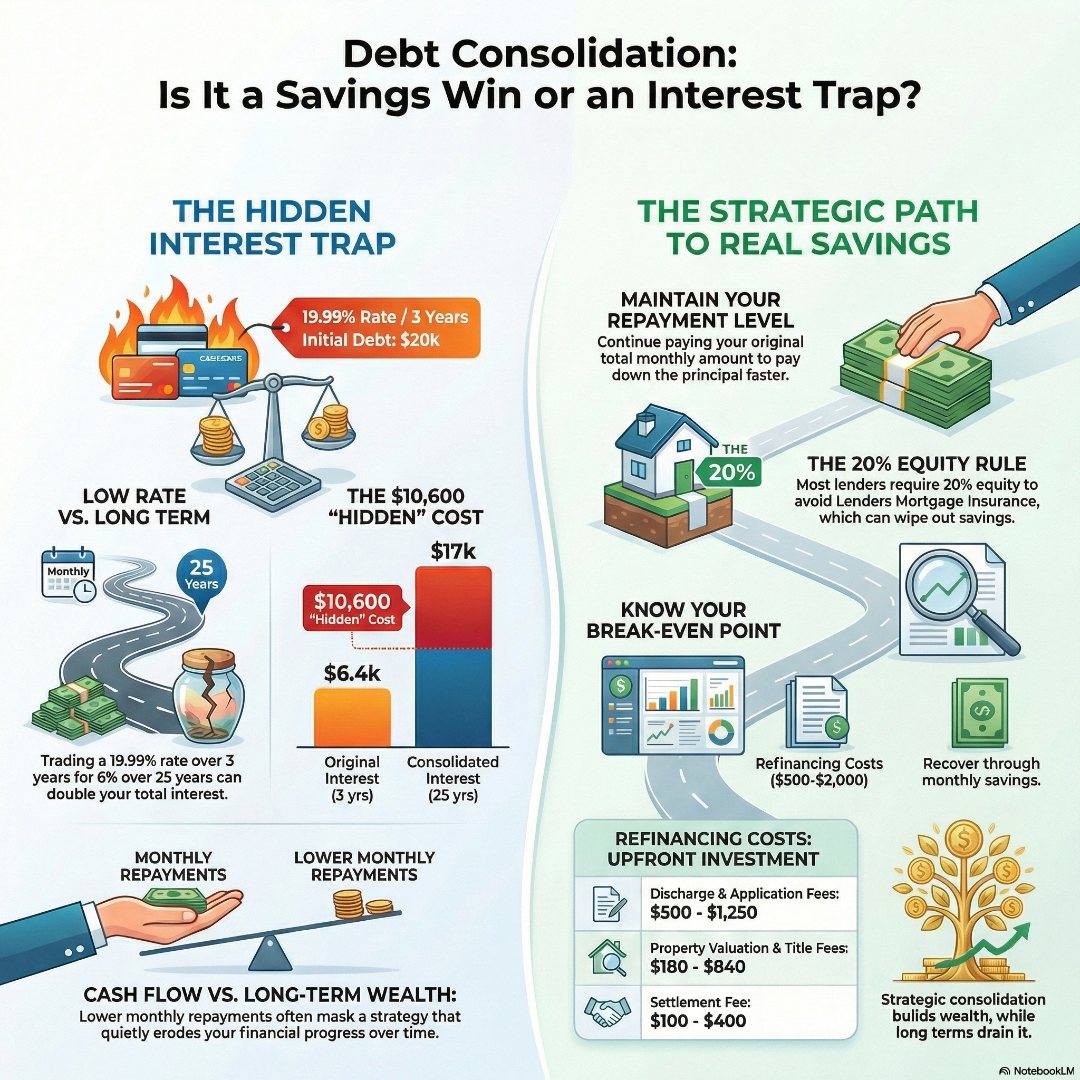
Consider this example. You have $20,000 in credit card debt at 19.99% interest. If you paid that off in 3 years, you would pay roughly $6,400 in interest. If you instead folded that $20,000 into your mortgage at 6% over 25 years, the total interest on that portion alone climbs to approximately $17,000.
That is more than double. And the lower monthly repayment felt like a win.
I have seen this play out with real clients. A couple came to me after their bank had already walked them through a debt consolidation plan. On the surface, it looked great – they were saving hundreds of dollars a month, and honestly, they were in a fortunate position where they could afford to follow through. But when I looked at the full picture, something did not add up. Their loans for a caravan and a boat would have been fully paid out within five years at their existing repayment pace. By folding those balances into their home loan and spreading them over 20 years, even at a significantly lower interest rate, they were on track to pay almost double the interest they would have otherwise. The bank had solved their cash flow problem. What it had not done was protect their long-term wealth.
This is the trap that catches people who consolidate without a clear repayment plan. The interest rate comparison is only half the story. Loan term is the other half – and it is the half that most people overlook.
When you refinance to consolidate debt, you are essentially using the equity in your home to pay off your other liabilities. Your mortgage lender increases your home loan balance by the total amount of your outstanding debts, and those debts are cleared. From that point, you have one loan, one repayment and one lender.
There are two common ways this is structured:
Home loan top-up. Your existing loan balance is increased to absorb the other debts. Your lender may do this as a straightforward internal refinance, or you may need to switch lenders to access a more competitive rate at the same time.
Cash-out refinance. You refinance your home loan with a new lender for a larger amount, receive the additional funds as cash, and use those funds to pay off your other debts directly.
In both cases, your secured home loan now carries the weight of what were previously unsecured debts. This is important to understand, because those debts are now backed by your home. If your financial situation deteriorates and repayments fall behind, the stakes are higher than they were with an unsecured credit card.
Done strategically, debt consolidation through refinancing can genuinely reduce the total amount of interest you pay. The key is maintaining your repayment behaviour rather than simply enjoying the lower minimum repayment.
Here is the strategy that makes it work. When you consolidate your debts into your home loan, your minimum monthly repayment will drop. But instead of pocketing that cash flow improvement, you continue to make repayments at the same level you were before. You essentially treat your consolidated loan as though it still carries the original, higher repayments.
By doing this, you pay down your principal faster, and the total interest over the life of the loan shrinks considerably. The lower interest rate is doing real work, but only because you are not extending the effective loan term.
This approach is particularly powerful for Australians who:
This is exactly the kind of strategic thinking Jane Slack-Smith and the team at Investors Choice Mortgages have spent nearly two decades applying with clients. The goal has never been simply to chase a lower rate. It is to find the right structure, the right repayment plan, and the right understanding of what the numbers actually mean for your long-term financial position.
Before you calculate the interest savings, you need to account for the costs of refinancing itself. These can range from $500 to $2,000 and typically include:
| Cost Item | Estimated Range |
| Discharge fee (old lender) | $350 – $500 |
| Application fee (new lender) | $150 – $750 |
| Property valuation fee | $50 – $600 |
| Title search and registration fees | $130 – $240 |
| Settlement fee | $100 – $400 |
These upfront costs need to be factored into your break-even calculation. If you are consolidating $15,000 in credit card debt and saving $80 per month in repayments, it will take roughly 18 to 24 months just to recover your refinancing costs before you are genuinely ahead.
This is why using a proper calculator before you commit is not optional – it is essential.
Before you move forward, there are five questions worth answering clearly:
The difference between debt consolidation that builds your wealth and debt consolidation that quietly costs you more comes down to one thing: going in with a strategy rather than simply responding to financial pressure.
Small, intentional financial decisions create massive, lasting change. That principle sits at the heart of everything Jane Slack-Smith and the Investors Choice Mortgages team do with clients. One client saved $1,200 per month after their refinancing strategy was implemented. Another built a portfolio of over $2.5 million from nothing over a decade, guided by the same approach: clear numbers, a defined structure, and expert support at every step.
For Australians in their 40s and 50s who have built up equity in their home and are starting to think seriously about what their financial future looks like, getting the debt consolidation decision right is not just about this year’s cash flow. It is about protecting the trajectory toward financial freedom and early retirement.
But the starting point is always the numbers – and knowing your numbers before you sit down with any lender or broker.
Refinancing to consolidate debt can be a powerful strategy for reducing financial pressure and cutting your overall interest bill. But it is not automatically a win. The impact on your total interest repayments depends on your loan term, your repayment discipline after consolidating, and the real costs involved in making the switch.
The Australians who benefit most from this strategy go in with clear numbers, a defined repayment plan and expert guidance to ensure the structure works for their long-term goals, not just their immediate cash flow. That is the difference between a financial decision that moves you toward early retirement and one that quietly sets you back.
Ready to find out if debt consolidation refinancing is the right move for you? Test the AI-powered Hub at Investors Choice Mortgages – Australia’s first of its kind, built to give our clients an unfair advantage. It is packed with calculators and tools to help you model exactly what refinancing to consolidate debt will do to your interest repayments, your loan term and your long-term wealth position, before you make any commitments. Start making decisions with clarity and confidence, not guesswork.
Will refinancing to consolidate debt always lower my total interest bill?
Not automatically. Refinancing to consolidate debt gives you a lower interest rate on those debts, but if you extend them over a much longer loan term, you can end up paying significantly more total interest. The key is maintaining your repayment level after consolidating, not simply enjoying the lower minimum repayment. Running the numbers through a calculator before you commit is the best way to see your real outcome.
How much equity do I need to consolidate debt through refinancing?
Most lenders in Australia require you to retain at least 20% equity in your home after consolidating the additional debt. If your loan-to-value ratio exceeds 80%, you may be required to pay Lender’s Mortgage Insurance, which adds cost and can reduce or eliminate any interest savings. Your available equity will also determine how much debt you are able to consolidate.
What types of debt can be consolidated into a home loan through refinancing?
Credit cards, personal loans, car loans and other unsecured debts can typically be consolidated into a home loan through refinancing. The key is that your property equity must be sufficient to cover the increased loan amount, and you will need to meet the lender’s serviceability requirements. A mortgage broker can assess your situation and identify which debts make the most financial sense to consolidate.
How do I know if the interest savings outweigh the refinancing costs?
You need to calculate your break-even point, which is the point at which your cumulative monthly savings exceed the upfront costs of refinancing, typically $500 to $2,000. A good calculator will help you model this accurately. The AI-powered Hub at Investors Choice Mortgages is designed to do exactly this, giving you a clear picture of your real savings before you commit.
What is refinancing to consolidate debt? Refinancing to consolidate debt is the process of using the equity in your home to pay off...

When inflation climbs, interest rates typically rise because central banks - like Australia's Reserve Bank - deliberately make...