

Why Do Interest Rates Rise During Inflation?
When inflation climbs, interest rates typically rise because central banks - like Australia's Reserve Bank - deliberately make...
The dream of building a property empire that generates passive income while you sleep is closer to reality than ever before. Gone are the days when successful property investment required decades of experience or insider knowledge. Today’s artificial intelligence revolution has democratised property investing, giving ordinary investors access to the same sophisticated analytics tools once reserved for institutional players.
Property investment has always been about making smart decisions based on the best available information. The challenge has been accessing, processing, and interpreting the vast amounts of data needed to identify genuine opportunities while avoiding costly mistakes.
What changed everything is AI analytics. These powerful tools can process historical sales data, demographic trends, economic indicators, and neighbourhood development patterns simultaneously, delivering insights in minutes that would take traditional analysts weeks to compile.
The transformation isn’t just about speed. AI analytics provides a level of precision and pattern recognition that human analysis simply cannot match. When Jane Slack-Smith built her multi-million-dollar portfolio using data-driven strategies, she was ahead of her time. Today, those same principles are accessible to any investor willing to embrace these technological advantages.
Jane remembers the day she first challenged property investing’s old guard: tucked away at the back of a crowded industry conference, listening to ‘insider’ tales she couldn’t relate to, she began to doubt whether she would ever play in the same league as those seasoned, well-connected experts. But back at her kitchen table, it wasn’t insider tips or crystal-ball forecasts that guided her next move—it was raw data. Jane built her own DIY spreadsheet, feeding in local sales figures and demographic trends, and—disregarding snide remarks from more experienced investors—she executed her first data-driven purchase. The outcome? That unglamorous, number-crunched decision outperformed many of the conference ‘gurus’ who acted on instinct. Jane’s leap of faith showed her (and plenty of others since) that access to the right tools—whether it’s a humble spreadsheet or today’s AI-powered platforms—levels the playing field. If anything, the barriers to smart investing are now lower than ever. Her story is a real-world testament that you don’t need decades of experience or secret handshakes; with the right analytical approach, technical innovation can help you outsmart the pros and build your portfolio with true confidence.
Smart investors are now using AI analytics to identify undervalued properties, predict rental yields, assess neighbourhood growth potential, and optimise their portfolio allocation across different property types and locations. This isn’t speculation; it’s strategic investment powered by data science.
For investors ready to move beyond traditional methods, AI analytics offers a proven pathway to building a diversified property portfolio that balances growth potential with sustainable returns. The question isn’t whether AI will transform property investment; it’s whether you’ll adapt early enough to gain a competitive advantage.
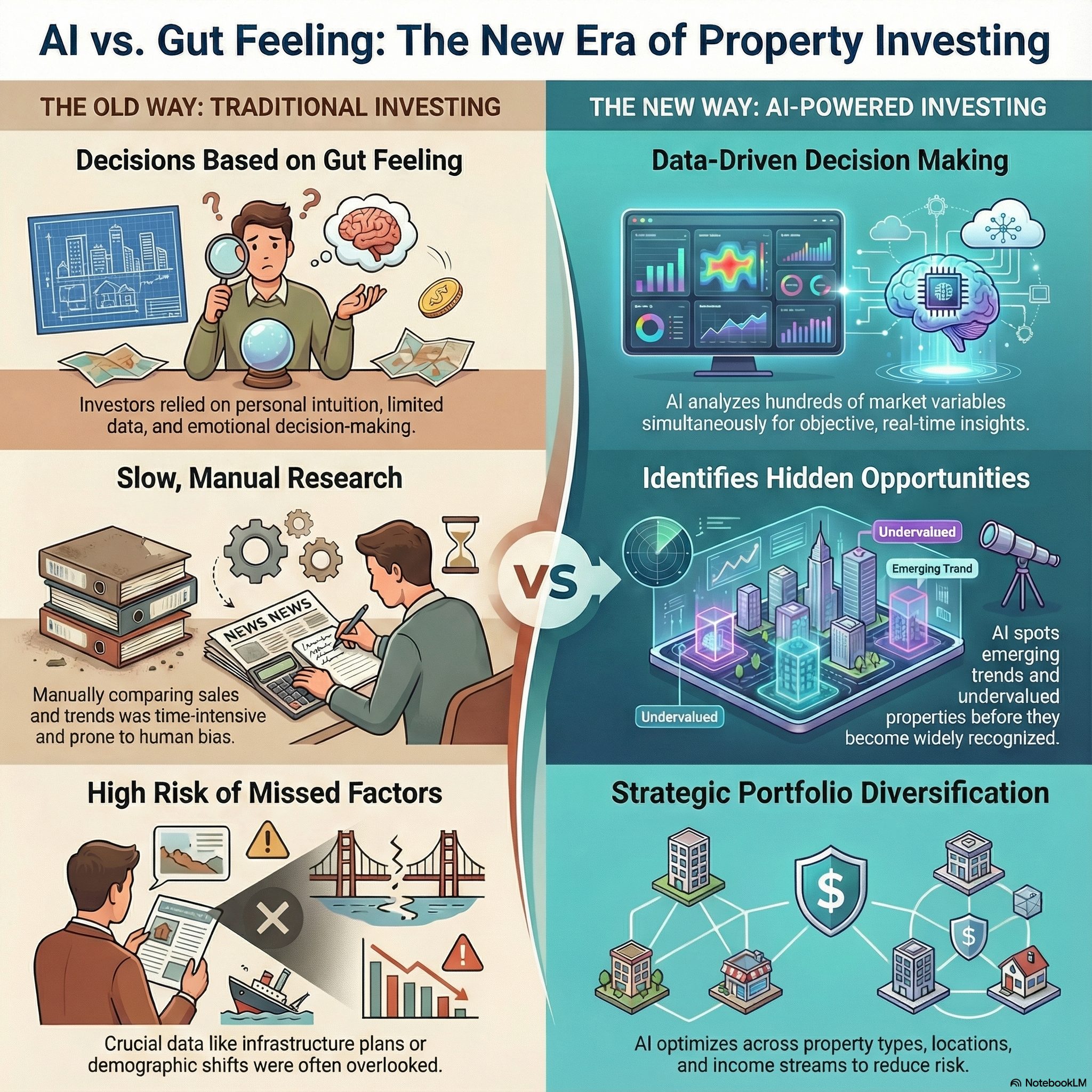
Property investment has always been plagued by information asymmetries and emotional decision-making. Traditional investors often rely on limited data sources, personal intuition, or recommendations from real estate agents who may have conflicting interests.
The old approach typically involved driving through neighbourhoods, attending auctions, and making decisions based on “gut feelings” about market potential. While some investors succeeded using these methods, many others fell victim to market cycles they didn’t anticipate or property characteristics they failed to properly evaluate.
Market research traditionally meant manually comparing recent sales, checking rental listings, and trying to assess neighbourhood trends through limited public data. This process was time-intensive, prone to human bias, and often missed crucial factors that influence long-term investment performance.
The complexity of modern property markets has only increased these challenges. Today’s investors must consider factors like planned infrastructure developments, demographic shifts, employment trends, interest rate movements, and regulatory changes, all while competing against sophisticated institutional investors armed with professional research teams.
Artificial intelligence has fundamentally changed how successful investors approach property acquisition and portfolio management. Modern AI analytics platforms process vast datasets that include property sales history, rental market trends, demographic movements, economic indicators, and development approvals, delivering actionable insights in real-time.
These tools analyse patterns that human analysts might miss entirely. For example, AI can identify subtle correlations between infrastructure investments and property value appreciation, or recognise early indicators of neighbourhood gentrification before they become obvious to the broader market.
PropertyPulse AI represents the cutting edge of this technology, using machine learning algorithms to analyse historical property data alongside current market conditions. The platform delivers detailed reports including price predictions, investment potential assessments, and comprehensive risk analysis for any property under consideration.
Similarly, MarketMind Analytics focuses on predictive market analysis, processing data from multiple sources to provide accurate forecasts and investment recommendations. Its sophisticated algorithms can identify emerging market trends weeks or months before they become widely recognised by traditional analysts.
The real power of AI analytics lies in its ability to continuously learn and adapt. As market conditions change and new data becomes available, these systems refine their predictions and recommendations, ensuring investors always have access to the most current insights.
Building a truly diversified property portfolio requires more than just buying properties in different suburbs. Effective diversification involves spreading investment risk across property types, geographical locations, tenant demographics, and income generation strategies.
AI analytics excels at identifying optimal diversification strategies by analysing correlations between different market segments. For instance, LocationLogic AI analyses hundreds of location-specific data points to provide comprehensive neighbourhood insights, helping investors identify areas with different risk-return profiles.
The platform evaluates factors such as employment diversity, population growth trends, infrastructure development plans, and demographic stability to assess long-term investment potential. This data-driven approach ensures investors aren’t inadvertently concentrating risk in areas with similar economic drivers.
Property type diversification becomes more strategic with AI insights. Tools like RentalRator Plus analyse rental markets across different property categories, comparing yields, vacancy rates, and tenant demographics for houses, units, townhouses, and commercial properties.
Geographic diversification gets enhanced precision through AI analysis of regional economic cycles, population growth patterns, and infrastructure investment. Rather than spreading investments randomly across different cities, investors can select markets that are genuinely uncorrelated and offer complementary risk-return characteristics.
Income stream diversification also benefits from AI analytics. Modern platforms can assess the viability of different strategies, from traditional buy-and-hold rentals to short-term accommodation, commercial leasing, or development opportunities, helping investors build portfolios with multiple income sources.
The AI analytics toolkit for property investors has expanded dramatically in recent years. ValueVision AI specialises in automated valuation models that provide highly accurate property valuations by incorporating both traditional and alternative data sources.
This platform offers detailed breakdowns showing how various factors influence property values in different markets. Users gain insights into which property characteristics drive value in specific areas, helping identify properties with the best improvement potential or undervaluation relative to market comparables.
For rental property analysis, TenantTracker AI uses artificial intelligence to predict tenant behaviour and optimise tenant selection processes. The platform provides detailed screening reports and recommendations for reducing vacancy rates while identifying tenant profiles that align with specific property types and locations.
PortfolioPlus AI offers sophisticated portfolio management capabilities, helping investors maintain balanced and diversified property holdings through AI-driven recommendations. Users can track performance metrics across their entire portfolio and receive alerts about potential issues or emerging opportunities.
Cash flow analysis gets transformed through CashFlow Catalyst, which uses AI to analyse and predict cash flow patterns across different property types and market conditions. The platform provides detailed financial projections and recommendations for improving cash flow performance.
Market analysis becomes more powerful with MarketMaster AI, which analyses various market indicators to identify potential investment opportunities before they become widely recognised. The platform’s predictive capabilities help investors stay ahead of market trends and movements.
AI analytics transforms market analysis from reactive observation to predictive intelligence. Modern platforms process thousands of data points daily to identify market inefficiencies, emerging trends, and optimal timing for acquisitions or disposals.
DealDetector Pro exemplifies this approach by using artificial intelligence to analyse market inefficiencies and identify properties with high appreciation potential. The platform allows investors to set custom criteria for opportunity identification and provides alerts when matching properties become available.
The tool’s comparative analysis features help evaluate different investment opportunities against standardised metrics, removing emotional bias from the decision-making process. This systematic approach ensures investors focus on properties that meet their specific return and risk criteria.
Predictive analytics capabilities have become increasingly sophisticated. InvestorIQ Pro combines traditional investment metrics with AI-powered insights to evaluate potential investments comprehensively. Users can analyse multiple properties simultaneously and receive detailed comparisons based on various financial and market criteria.
Market timing optimisation benefits from AI’s ability to process economic indicators, interest rate trends, and market sentiment data. PropertyPulse Predictor focuses on long-term value prediction, combining multiple data sources to provide accurate appreciation forecasts across different markets and property types.
These tools help investors identify not just what to buy, but when to buy it. By analysing market cycles, economic conditions, and local factors, AI platforms can suggest optimal timing for different types of investments within a diversified portfolio strategy.
Risk management becomes more precise and proactive with AI analytics. Modern platforms assess portfolio risk across multiple dimensions, market risk, concentration risk, liquidity risk, and operational risk, providing comprehensive protection strategies.
AI-powered risk assessment analyses correlations between different investments to ensure true diversification. The technology identifies hidden connections between properties that might not be obvious through traditional analysis, such as shared economic drivers or overlapping tenant demographics.
Portfolio optimisation algorithms continuously evaluate asset allocation and suggest rebalancing strategies based on changing market conditions and investment performance. This dynamic approach ensures portfolios remain optimised as markets evolve and new opportunities emerge.
Predictive maintenance analysis helps investors anticipate and plan for property upkeep expenses through AI analysis of building age, construction quality, and historical maintenance patterns. RenovationROI AI assists with analysing potential returns from various improvement projects, using AI to predict renovation impact on property values across different markets.
The integration of ESG (Environmental, Social, and Governance) factors into risk assessment has become increasingly important. AI tools now evaluate properties based on energy efficiency, environmental risks, and regulatory compliance, helping investors align with sustainability trends while managing long-term risk exposure.
Successfully implementing AI analytics requires a systematic approach that aligns technology capabilities with investment objectives. The first step involves clearly defining investment goals, whether focusing on cash flow generation, capital appreciation, or balanced returns across a diversified portfolio.
Technology selection should match specific investment strategies and experience levels. Beginners might start with comprehensive platforms like PropertyPulse AI that provide user-friendly interfaces and educational resources, while experienced investors might prefer specialised tools that integrate with existing investment workflows.
Data quality and integration represent crucial implementation considerations. AI analytics platforms require access to accurate, comprehensive data to deliver reliable insights. Investors should ensure chosen platforms integrate with relevant data sources and provide transparent methodologies for their analysis and recommendations.
Starting with pilot investments allows investors to test AI recommendations against actual market performance, building confidence in the technology while refining their implementation approach. This gradual scaling approach minimises risk while maximising learning opportunities.
Continuous monitoring and adjustment ensure AI tools remain aligned with evolving investment objectives and market conditions. Regular performance reviews help identify which tools and strategies deliver the best results for specific investment goals and risk tolerance levels.
The evolution of AI analytics in property investment continues accelerating. Generative AI is beginning to transform how investment reports, property descriptions, and market analyses are created, dramatically reducing the time required for documentation and research.
Multimodal AI systems that analyse text, images, satellite data, and economic indicators simultaneously are providing more comprehensive property assessments. These advanced systems evaluate properties from multiple perspectives, improving accuracy and reducing the risk of overlooking important factors.
Blockchain integration with AI analytics promises to automate property transactions through smart contracts, reducing transaction costs and settlement timeframes. This technology combination could make property investment more accessible and efficient for smaller investors.
Sustainability analysis through AI is becoming increasingly sophisticated, helping investors identify properties that align with environmental standards and future regulatory requirements. This capability will become essential as ESG considerations become more prominent in investment decision-making.
The democratisation of institutional-grade analytics continues as AI tools become more accessible and affordable. Individual investors now have access to analysis capabilities that were previously available only to large investment firms and institutions.
Building a diversified property portfolio using AI analytics begins with education and strategic planning. Understanding available tools and their capabilities provides the foundation for making informed technology choices that align with your investment objectives.
Start by defining your portfolio goals clearly, target returns, acceptable risk levels, preferred property types, and geographic preferences. This clarity helps guide technology selection and ensures AI recommendations align with your specific investment strategy.
Consider beginning with a single AI analytics platform to understand how the technology works and how it integrates with your investment process. Many platforms offer trial periods or demonstration accounts that allow hands-on experience before committing to long-term subscriptions.
Focus on understanding the data sources and methodologies behind AI recommendations. The best platforms provide transparency about their analysis approaches, helping investors make informed decisions about when to follow AI guidance and when to apply additional human judgment.
Regular performance monitoring ensures your AI-powered investment strategy remains effective. Track how AI recommendations perform against actual market outcomes and adjust your approach based on these results.
Remember that AI analytics enhances human decision-making rather than replacing it entirely. The most successful investors combine technological insights with personal knowledge, market experience, and strategic thinking to build portfolios that achieve their long-term financial objectives.
Your property investment journey doesn’t have to follow the traditional path of trial and error. By embracing AI analytics, you’re positioning yourself to make more informed decisions, identify better opportunities, and build a truly diversified portfolio that can withstand market volatility while generating sustainable returns.
The tools exist today to transform your property investment approach. The question is whether you’ll take advantage of them to build the diversified portfolio that supports your financial future.
The convergence of artificial intelligence and property investment represents a paradigm shift in how successful portfolios are built and managed. AI analytics tools have democratised access to institutional-grade market analysis, enabling individual investors to make data-driven decisions that were previously impossible without extensive resources and expertise.
Building a diversified property portfolio through AI analytics isn’t just about using technology; it’s about leveraging data science to reduce risk, identify opportunities, and optimise returns across multiple market segments and property types. The most successful investors of the next decade will be those who embrace these tools while maintaining the strategic thinking that drives long-term wealth creation.
The transformation from intuition-based to data-driven property investment creates opportunities for investors willing to adapt their approaches. As AI analytics continue evolving, early adopters will maintain competitive advantages that compound over time, building portfolios that outperform traditional investment strategies.
Your property investment success no longer depends on market timing luck or insider knowledge. With AI analytics, you have access to the same sophisticated tools that institutional investors use to build billion-dollar property portfolios. The choice is yours: continue with traditional approaches or embrace the technological revolution that’s reshaping property investment forever.
Watch our AI property investor tools walkthrough here to see these strategies in action and discover how technology can accelerate your property investment success.
How accurate are AI property valuations compared to traditional appraisals?
AI property valuations typically achieve accuracy within 5-10% of market value when using comprehensive datasets. While traditional appraisals remain important for financing purposes, AI valuations excel at identifying market trends and comparative value analysis across large property samples. The most effective approach combines AI-powered initial assessments with targeted professional appraisals for final purchase decisions.
Can AI analytics predict property market crashes or bubbles?
AI analytics can identify warning signs and market stress indicators that precede market corrections. However, predicting exact timing remains challenging due to external factors like policy changes or economic shocks. AI tools are best used for risk assessment and trend identification rather than precise crash prediction. Their greatest value comes from highlighting potentially overheated markets so investors can adjust their diversification strategy accordingly.
What’s the minimum portfolio size needed to benefit from AI analytics tools?
Most AI analytics platforms provide value from your first property purchase. Even single-property investors benefit from market analysis, valuation insights, and rental yield projections. The tools scale effectively from individual properties to large portfolios without requiring minimum investment thresholds. In fact, beginning investors often see the greatest relative benefit as AI helps them avoid costly first-time mistakes.
How do I integrate AI analytics with my existing property investment strategy?
Start by using AI tools to validate your current investment criteria and identify potential improvements. Gradually incorporate AI insights into your property selection process, market analysis, and portfolio optimisation decisions. Most successful investors blend AI recommendations with their existing knowledge and experience. Consider running parallel analyses comparing your traditional methods with AI suggestions before making significant strategy adjustments.
When inflation climbs, interest rates typically rise because central banks - like Australia's Reserve Bank - deliberately make...

Market volatility is inevitable in property investing, but it doesn't have to derail your wealth-building plans. Most successful...