

Should Investors Buy Property During Economic Uncertainty or Wait?
Economic uncertainty creates a unique paradox: while most investors freeze in fear, educated investors often find their greatest opportunities....
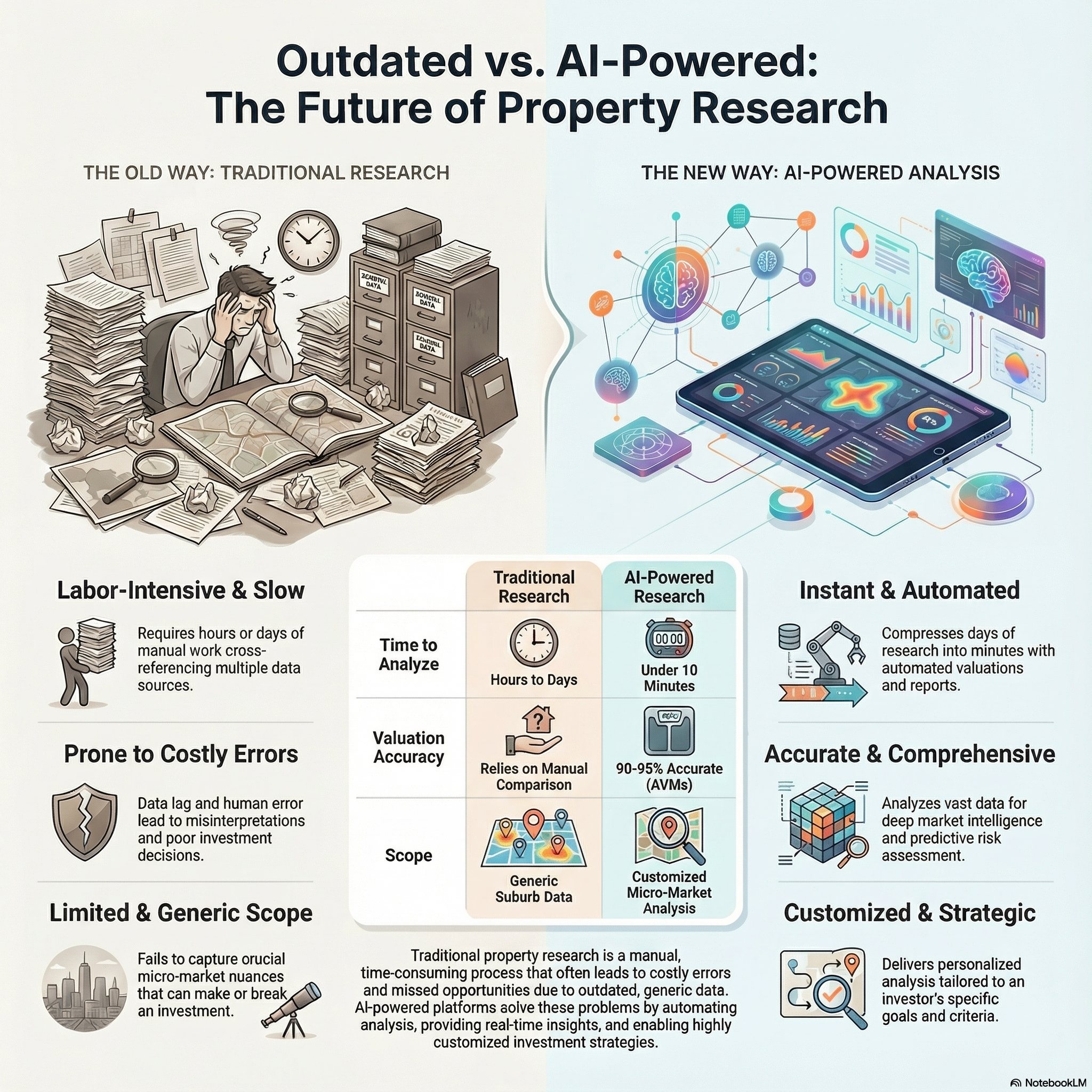
The Australian property investment landscape has undergone dramatic changes over the past two decades, yet many investors still rely on outdated research methods that can cost them thousands—or even hundreds of thousands—in missed opportunities and poor decisions.
After 20 years of coaching property investors and building an 8-figure portfolio myself, I’ve witnessed firsthand how traditional property research methods create significant barriers to successful investing. The good news? Artificial intelligence is revolutionising how we approach property research, making sophisticated analysis accessible to everyday investors.
Property research has traditionally been a labour-intensive process that relies heavily on manual data collection and analysis. Most investors still depend on familiar platforms like Domain, realestate.com.au, and CoreLogic RP Data (formerly Residex) for basic suburb searches, median prices, and rental yields. While these platforms provide valuable baseline information, they represent just the tip of the iceberg when it comes to comprehensive property analysis.
The fundamental problem isn’t with the data sources themselves—it’s with how investors are forced to piece together information manually. Traditional research methods require investors to spend countless hours cross-referencing different platforms, manually comparing comparable sales, and attempting to interpret market trends without sophisticated analytical tools.
This manual approach creates several critical challenges. First, the time investment is enormous. What should take minutes often stretches into hours or even days of research. Second, human error inevitably creeps into manual processes, leading to miscalculations and misinterpretations that can have costly consequences. Third, the scope of analysis remains limited by human capacity—most investors simply cannot process and correlate the vast amounts of data necessary for truly informed decision-making.
Perhaps most concerning is the lag time inherent in traditional research methods. By the time investors compile and analyse data manually, market conditions may have already shifted. In volatile markets, properties can gain or lose $50,000 in value within six months while investors are still gathering information.
The limitations of traditional property research extend far beyond time constraints. One of the most significant issues is the lack of customisation available through conventional methods. Standard property reports provide generic information that may not align with specific investment strategies or individual circumstances.
For instance, most platforms offer suburb-wide statistics, but savvy investors know that property values can vary dramatically within a single postcode. A property within 500 meters of a train station may command significantly higher rental yields than similar properties just one kilometre away. Traditional research methods struggle to capture these micro-market nuances that can make or break an investment decision.
Data quality and consistency present another major challenge. Different platforms often report conflicting information about the same properties or markets, leaving investors confused and uncertain about which data to trust. The manual process of reconciling these discrepancies consumes valuable time and introduces additional opportunities for error.
The complexity of modern property investment strategies compounds these challenges. Today’s investors need to consider factors like gentrification patterns, infrastructure developments, demographic shifts, and regulatory changes—all while analysing traditional metrics like capital growth potential and rental yields. Traditional research methods simply cannot process and correlate this multifaceted information effectively.
Furthermore, most traditional research platforms lack sophisticated risk assessment capabilities. They may provide historical data about price movements, but they offer little insight into future risks such as oversupply, changing demographics, or economic factors that could impact property performance.
The consequences of relying on traditional property research methods extend far beyond inconvenience. The information gap created by manual research processes has real financial implications that can significantly impact investment outcomes.
Consider the challenge of timing market entry. Traditional research methods often require weeks of analysis before investors feel confident enough to make an offer. During this extended research phase, market conditions can shift, interest rates may change, and the most attractive properties may be purchased by more decisive competitors.
This delay is particularly costly in competitive markets where good properties receive multiple offers within days of listing. Investors using traditional research methods often find themselves consistently outbid by those who can make faster, more informed decisions.
The limited scope of traditional analysis also leads to missed opportunities. Most investors focus on obvious metrics like median prices and rental yields, but they miss subtle indicators that could identify emerging growth areas or properties with hidden potential. Without sophisticated analytical tools, investors may overlook factors like planned infrastructure developments, zoning changes, or demographic trends that could significantly impact future property values.
Risk assessment represents another critical gap in traditional research approaches. Most investors lack access to comprehensive risk analysis tools, leaving them vulnerable to threats like oversupply, natural disasters, or economic downturns that could devastate their investment returns.
The cumulative effect of these limitations is substantial. Investors using traditional research methods typically achieve lower returns, experience higher transaction costs due to longer research periods, and face greater exposure to investment risks they haven’t properly identified or quantified.
Artificial intelligence addresses virtually every limitation of traditional property research by automating analysis, providing real-time insights, and offering unprecedented customisation capabilities. AI-powered platforms can process vast amounts of data instantly, identify patterns human analysts might miss, and deliver personalised insights tailored to individual investment strategies.
“This shift isn’t theoretical; it’s a solution born out of the painful limitations I personally faced and witnessed over twenty years.”
I’ve spent two decades watching smart, driven investors get bogged down in spreadsheets and conflicting data. That frustration became the genesis of my own mission. It wasn’t enough to just coach; I needed to change the game itself. That drive led me to develop the PropertyChat AI tool—a platform designed specifically to democratize property insights and cut through the research noise. I remember the moment we were named a finalist for the Australian AI Awards; it wasn’t just a win for me, it was validation that the technology we created could genuinely empower everyday investors to conduct research previously only accessible to major firms. Seeing that technology bridge the gap between complex data and confident decision-making is why I believe so strongly in this AI revolution.
The transformation begins with data processing speed and accuracy. While traditional research might require days to analyse comparable sales in a specific area, AI can process thousands of property transactions in seconds, identifying relevant comparisons and calculating accurate market valuations. This speed advantage allows investors to respond quickly to market opportunities and make competitive offers with confidence.
AI platforms excel at customisation, offering analysis tailored to specific investment criteria. Whether an investor is looking for 3-bedroom, 2-bathroom properties within 1 kilometre of public transport or seeking industrial properties with specific zoning characteristics, AI can filter and analyse relevant data instantly. This level of customisation was virtually impossible with traditional research methods.
Perhaps most importantly, AI provides comprehensive risk assessment capabilities that far exceed traditional approaches. Modern AI systems can analyse economic indicators, demographic trends, supply and demand factors, and regulatory changes to provide detailed risk profiles for specific properties or markets.
These capabilities extend to predictive analysis as well. While traditional research focuses on historical data, AI can identify trends and patterns that suggest future market movements, helping investors position themselves advantageously for changing conditions.
Today’s AI-powered property research tools offer capabilities that would have seemed impossible just a few years ago. Automated Valuation Models (AVMs) provide instant, accurate property assessments based on comprehensive data analysis. These tools consider factors like recent comparable sales, property characteristics, market trends, and local economic indicators to generate reliable valuations.
Comparative Market Analysis (CMA) tools use AI to identify truly comparable properties, accounting for factors like property condition, recent renovations, and micro-location advantages that human analysts might overlook. This sophisticated comparison capability provides more accurate market insights and helps investors make competitive offers with confidence.
AI-powered suburb analysis tools can generate comprehensive reports covering demographics, infrastructure developments, economic indicators, and growth projections. These reports provide the kind of detailed market intelligence that was previously available only to large institutional investors.
Risk assessment platforms use machine learning algorithms to identify potential threats to property investments, including oversupply risks, economic vulnerabilities, and natural disaster exposure. These tools help investors build more resilient portfolios by avoiding high-risk investments and preparing for potential market challenges.
Portfolio optimisation tools use AI to analyse existing investments and suggest improvements, whether through refinancing opportunities, tax optimisation strategies, or strategic property acquisitions that complement existing holdings.
The practical applications of AI in property research extend across every aspect of the investment process. For property identification, AI can scan entire markets instantly, filtering properties based on complex criteria and ranking them according to investment potential. This capability allows investors to identify opportunities they might never have discovered through traditional research methods.
Due diligence processes benefit enormously from AI automation. Instead of manually researching zoning regulations, flood risks, and development applications, AI tools can compile comprehensive property reports in minutes, covering all relevant factors that might impact investment performance.
Market timing decisions become more sophisticated with AI analysis. These systems can identify market cycles, predict optimal entry and exit points, and suggest portfolio rebalancing strategies based on changing market conditions.
Rental analysis tools use AI to optimise rental pricing, identify tenant preferences, and predict vacancy rates based on property characteristics and local market conditions. This intelligence helps investors maximise rental returns and minimise vacancy periods.
Exit strategy planning benefits from AI’s ability to analyse market projections, tax implications, and portfolio performance to suggest optimal timing and methods for property sales.
The transformation from traditional to AI-powered property research represents more than just technological advancement—it represents a fundamental shift in how successful property investment decisions are made. Investors who embrace these tools gain significant advantages in speed, accuracy, and strategic insight over those who rely on traditional methods.
The evidence is clear: AI doesn’t just solve the limitations of traditional property research—it enables entirely new levels of investment sophistication and success. As these technologies continue to evolve and become more accessible, the gap between AI-enabled investors and those using traditional methods will only widen.
For property investors serious about optimising their research process and investment outcomes, the question isn’t whether to adopt AI-powered tools—it’s which tools to implement first and how quickly they can be integrated into existing investment strategies.
Watch our AI property investor tools walkthrough here to discover how cutting-edge technology can transform your property investment research and decision-making process.
How much faster is AI-powered property research compared to traditional methods?
AI-powered property research can complete tasks in minutes that would traditionally take hours or days. For example, analysing comparable sales, assessing market trends, and generating comprehensive property reports can be accomplished in under 10 minutes with AI tools, compared to several hours of manual research using traditional methods. This efficiency advantage can be crucial in competitive markets where timing is essential for securing the best opportunities.
Can AI property research tools replace human expertise entirely?
While AI dramatically enhances research capabilities, it works best when combined with human expertise and local market knowledge. AI excels at data processing and pattern recognition, but experienced investors and advisors provide strategic context, risk assessment, and personalised guidance that remains valuable in the decision-making process. The most successful approach integrates AI tools with human judgment to leverage the strengths of both.
What specific data sources do AI property research tools access?
AI property research platforms typically integrate multiple data sources including property sales records, rental market data, demographic information, economic indicators, infrastructure development plans, and zoning regulations. This comprehensive data integration provides more complete market analysis than any single traditional research platform. Advanced systems may also incorporate non-traditional data sources like social media sentiment, satellite imagery, and local business activity patterns.
How accurate are AI-generated property valuations compared to traditional appraisals?
AI-powered Automated Valuation Models (AVMs) have shown accuracy rates of 90-95% when compared to professional appraisals, with the advantage of instant availability and consistent methodology. While they may not replace formal appraisals for lending purposes, they provide highly reliable estimates for investment decision-making and initial property assessment. The accuracy continues to improve as more data becomes available and algorithms are refined.
Economic uncertainty creates a unique paradox: while most investors freeze in fear, educated investors often find their greatest opportunities....

Interest rates are the invisible hand that shapes every property investment decision you make. Whether you're building your first...