

How to Reduce Your Monthly Mortgage Payments
There is no single magic switch, but there are several proven levers you can pull to reduce your monthly mortgage payments - and the right one...
Market uncertainty creates anxiety for many investors, but experienced property investors know that uncertain times often present the most lucrative opportunities. While market volatility can feel overwhelming, the best property investment strategies during uncertain markets focus on proven fundamentals: buy and hold strategies, countercyclical investing, and selecting well-located properties with strong rental demand. Success comes from maintaining a long-term perspective while others react emotionally to short-term market movements.
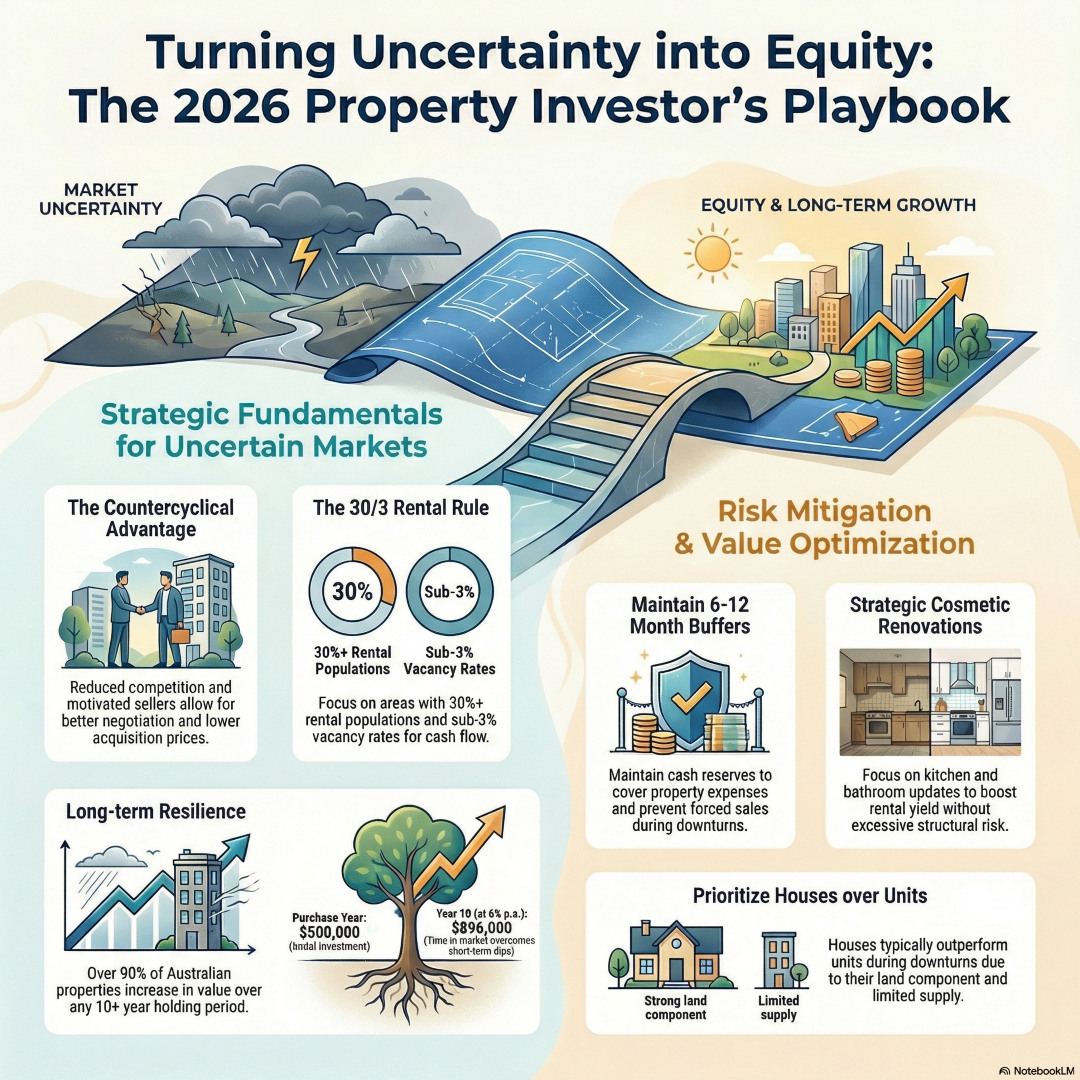
When headlines scream about market instability and economic uncertainty, most investors retreat to the sidelines. This collective fear creates exactly the environment where savvy property investors thrive. Uncertain markets typically feature reduced competition, motivated sellers, and improved negotiating power for buyers.
The concept of countercyclical investing – going against prevailing market sentiment – forms the backbone of successful property investment during turbulent times. When panic grips the market and prices soften, quality properties become available at prices that wouldn’t exist during boom periods.
Rita, a 45-year-old professional with a nearly paid-off home, exemplifies the type of investor who can capitalise on uncertain markets. With stable income and existing equity, she has the financial capacity to act when others cannot. Her challenge isn’t lack of opportunity – it’s overcoming the fear of making decisions during uncertain times.
Market uncertainty often reveals the true quality of investment locations. Areas with strong fundamentals – good transport links, employment centres, schools, and established infrastructure – tend to hold their value better than speculative growth areas. This makes uncertain periods ideal for acquiring properties in proven locations that may have been overpriced during boom times.
The most successful property investment strategy during uncertain markets remains refreshingly simple: buy well-located property and hold for the long term. Australian property data consistently shows that over 90% of homes appreciate in value over 10+ year holding periods, regardless of short-term market fluctuations.
The mathematics of property investment favour patient investors. A property purchased for $500,000 that grows at 6% annually becomes worth approximately $896,000 after 10 years. Even if market uncertainty delays this growth for 2-3 years initially, the long-term result remains compelling.
I remember one woman who joined a mentor call of mine back in late 2023. She had spent years watching the headlines, waiting for that “perfect” moment when the clouds would part and the market would finally feel safe. She was so paralyzed by the fear of getting it wrong that she chose to do nothing at all. While she sat on the sidelines, she watched two different growth cycles pass her by. By the time we spoke, she realized that her desire for absolute certainty had actually cost her hundreds of thousands of dollars in potential equity. It was a stark reminder that the danger of inaction is often far more expensive than the risks of an uncertain market. She didn’t lose money on a bad investment – she lost the financial freedom she would have had today if she had simply started five years earlier.
This real-world cost of hesitation is why, during uncertain markets, focus shifts from speculative capital gains to sustainable rental income. Properties in areas with at least 30% rental populations and vacancy rates under 3% provide reliable cash flow that helps weather market storms. These locations often feature a mix of professionals, families, and students who require stable housing regardless of economic conditions.
Consider targeting suburbs adjacent to already-established growth areas – this is known as the ripple effect phenomenon. When premium areas become unaffordable, demand flows to neighbouring suburbs with similar amenities but lower entry costs. This strategy provides growth potential while reducing the premium typically paid for already-recognised hotspots.
Uncertain markets demand conservative financing approaches that prioritise flexibility over maximum leverage. Maintaining borrowing capacity below maximum approved limits creates a crucial buffer that enables opportunistic purchases when market conditions deteriorate.
Interest-only loans often suit uncertain market conditions better than principal-and-interest loans for investment properties. The reduced monthly commitments preserve cash flow and borrowing capacity, allowing investors to service multiple properties while maintaining financial flexibility.
However, this strategy requires discipline. The cash flow savings should be directed toward building emergency reserves or preparing for additional property purchases, not lifestyle inflation. A solid emergency fund covering 6-12 months of property expenses provides peace of much-needed mind and prevents forced sales during difficult periods.
Property selection becomes even more critical during uncertain times. Houses typically outperform units during market downturns due to their land component and limited supply. However, apartments in high-demand rental areas can offer superior yields that support cash flow during extended low-growth periods.
Market uncertainty often creates ideal conditions for value-adding renovations. Reduced demand for tradespeople can result in more competitive pricing, while motivated property sellers may accept offers on properties requiring cosmetic improvements.
Strategic renovations should focus on improvements that boost rental income or property value without major structural changes. Kitchen and bathroom updates, fresh paint, quality flooring, and improved gardens typically provide strong returns while remaining within manageable budgets.
The key is avoiding over-renovation for the area. A $50,000 renovation that increases property value by $80,000 and rental income by $50 per week provides excellent returns. However, the same renovation in a lower-value area might only add $30,000 in value, making it economically unviable.
During uncertain markets, renovation strategies should prioritise rental appeal over pure capital growth. Properties that command premium rents provide stable returns regardless of short-term capital movements. Features like air conditioning, secure parking, quality appliances, and outdoor spaces become valuable differentiators in competitive rental markets.
Certain market conditions signal exceptional buying opportunities during uncertain periods. These include:
Rising rental yields despite falling prices: When property prices decline but rents remain stable, yield improvements make purchases more attractive from a cash flow perspective.
Increased auction clearance rates for quality properties: Well-located properties continue selling even during uncertain times, indicating underlying demand strength.
Banks maintaining reasonable lending standards: When quality borrowers can still access finance at reasonable rates, market uncertainty may be sentiment-driven rather than fundamental.
Infrastructure investment announcements: Government infrastructure projects often continue during uncertain times, providing long-term growth catalysts for affected areas.
The Australian property market has demonstrated remarkable resilience through various uncertain periods – the 1990s recession, GFC, and recent pandemic disruptions. Each time, patient investors who maintained quality holdings and avoided forced sales ultimately benefited from post-crisis recovery phases.
Successful property investors understand that uncertain markets are temporary phases within longer economic cycles. Rather than attempting to time perfect entry and exit points, focus on building a diversified portfolio that can weather various market conditions.
This approach requires understanding your investment timeline and risk tolerance. Investors like Rita, approaching retirement, may prioritise cash flow and capital preservation over aggressive growth. Younger investors might accept higher risk for greater long-term returns, using uncertain markets to acquire properties they couldn’t afford during boom periods.
Property investment during uncertain markets rewards patience, preparation, and perspective. Investors who maintain long-term focus while others react emotionally to short-term volatility consistently achieve superior results. The key is distinguishing between temporary market sentiment and fundamental economic changes that might genuinely alter long-term property prospects.
Market uncertainty also highlights the importance of professional guidance. Working with experienced investment property mortgage brokers and property advisors provides access to market insights and financing options that individual investors might miss.
The most successful property investors don’t wait for perfect market conditions – they develop strategies that work across different economic cycles. Whether you’re concerned about current market uncertainty or preparing for future opportunities, having the right financial structure and professional guidance makes all the difference.
Book a mortgage review call today to discuss how your current financial position can be optimised for property investment success, regardless of market conditions. Our experienced team will help you understand your borrowing capacity, identify suitable investment strategies, and develop a framework that positions you to benefit from both uncertain and stable market periods.
Don’t let market uncertainty prevent you from building long-term wealth through property investment. The right preparation and professional support can turn uncertain times into your greatest opportunity for financial growth.
What are the best property investment strategies during uncertain markets?
The most effective strategies include buy-and-hold investing in well-located properties, countercyclical investing when others are fearful, focusing on areas with strong rental demand (30%+ renters, sub-3% vacancy), and maintaining conservative gearing with cash flow buffers. These approaches allow investors to capitalise on market opportunities while minimising downside risk during volatility.
Is it safe to invest in property during market uncertainty?
Property investment can be safer during uncertain markets if you focus on fundamentals: quality locations, strong rental demand, conservative financing, and long-term holding strategies. Market uncertainty often creates better buying opportunities for prepared investors with stable income sources and the patience to ride out short-term volatility for long-term gains.
How much deposit do I need for investment property during uncertain markets?
Most lenders require 20% deposit for investment properties, though some accept 10% with Lenders Mortgage Insurance. During uncertain markets, having larger deposits (25-30%) provides better loan terms, stronger negotiating power with sellers, and creates a safety buffer against potential short-term market corrections or interest rate rises.
Should I wait for markets to stabilise before investing in property?
Waiting for “perfect” market conditions often means missing the best opportunities. Over 90% of Australian properties increase in value over 10+ year periods regardless of short-term uncertainty. Quality properties in good locations with strong rental demand can perform well through various market cycles, making timing less important than property selection and financial preparation.
What areas should I target for property investment during uncertain economic times?
Focus on suburbs with established infrastructure, diverse employment, good transport links, and strong rental demand. Areas adjacent to established growth zones (ripple effect) often provide good value. Avoid speculative developments and prioritise locations with proven rental markets and low vacancy rates that will remain resilient during economic downturns.
There is no single magic switch, but there are several proven levers you can pull to reduce your monthly mortgage payments - and the right one...

The first time home buyer mortgage process follows six clear steps: sort your finances, save a deposit, speak to a mortgage broker, secure...