
Are Mortgage Calculators Accurate?
https://vimeo.com/1186811137/1b4b319ef3 Most Australians start their property journey on an online mortgage calculator. The maths it returns...
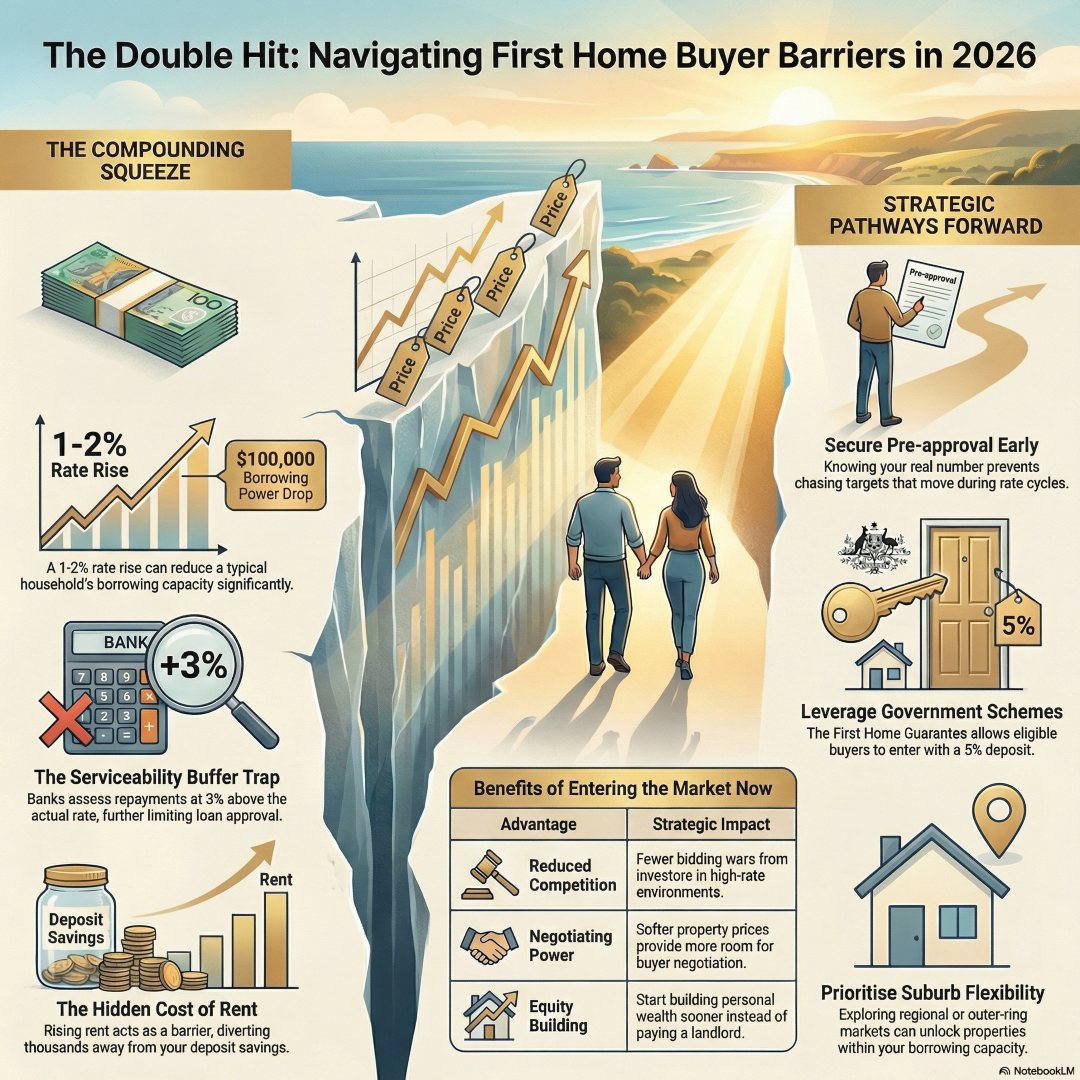
When inflation climbs and interest rates follow, the first home buyer barriers that were already steep become near-vertical walls. It is not just about a bigger deposit or a higher repayment. It is a compounding squeeze – rising living costs reduce what you can save each month, while higher rates slash the amount banks are willing to lend you. For most aspiring buyers aged 25-35 in Australia, this dual pressure creates one of the most frustrating environments in a generation: working harder, earning more, and still falling behind.
Most people understand that higher interest rates mean higher repayments. What is less obvious is how inflation compounds that problem long before you ever sign a contract.
Consider Jess, a 29-year-old nurse in Brisbane earning $85,000 a year. She has been saving diligently for two years, putting away $800 a month. Then inflation pushes up her weekly grocery bill, energy costs, and rent. Suddenly that $800 becomes $500. And when the RBA lifts the cash rate, her bank reassesses what she can borrow – and the number drops by $60,000 to $80,000 in a single cycle.
That is not a hypothetical. That is the lived experience of thousands of Australians right now. Inflation erodes purchasing power in two directions at once – what you can save, and what you can spend. For first home buyers, both matter enormously.
One of the most demoralising first home buyer barriers in a high-inflation environment is that the goalposts keep shifting.
When living costs rise, your savings rate drops. But property prices – particularly in metro areas – do not always fall in line with rising rates. In fact, limited housing supply has kept prices stubbornly high even as rates climbed through 2022 and 2023. So while you are saving more slowly, the 20% deposit target may still be creeping upward.
If you are targeting a $700,000 property, a 20% deposit means $140,000 – plus stamp duty, legal fees, and inspections. That is potentially $165,000 to $175,000 you need in cash before you even walk through the door.
This is precisely where many first home buyers get stuck: they believe waiting until they have a full 20% deposit is the safe, sensible approach. But as one mortgage expert has noted, the biggest first home buyer mistake is often saving too long. Every extra year of saving is another year of rent paid and equity not built.
Schemes like the First Home Guarantee allow eligible buyers to purchase with just a 5% deposit – which means a $35,000 target instead of $140,000 on that same property. Understanding what the latest government home schemes offer is one of the most practical steps a first home buyer can take in a high-inflation, rising-rate environment.
When the RBA raises the cash rate, lenders increase their interest rates accordingly – and their serviceability buffers. In Australia, banks are required to assess whether you can afford repayments at a rate approximately 3% above the actual rate on offer. So if rates sit at 6.5%, you need to prove you could manage repayments at 9.5%.
This buffer exists to protect you – but in a rising-rate environment, it also means your approved borrowing amount can fall substantially within a short period.
For a couple earning a combined $160,000 a year with moderate expenses, the difference between being assessed at a 6% rate vs a 9% buffer can translate to $100,000 or more in reduced borrowing capacity.
That’s the difference between the suburb they want and a suburb they’ll settle for – or between getting into the market now and waiting another 18 months.
Understanding your borrowing capacity and how to protect it is one of the most strategic conversations you can have with a mortgage broker before you start house hunting. Knowing your real number – not a rough estimate from an online calculator – lets you set a realistic plan rather than chasing a moving target.
Here is an irony that catches many first home buyers off guard. Inflation does not just push up grocery bills – it pushes up rent. Landlords respond to higher costs and higher mortgage rates by increasing rents, which means the very thing keeping you out of property ownership is actively working against you.
If your rent increases by $150 per week – a realistic figure in many Australian cities over the past two years – that is $7,800 per year no longer available for your deposit savings. Over three years of waiting, that is $23,400 that went to your landlord instead of your own asset.
This is why many experienced brokers and financial advisers argue that waiting is never truly risk-free. The alternative to buying is not simply doing nothing – it is actively losing money to rent while property prices and interest rates move in ways entirely outside your control.
Building a clear picture of your first home savings strategy – including what you’re losing by waiting – is a critical first step in making a genuinely informed decision.
The good news is that a rising-rate, high-inflation environment doesn’t have to mean permanent exclusion from the property market. The buyers who succeed aren’t always those with the highest incomes – they’re the ones with the clearest strategy.
Here’s what a practical response looks like:
Understanding why interest rates rise during inflation can also help you make sense of the economic environment you’re navigating – and make better decisions about fixed vs variable rates when you do purchase.
The short answer: for most first home buyers, yes – provided you have a structured plan and realistic expectations.
The longer answer is more nuanced. If you’re buying a home you intend to live in for at least five to seven years, the short-term discomfort of a higher repayment is typically outweighed by the long-term benefit of owning an appreciating asset. Australian property has historically recovered from rate-driven downturns, and buyers who entered during peak-rate periods in previous cycles have generally been well rewarded once rates normalised.
What matters most is not the rate environment at the time of purchase – it’s whether your loan is structured correctly, your deposit strategy is sound, and your repayments are comfortably within your means.
Check out the ICM Hub for tools, resources, and guidance designed to help you navigate your property journey — without the overwhelm.
What are the main barriers first home buyers face when inflation and interest rates rise?
The two biggest barriers are reduced savings capacity and reduced borrowing power. Inflation increases everyday living costs, leaving less money to put toward a deposit. Higher interest rates lower the amount lenders are willing to approve, meaning buyers can afford less even when their income stays the same. Together, these two forces create a compounding squeeze on first home buyers.
How much can rising interest rates reduce a first home buyer’s borrowing capacity in Australia? It varies depending on income, expenses, and lender, but a sustained increase in the cash rate of 1% to 2% can reduce borrowing capacity by $50,000 to $100,000 or more for a typical household. Australian banks also apply a 3% serviceability buffer above the actual rate, which further limits borrowing power during rate-rising cycles.
Is it better to wait until rates fall before buying your first home?
Waiting carries its own risks. While you wait for rates to fall, you continue paying rent (which may itself be rising), and property prices may recover before you have enough saved. Many buyers who waited through previous rate cycles missed subsequent price growth. Getting structured advice about your individual position is more useful than timing the market.
How does the First Home Guarantee help during high inflation and rising rates?
The First Home Guarantee allows eligible first home buyers to purchase with just a 5% deposit without paying Lenders Mortgage Insurance (LMI). This dramatically reduces the deposit target and gets buyers into the market sooner – before further price growth – even when their savings rate has slowed due to inflation.
What deposit do first home buyers need in Australia in 2026?
With standard lending, you typically need a 20% deposit to avoid LMI. However, government schemes like the First Home Guarantee reduce this to 5% for eligible buyers. On a $700,000 property, that’s the difference between needing $140,000 and needing $35,000 – a significant change for buyers whose savings have been slowed by rising living costs.
https://vimeo.com/1186811137/1b4b319ef3 Most Australians start their property journey on an online mortgage calculator. The maths it returns...
The instinct makes perfect sense. You see government targets for 1.2 million new homes, headlines about record building approvals, and your first...