

Your loan will usually roll automatically onto your lender’s variable revert rate unless you arrange another option. Understanding what happens when fixed rate ends matters because that rate may be higher than both your old fixed rate and the lender’s most competitive variable offer. You can negotiate with your lender, refix, choose a split loan or refinance, but the right decision depends on the total cost, flexibility and your plans. Start comparing around three months before expiry rather than accepting the automatic rollover.
Key Takeaways
- Your loan will usually revert automatically to a variable interest rate.
- The lender’s revert rate may not be its most competitive available rate.
- Begin reviewing your options approximately three months before expiry.
- Compare fees, features and flexibility rather than focusing only on interest rates.
- Refixing, refinancing or splitting the loan should support your longer-term property plans.
What Happens to Your Loan After the Fixed Period Finishes?
When you have a fixed rate home loan expiring, the mortgage continues but your repayment certainty ends. Your lender will normally transfer the outstanding balance to the variable rate specified in your agreement. This may be called the standard variable rate or revert rate.
You usually do not need to complete a new application for this rollover. However, taking no action means accepting the lender’s default pathway, which could cause home loan repayment shock.
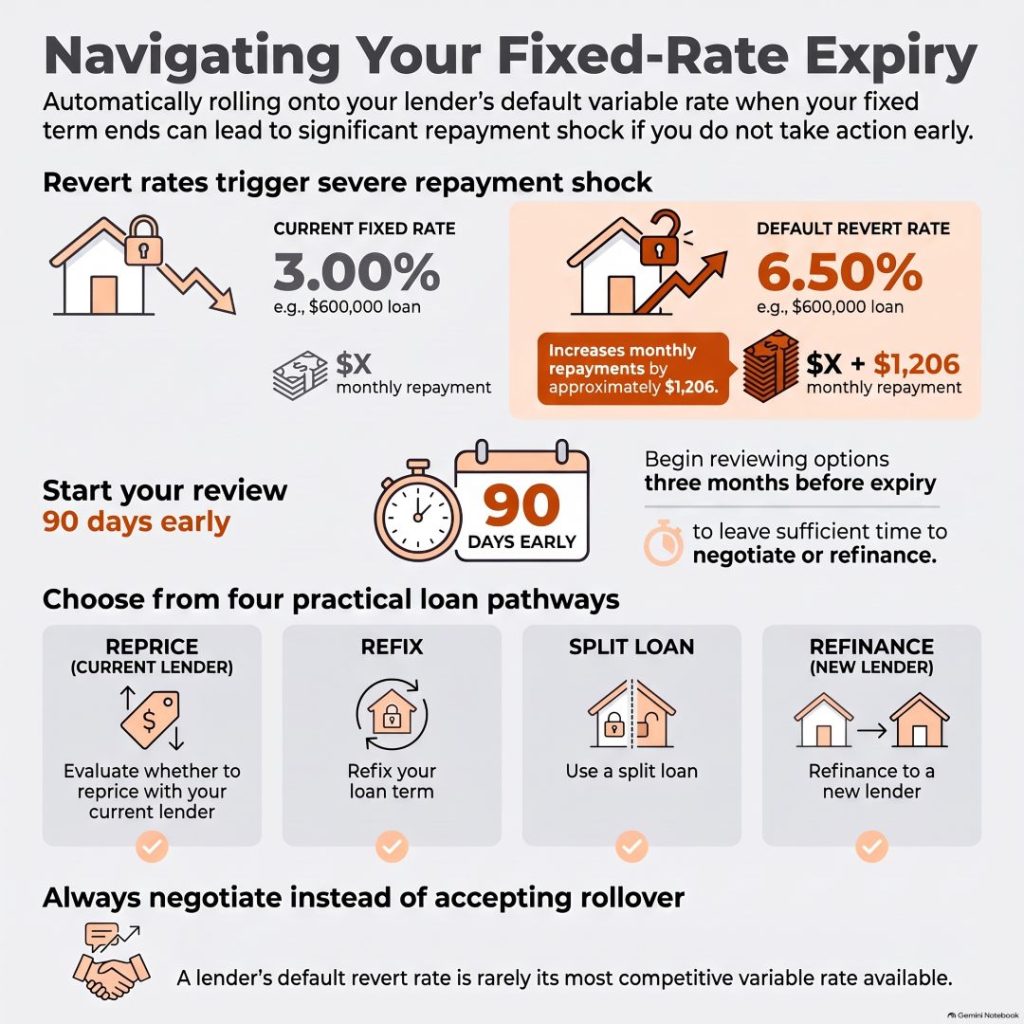
Consider an illustrative $600,000 principal-and-interest loan with 25 years remaining:
| Loan position | Interest rate | Approximate monthly repayment |
| Existing fixed period | 3.00% | $2,845 |
| Variable revert rate | 6.50% | $4,051 |
| Estimated change | +$1,206 per month |
These estimates demonstrate the potential impact of a standard variable rate after fixed term. Your actual repayment will depend on your balance, remaining term, repayment type and lender’s offer.
Why Is the Mortgage Revert Rate Important?
The mortgage revert rate Australia borrowers receive is not necessarily the most competitive variable rate their lender offers.
Pricing can differ based on loan size, loan-to-value ratio, repayment history and customer profile. A borrower who requests a pricing review may receive a better discount than someone who accepts the automatic rollover.
Before accepting the revert rate:
- Ask for the proposed rate in writing.
- Request the lender’s most competitive rate for your circumstances.
- Ask to speak with its retention team.
- Obtain comparable offers from other lenders.
- Compare total costs, features and flexibility.
I experienced the value of persistence firsthand when my own fixed loan rate with RAMS was expiring. The lender initially offered me a new rate of 5.33%. Rather than accepting the first offer, I kept asking questions and checking what else was available. The rate was reduced to 4.14% and, after further discussion, to 3.13% for some of my lending. Even with my industry experience, I still had to ask more than once to uncover the most competitive rate for my situation. It reinforced why borrowers should negotiate and compare before automatically accepting a lender’s first offer.
A better rate may be available without refinancing. However, the lowest rate may not provide the most suitable outcome if you lose an offset account, repayment flexibility or features required for your next property purchase.
What Should You Do Three Months Before Your Fixed Rate Expires?
Start a structured review approximately 90 days before expiry. This provides time to compare your fixed rate expiry options Australia, negotiate with your lender and complete a refinance if appropriate.
Step 1: Confirm the expiry details
Ask your lender for:
- The exact fixed-rate expiry date
- The proposed revert rate
- Your balance and remaining term
- Annual or package fees
- Available fixed, variable and split-loan options
Step 2: Test the repayment impact
Calculate repayments at the proposed rate and at least one higher rate. The RBA cash rate impact on mortgage repayments may not be immediate or identical across lenders, so test whether your budget could manage another increase.
Step 3: Review your plans
Consider whether you expect to sell, renovate, make additional repayments, access equity, buy an investment property or reduce your working hours. Your plans may make flexibility more valuable than a slightly lower advertised rate.
Should You Reprice, Refix, Split or Refinance?
There are four practical options when your fixed period ends.
| Option | May suit borrowers who | Main consideration |
| Reprice | Want to remain with their lender | A better variable rate may be available |
| Refix | Prioritise repayment certainty | Restrictions and break costs may apply |
| Split | Want certainty and flexibility | Each loan portion has different rules |
| Refinance | Can obtain a better overall structure | Costs and eligibility must be assessed |
Reprice with your existing lender
Request a formal pricing review supported by comparable offers. This may reduce your rate without discharge, application or valuation costs.
Refix all or part of the loan
A new fixed term can provide certainty, but it may restrict additional repayments, offset access, refinancing and equity releases. Anyone researching refix home loan Australia options should consider both flexibility and possible mortgage break costs Australia if circumstances change.
Read our guide to fixed versus variable rates when comparing a fixed vs variable home loan 2026.
Use a split loan
A split loan fixes part of the balance and leaves the remainder variable. This can provide some repayment certainty while preserving access to variable features.
Refinance to another lender
People searching for refinance fixed rate mortgage Australia should compare long-term savings with discharge, settlement, application, valuation, registration and package fees. Lenders Mortgage Insurance may also apply where the loan-to-value ratio exceeds the new lender’s threshold.
Use this calculation:
Total switching costs ÷ monthly saving = break-even period
If refinancing costs $2,400 and saves $200 per month, the break-even period is 12 months. Read our refinance now or wait checklist before applying.
Pros and Cons of Your Fixed Rate Expiry Options
Pros of Refixing Your Home Loan
- Predictable repayments
- Protection from variable-rate increases
- Easier household budgeting
- Reduced cash-flow uncertainty
Cons of Refixing Your Home Loan
- Potential break costs
- Restricted additional repayments
- Limited offset or redraw features
- No benefit if variable rates fall
Pros of Moving to a Variable Rate
- Greater repayment flexibility
- Potential offset and redraw access
- Easier refinancing or selling
- Possible savings if rates fall
Cons of Moving to a Variable Rate
- Repayments can rise
- Budgeting is less predictable
- The revert rate may be uncompetitive
- Rate increases may pressure household cash flow
What Mistakes Should You Avoid?
The most expensive mistake may be doing nothing. Other common errors include waiting until the final week, refixing because of headlines, refinancing for cashback alone, making multiple applications and extending the loan term without calculating total interest.
The phrase mortgage cliff Australia 2026 may sound alarming, but your decision should be based on your actual balance, budget and plans rather than media headlines.
How Can You Compare Fixed and Variable Options?
Model every option using the same balance, remaining term and expected holding period. Compare interest, fees, offset benefits, repayment limits and certainty.
The Fix or Float Calculator in the Investors Choice Mortgages Hub can help you compare fixed and variable options over one to five years.
Take Control Before the Automatic Rollover
A fixed-rate expiry is an opportunity to check whether your mortgage still supports your household, property plans and long-term financial security. Confirm the revert rate, model the repayment change and compare repricing, refixing, splitting and refinancing.
If your fixed term is approaching, book a strategy call with us. We can help you understand the costs, compare suitable options and avoid automatically rolling onto an uncompetitive rate. Visit the Investors Choice Mortgages Hub to start comparing your options.
Frequently Asked Questions
What happens when a fixed-rate mortgage expires in Australia?
The loan generally rolls onto the lender’s nominated variable revert rate unless you arrange another option. Repayments are recalculated using that rate, your balance and remaining term.
How early should I review my home loan before the fixed rate expires?
Begin approximately three months before expiry. This allows time to negotiate, compare alternatives and complete a refinance if required.
Should I refinance when my fixed rate ends?
Refinancing may be suitable if the long-term savings and strategic benefits exceed all switching costs. Compare the break-even period, loan features and future borrowing needs.
Can I refix my home loan after the fixed term ends?
Yes, subject to available products and eligibility. Check repayment restrictions, offset availability and potential break costs before refixing.
Will I pay break costs after my fixed rate has expired?
Break costs generally relate to leaving during the fixed period and usually cease when it ends. Discharge, settlement and refinancing costs may still apply, so confirm all fees with your lender.