

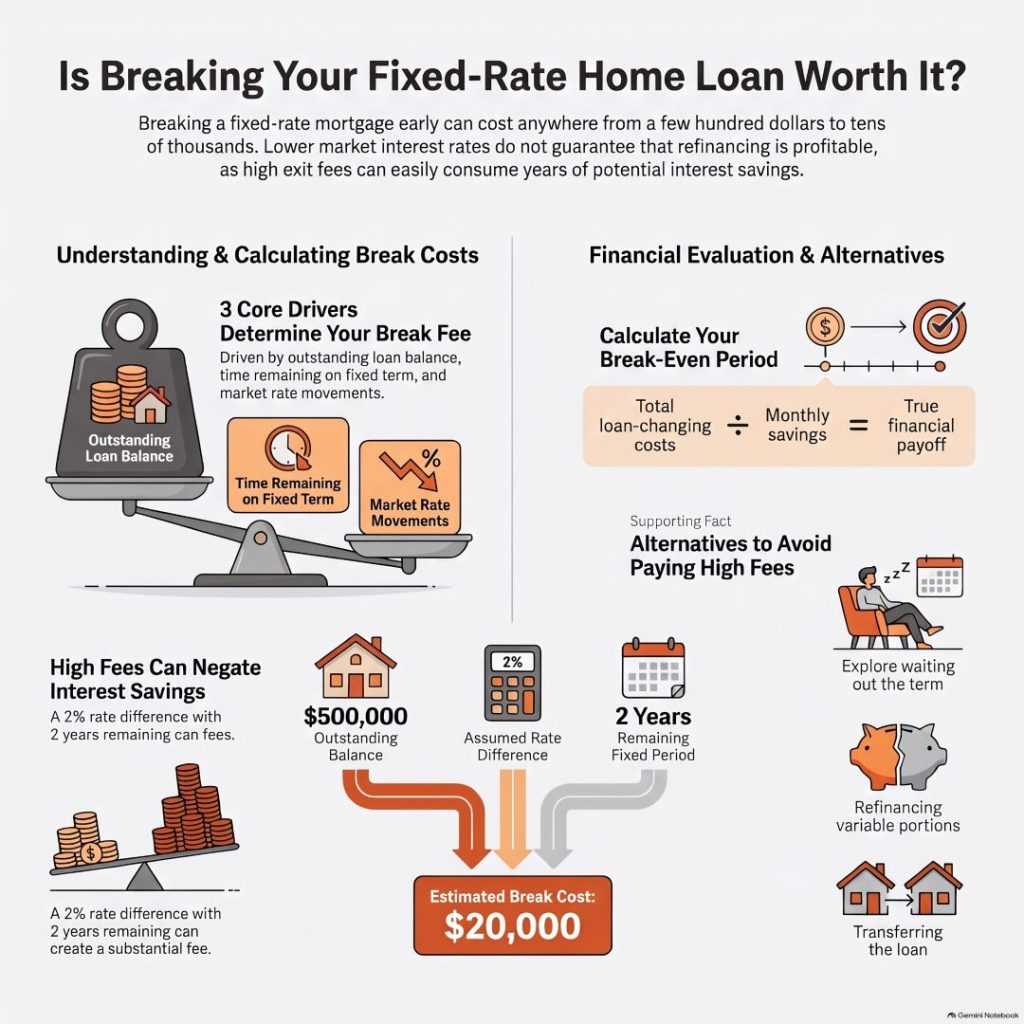
Breaking a fixed loan can cost anywhere from a few hundred dollars to tens of thousands. The amount depends mainly on your outstanding balance, the time remaining on your fixed term and how market funding rates have moved since you fixed. A lower available rate does not automatically make refinancing worthwhile because the exit cost can absorb years of potential savings. To answer “how much does it cost to break a fixed rate home loan?”, compare the lender’s written quote with refinancing fees, repayment savings and your longer-term property strategy before making a decision about changing your loan early today.
Key Takeaways
- Break costs can range from a small administration fee to tens of thousands of dollars.
- A larger balance, longer remaining term and falling market rates generally increase the cost.
- Your lender’s written payout quote is the only reliable figure for your loan.
- Compare the total cost of leaving with the total financial benefit, not just the new interest rate.
- Waiting may reduce the fee, but it could delay a valuable refinancing or investment opportunity.
What Is a Fixed Rate Home Loan Break Cost?
A fixed rate home loan break cost is an amount a lender may charge when you change or repay a fixed loan before the agreed fixed period ends.
When you fix your rate, the lender commits to providing your loan at that price for a set period and may arrange funding accordingly. If you end the agreement early after comparable market rates have fallen, the lender may incur an economic loss.
The charge may be called:
- A break cost
- An economic cost
- An early repayment adjustment (ERA)
- A fixed rate exit fee
- An early termination cost
It is not always a simple penalty listed in a fee schedule. The economic component may change daily as market rates move. Administration and discharge fees may also apply under your loan contract.
How Is a Fixed Rate Break Fee Calculated in Australia?
Lenders generally compare the funding position when your rate was fixed with the current market position for the remaining fixed term.
A simplified formula is:
Outstanding loan balance × rate difference × remaining fixed term
This formula is only an educational estimate. Lenders use their own contractual formulas and funding assumptions. Some may refer to wholesale benchmarks, including the Bank Bill Swap Rate (BBSW), rather than the advertised home loan rate.
The three main influences are:
- Outstanding balance: A cost calculated on 700,000 will generally be higher than one calculated on 200,000.
- Time remaining: Leaving with two years remaining may cost substantially more than leaving with two months remaining.
- Market rate movements: Falling comparable rates may increase the economic cost. If rates have risen, it may be lower or zero.
This is why a break cost calculator Australia homeowners find online can only provide a rough estimate. A BBSW home loan break cost calculation may also differ from a calculation based on advertised rates.
What Could the Break Cost Look Like on a $500,000 Loan?
Consider a homeowner with a $500,000 fixed balance, two years remaining and an illustrative rate difference of two percentage points.
| Item | Illustrative figure |
| Outstanding balance | $500,000 |
| Assumed rate difference | 2% |
| Remaining fixed period | 2 years |
| Simplified estimate | $20,000 |
500,000×220,000
[NOTE: This is an illustrative example, not a lender quote. Actual formulas may account for wholesale funding rates, repayment timing and discounted cash flows.]
Imagine Rita and her husband have nearly repaid their home and want to access equity for an investment property. Paying $20,000 merely to secure a slightly lower rate may be difficult to justify. The decision may look different if refinancing also improves their loan structure, releases usable equity and supports a carefully researched purchase.
That is why refinancing to buy another property should be assessed as a complete strategy rather than a rate chase.
When Can the Break Cost Be Small or Zero?
The economic component may be small or zero when current funding rates are similar to or higher than the rates that applied when your fixed loan began.
However, a zero economic break cost does not necessarily make leaving free. You may still pay:
- Fixed loan administration fees
- Mortgage discharge fees
- New lender application or settlement fees
- Valuation expenses
- Government registration charges
- Lenders mortgage insurance, if applicable
A fixed rate mortgage exit fee may refer only to one component of the total refinancing fixed rate home loan cost. If your term is nearly finished, review what happens when a fixed rate ends before changing your loan.
Is It Worth Paying the Break Cost to Refinance?
It may be worthwhile when the measurable benefits exceed the total costs and the replacement loan supports your longer-term goals.
Use this calculation:
Total expected benefit – total cost of changing loans = estimated net benefit
If exit and refinancing costs total 12,000 and the new loan is expected to save 650 per month, the approximate break-even period is 18.5 months. This estimate assumes the rates, fees and balance do not change.
Also consider whether refinancing could:
- Reduce repayments
- Improve cash flow
- Provide an offset account
- Release equity for another purchase
- Correct an unsuitable structure
- Improve future borrowing flexibility
Before proceeding, consider whether you should refinance now or wait.
Breaking or Keeping the Fixed Loan: Pros and Cons
| Option | Potential benefits | Potential drawbacks |
| Break the loan | Access a more suitable rate, features or structure; release equity; improve flexibility | Pay a potentially substantial break cost and new loan fees |
| Keep the loan | Maintain predictable repayments; avoid an immediate break cost; reduce paperwork | Remain in an unsuitable structure or miss a strategic opportunity |
Extending your loan term while refinancing can also increase total lifetime interest, even if monthly repayments fall. Investors comparing fixed vs variable home loan Australia options can read about fixed versus variable rates for investment properties.
How Do You Get an Accurate Break Cost Quote?
Ask your lender for a written break cost or payout quote before applying for another loan.
- Confirm the fixed balance and expiry date.
- Request the economic break cost and administration fees separately.
- Check how long the quote remains valid.
- Request a complete payout figure, including discharge costs.
- Compare the payout figure with the projected refinancing benefit.
Ask whether extra repayments, selling, changing products or refinancing part of the balance would trigger a cost. Do not submit a discharge request until you understand the financial consequences.
I recently helped a client uncross-collateralise her properties and refinance. Although restructuring made sense, I advised her not to refinance the fixed portion immediately because her rate was highly competitive and breaking the contract would have sacrificed significant financial benefits. It reinforced a principle I share with every client: do not rush a major loan change. Get the facts from your lender first, then weigh the full cost.
How to Avoid Fixed Rate Break Costs
You generally cannot negotiate away a genuine economic loss, but alternatives may include:
- Waiting until the fixed period expires
- Refinancing only the variable portion of a split loan
- Using the permitted extra-repayment allowance
- Keeping the loan while restructuring other debts
- Asking whether the loan can be transferred to another property
- Comparing an internal product change with external refinancing
The lowest immediate cost is not always the strongest long-term strategy. The aim is to preserve useful flexibility without paying a large fee for a limited benefit.
Conclusion: Make the Decision Using the Full Financial Picture
A break fee should never be assessed in isolation. Compare the written payout figure, replacement loan costs, repayment savings, break-even period and strategic value of changing your loan.
Investors Choice Mortgages can help you understand the available pathways without focusing only on the cheapest headline rate. Book your strategy call with us to explore whether breaking, waiting or restructuring could better support your property and financial goals.
Frequently Asked Questions
Can I break my fixed rate home loan early?
Yes. Most fixed loans can be repaid, refinanced or changed before expiry. Your lender may charge an economic break cost, administration fee and discharge costs, so request a written payout quote first.
How much does a fixed rate mortgage exit fee cost in Australia?
A break fee fixed rate mortgage Australia borrowers receive can range from a few hundred dollars to tens of thousands. The amount depends on the lender’s formula, balance, remaining fixed term and relevant market funding rates.
Is a fixed rate break cost tax deductible on an investment property?
Tax treatment may depend on why the loan ended, how the borrowed funds were used and whether the debt was refinanced. Ask a registered tax agent for advice based on your circumstances.
Can I avoid a break cost by selling my house?
Not necessarily. Selling usually requires the mortgage to be discharged, which can trigger a break cost during the fixed term. Ask whether your lender offers loan portability and whether you meet its conditions.
How long is a lender’s break cost quote valid?
Validity periods vary and may be short because wholesale rates can change daily. Confirm the expiry date, whether the quote is indicative or final, and when the amount will be recalculated.