

Usable equity is the portion of your property’s value that a lender may allow you to borrow against, commonly while keeping total lending at or below 80% of the lender-assessed value. To calculate usable equity, multiply the property value by 80% and subtract your current loan balance. This helps explain usable equity vs home equity, because total home equity is not always accessible. Approval still depends on your income, expenses, debts, loan purpose, credit history and lender policy. Understanding this difference can help you assess whether equity release Australia options support your investment plans without placing unnecessary pressure on your home or long-term financial security.
Key Takeaways
- Total home equity and usable equity are not the same amount.
- The common formula is: (Property value × 80%) − current loan balance.
- Keeping your LVR at or below 80% may help you avoid Lenders Mortgage Insurance.
- The lender’s valuation, rather than an online estimate, normally determines the calculation.
- Equity is security for additional debt. It is not free cash or automatic loan approval.
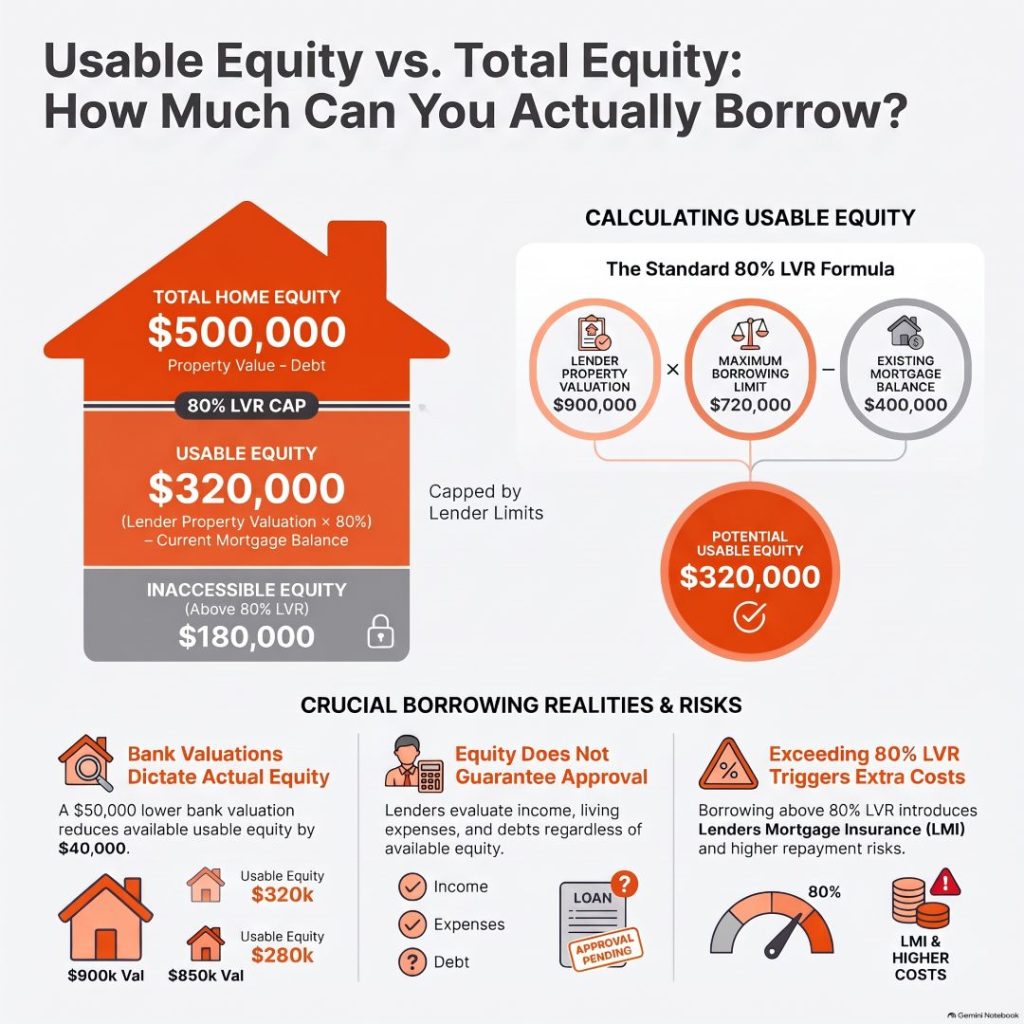
What Is the Difference Between Home Equity and Usable Equity?
Home equity is the difference between your property’s current value and the amount you owe against it.
Imagine you are in your mid-40s. Your children are becoming independent, your mortgage is steadily shrinking and you are wondering whether the family home could help you build a small investment portfolio.
If your property is worth $900,000 and your mortgage balance is $400,000:
Total home equity = $900,00 – 400,000 = $500,000
However, this does not mean you have $500,000 available for a deposit, renovation or second property.
Lenders commonly prefer total debt secured against a property to remain at or below 80% of its assessed value if you want to avoid Lenders Mortgage Insurance, or LMI. As a result, only part of your total equity may be accessible.
| Measure | Calculation | Amount |
| Property value | Lender-assessed value | $900,000 |
| Current mortgage | Existing loan balance | $400,000 |
| Total home equity | $500,000 | |
| Maximum debt at 80% LVR | $900,000 × 80% | $720,000 |
| Potential usable equity | $320,000 |
This total equity vs usable equity distinction matters because your property may look wealthy on paper while your borrowing capacity remains limited.
How to Calculate Usable Equity
The commonly used formula is:
Usable Equity = (Property Value × 80%) – Outstanding Loan Balance
For example:
- Lender valuation: $600,000
- Outstanding mortgage: $300,000
- Maximum lending at 80% LVR: $480,000
- Potential usable equity: $180,000
The calculation is:
$600,000 × 0.80 = $480,000
$480,000 – $300,000 = $180,000
This is an estimate, not loan approval. The lender must still determine whether you can service the increased debt and whether the intended use meets its credit policy.
For a more reliable starting point, learn what happens during a bank property valuation before relying on an agent’s appraisal or property website estimate.
Why Does the 80% LVR Equity Threshold Matter?
Loan-to-value ratio, or LVR, compares the debt secured against a property with its lender-assessed value:
LVR = Total secured lending ÷ Property value × 100
If your home is valued at $800,000 and the total secured lending is $640,000, your LVR is 80%.
Borrowing above 80% LVR may trigger LMI and stricter lending requirements. LMI generally protects the lender if a borrower defaults and the property sale does not recover the debt. It does not protect you from repayment difficulties or financial loss.
Although some lenders permit borrowing above 80% LVR, this may involve:
- An LMI premium
- Higher repayments
- Different rates or loan conditions
- Less protection if property prices fall
- Greater pressure if your income changes
The maximum available is not necessarily the right amount to use.
Does Having Equity Guarantee Loan Approval?
No. Equity provides security, while borrowing capacity indicates whether a lender believes you can repay the debt.
A household may have $300,000 available under the 80% LVR calculation but still be unable to borrow that amount. Lenders may assess:
- PAYG, self-employed and rental income
- Mortgage and personal loan repayments
- Credit card limits
- Household and dependant expenses
- Interest-rate serviceability buffers
- Remaining loan term and retirement plans
- The purpose and structure of the lending
Our guide to property investment borrowing capacity explains why lenders can reach different results using the same household income.
How Can a Bank Valuation Affect Usable Equity?
Suppose you estimate your home is worth 1 million and you owe $600,000:
$1,000,000 × 80% – $600,000 = $200,000
If the lender values it at $950,000:
$950,000 × 80% – $600,000 = $160,000
A $50,000 valuation difference reduces the potential usable equity by $40,000.
Valuations can differ between lenders because they use different valuers, comparable sales, assessment methods and risk settings. A strategic mortgage review may therefore be more useful than applying immediately to your existing bank.
How Can You Use Equity to Buy an Investment Property?
Using equity as a deposit may help fund an investment property deposit and purchasing costs, subject to approval. These costs may include:
- Stamp duty
- Conveyancing and searches
- Building and pest inspections
- Lender and settlement fees
- An emergency cash reserve
Released funds are commonly established through a new loan split, loan increase or separate facility secured against your existing property. The money remains borrowed and interest applies.
Clear loan separation may make record-keeping easier when funds are used for investment. Obtain lending, tax and legal advice before proceeding. You can also read our guide to refinancing to buy another property.
What Are the Pros and Cons of Accessing Equity?
Potential Benefits
- You may avoid LMI by remaining at or below 80% LVR.
- Existing property wealth may help fund another purchase.
- A separate loan split can support clearer record-keeping.
- You may retain cash savings as an emergency reserve.
Potential Risks
- Your debt and repayments increase.
- Your home may secure debt used for an investment.
- Interest applies to every amount drawn.
- Falling property values can reduce your equity buffer.
- Borrowing above 80% LVR may limit lender choices and trigger LMI.
Before proceeding, consider the risks of using your home as a bank.
How Much Equity Should You Leave Untouched?
A prudent investor does not automatically release every available dollar. Keeping a buffer can help cover repairs, vacancies, insurance excesses, rate increases, income disruption and family expenses.
If you can release $200,000 but your planned deposit and costs require $140,000, borrowing the full amount may add unnecessary interest and risk.
The better question is not, “What is the maximum the bank will lend?” It is, “What amount supports our next step without placing our home, lifestyle or retirement plans under avoidable pressure?”
Conclusion: Turn Your Equity Estimate Into a Safe Strategy
The formula provides a starting point, but your decision should consider the lender’s valuation, your borrowing capacity and the buffer you want to preserve.
Investors Choice Mortgages provides personalised, transparent guidance to help homeowners structure lending around their long-term property goals. Book a strategy call with us to understand what you may be able to access, comfortably service and structure for greater flexibility.
Frequently Asked Questions
Is usable equity the same as total home equity?
No. Total home equity is the property’s value minus the outstanding mortgage. Usable equity is generally lower because lenders commonly calculate it against an 80% LVR threshold when avoiding LMI.
How much equity can I borrow against in Australia?
A common estimate is 80% of the lender-assessed property value minus your existing secured loan balance. The approved amount may be lower due to serviceability, credit history, loan purpose and lender policy.
Can my usable equity fall without me borrowing more?
Yes. If the lender-assessed property value falls, your usable equity can decrease even when the loan balance remains unchanged. A lower valuation may also increase your existing LVR.
How do I access home equity in Australia, and must I use it immediately?
You may apply for a loan increase, new loan split, refinance or another approved credit facility. You do not necessarily need to use the funds immediately, but conditions and interest treatment depend on the facility. Avoid releasing equity without a clear purpose, and obtain tax advice before mixing private and investment expenses.