

Refinancing can create a valuable financial buffer when your new home loan is deliberately structured around lower costs, accessible funds and disciplined spending. The strongest approach is usually to direct repayment savings into a 100% offset account, maintain your previous repayment amount or establish a carefully controlled equity facility. However, refinancing only strengthens financial resilience when the long-term benefit exceeds switching costs and available credit does not become lifestyle debt.
Key Takeaways
- Refinancing can release monthly cash flow, but the saving must be preserved rather than spent.
- A practical buffer generally covers three to six months of loan repayments and essential living expenses.
- Money in a 100% offset account remains accessible while reducing mortgage interest.
- Equity access creates debt, not free cash, so the loan purpose and spending rules matter.
- Refinancing costs, loan terms and future interest must be compared before switching.
How Can Refinancing Create a Financial Safety Net?
Refinancing can help create a financial safety net in two main ways: reducing your home loan costs or providing controlled access to usable equity.
Imagine a couple in their mid-40s with stable PAYG incomes, a $600,000 mortgage and plans to buy an investment property. Their income is comfortable, but their offset balance has fallen below $5,000 after home repairs. A vacancy, job change or unexpected bill could force them to rely on a credit card.
A refinance may provide three improvements:
- A lower interest rate, reducing the required monthly repayment.
- A 100% offset account, allowing surplus income to reduce interest while remaining accessible.
- A separate equity facility, available for approved emergencies or investment purposes.
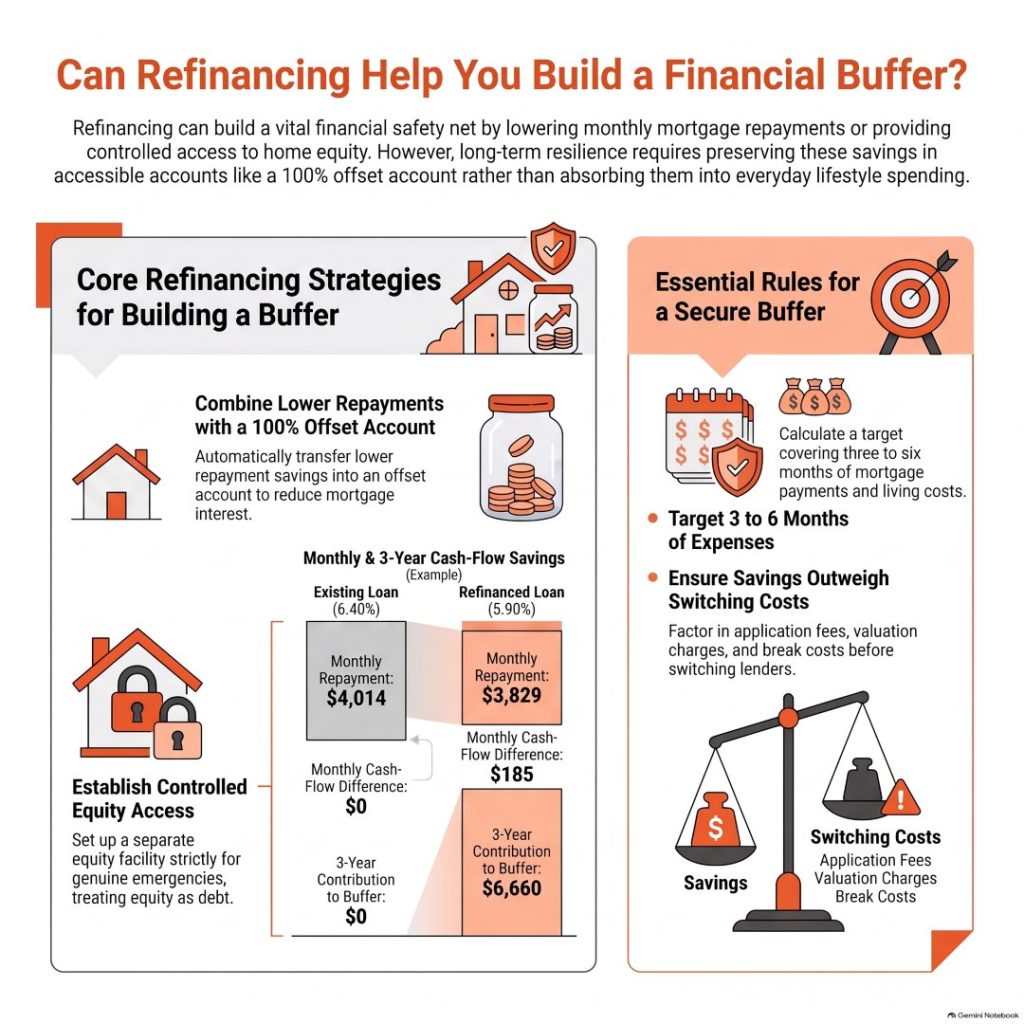
The critical step comes after settlement. If the couple saves $185 each month but absorbs it into everyday spending, their position is no safer. If they automatically transfer that amount into an offset account, they could accumulate approximately $6,660 over three years, before additional contributions and interest savings.
This is refinancing to build savings with a clear purpose, rather than simply changing lenders.
Can Refinancing Save You Money Through Lower Repayments?
A refinance home loan with lower repayments can improve mortgage cash flow when the difference is automatically preserved.
Consider an illustrative $600,000 principal-and-interest loan with 25 years remaining:
| Loan position | Existing loan | Refinanced loan |
| Interest rate | 6.40% | 5.90% |
| Approximate monthly repayment | $4,014 | $3,829 |
| Monthly cash-flow difference | $185 | |
| Three-year contribution to buffer | $6,660 |
These figures are illustrative and will vary according to the lender, fees and repayment frequency.
You could capture the benefit by:
- Continuing to pay approximately $4,014 to reduce the loan faster.
- Paying the new minimum and automatically directing the $185 difference into an offset account.
The second option offers greater liquidity because the money remains available for genuine emergencies. The first can support faster debt reduction, but access may depend on the lender’s redraw rules.
Before refinancing, compare the saving with discharge fees, application costs, valuation charges and any fixed-rate break costs. Learn more in our guide to whether now is a good time to refinance your home loan.
How Much Financial Buffer Should a Homeowner Keep?
A sensible starting point is three to six months of mortgage repayments and essential household expenses.
If your mortgage repayment is $3,500 per month and essential living costs are $3,000, your target could be:
- Three-month buffer: $19,500
- Six-month buffer: $39,000
Property investors may need more because they can also face vacancies, insurance excesses, maintenance and unexpected repairs. Households with variable income, multiple loans or limited insurance may benefit from aiming towards the upper end of the range.
Use the mortgage savings buffer guide to calculate a target based on your commitments.
Is an Offset Account the Best Place for Refinancing Savings?
For many Australian mortgage holders, a 100% offset account is an effective place to hold a financial cushion because it combines accessibility with mortgage interest savings.
If you owe $500,000 and keep $30,000 in a full offset account, interest is generally calculated on $470,000. At a 6% interest rate, that balance could reduce interest by approximately $1,800 over one year, assuming the balance remains constant.
For me, this approach has always been about reducing risk. On every property I’ve bought, I’ve chosen interest-only loans and focused on building money in an offset account rather than paying extra principal unnecessarily. Circumstances change, and although many Australians expect to remain in their property long term, they move every nine years on average. Maintaining a cash buffer gives me flexibility, helps protect me when plans change and turns fear about the unexpected into a practical financial strategy.
Unlike a standard savings account, an offset account does not pay taxable interest. Its value comes from reducing the interest charged on your mortgage. However, some offset products carry package fees or higher rates, so the benefit must justify the cost.
Set a minimum balance that can only be used for an agreed emergency. Learn more about using offset accounts to reduce mortgage interest.
Can Accessing Home Equity Create a Financial Cushion?
Accessing equity can provide a financial cushion, but it creates additional debt rather than additional wealth.
Suppose your home is valued at $900,000 and your mortgage is $500,000. At an 80% loan-to-value ratio, the theoretical lending limit is $720,000, leaving up to $220,000 in usable equity. This amount is not guaranteed, and borrowing the full sum may not be appropriate. Approval depends on income, expenses, credit history, valuation and lender policy.
Possible structures include:
- A line of credit where interest applies to the amount drawn.
- A separate loan split with a clearly defined purpose.
- An equity release held in a linked offset account.
Keep personal, investment and emergency borrowing separate to avoid accounting and potential tax complications. The guide to getting cash from home equity compares equity release, loan top-ups and lines of credit.
What Are the Pros and Cons of Refinancing for a Buffer?
Pros of Lower-Rate Refinancing
- Lower required repayments can improve monthly cash flow.
- Savings can be redirected into an offset account.
- A better loan structure may provide greater flexibility.
Cons of Lower-Rate Refinancing
- Switching fees may outweigh short-term savings.
- Restarting a 30-year term can increase total interest.
- Approval remains subject to current lending requirements.
Pros of Equity-Based Refinancing
- Funds may be available before an emergency occurs.
- A separate facility can keep loan purposes clear.
- With some facilities, interest applies only to funds drawn.
Cons of Equity-Based Refinancing
- Accessible equity is borrowed money that must be repaid.
- Easy access may encourage lifestyle spending.
- A larger credit limit can affect future borrowing capacity.
When Is Refinancing Not Worth It?
Refinancing may not be worthwhile when costs exceed likely savings or the new loan conflicts with your future plans.
Warning signs include:
- A long break-even period when you expect to sell soon.
- Fixed-rate break costs that absorb the saving.
- Refinancing mainly to fund routine expenses, a car or a holiday.
- Extending the loan term without comparing lifetime interest.
- Selecting a lender that restricts future investment plans.
Ask your current lender for a pricing review first. You may receive a lower rate without paying switching costs.
Conclusion
Refinancing is most useful when a stronger loan structure creates lasting financial resilience. Set a three-to-six-month target, automate your savings, protect your offset balance and keep any equity facility separate from everyday spending.
Ready to understand how refinancing may affect your repayments and financial buffer? Visit the Investors Choice Mortgages Hub to access practical tools, calculators and resources that can help you review your position and make a more informed decision.
Frequently Asked Questions
How much can I save by refinancing my home loan?
Your saving depends on the loan balance, rate reduction, remaining term and switching costs. Divide total refinancing costs by the monthly saving to estimate your break-even period.
Should I keep my refinancing savings in an offset or redraw?
An offset account generally keeps your money separate while reducing the balance used to calculate interest. Redraw access depends on lender rules, so review the conditions before relying on it as an emergency fund.
Can I refinance my mortgage to build an emergency fund?
Yes. You may direct lower repayments into an offset account or establish controlled access to equity. The strategy only works when you preserve the funds and the long-term benefit exceeds refinancing costs.
Is it risky to use home equity as a financial buffer?
Yes. Accessed equity is additional borrowing secured against your property. Keep the facility separate, limit its purpose and confirm you could service any amount drawn if rates or household costs rise.
How long does it take to build a financial buffer through refinancing?
Divide your target by the amount you can save each month. A $20,000 target funded at $500 per month would take approximately 40 months, although bonuses, tax refunds and interest savings may shorten the timeframe.