

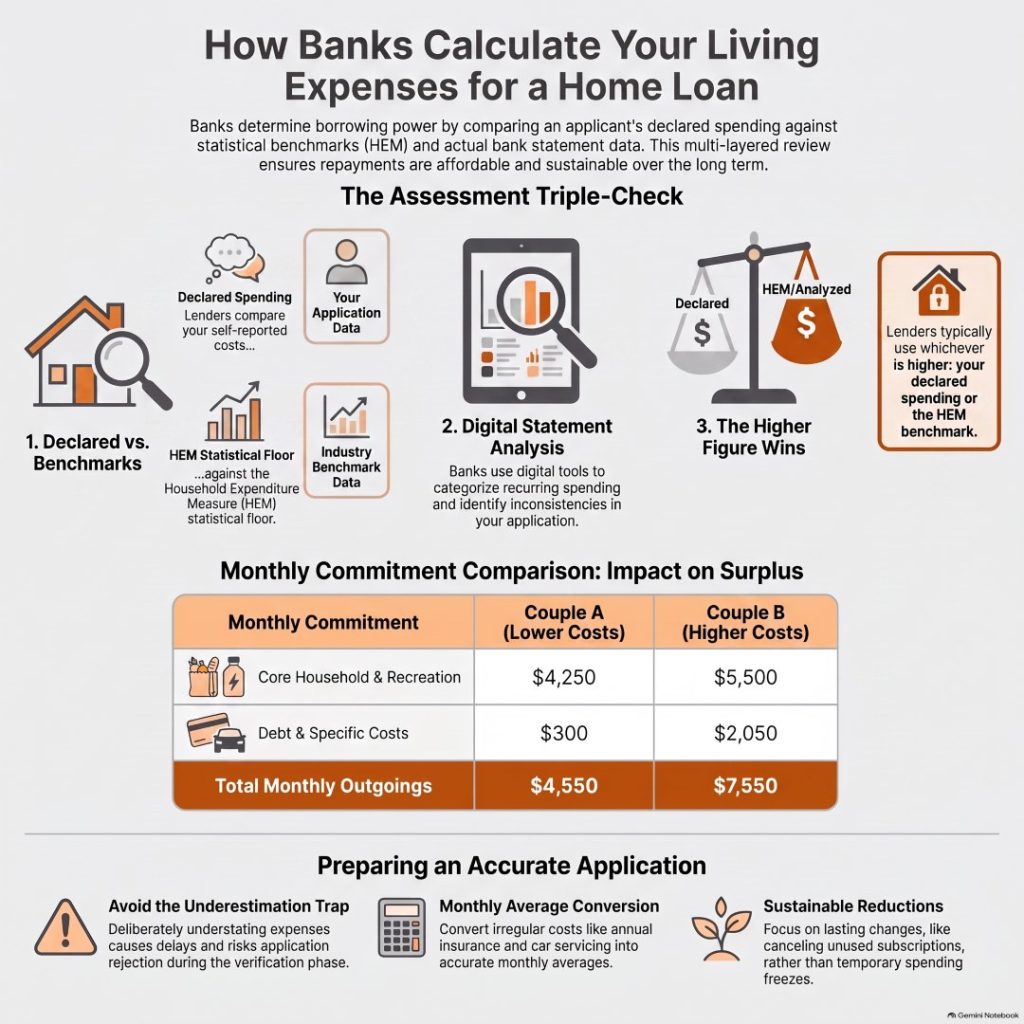
Banks assess your living costs by comparing the expenses you declare with a household spending benchmark, then reviewing supporting information such as transaction and credit card statements. Understanding how banks calculate living expenses matters because lenders will generally use a conservative figure when testing your home loan application. Your household size, dependants, lifestyle, debts and recurring commitments can all influence the result. Because assessment methods vary between lenders, the same applicant may receive different borrowing estimates from different banks. This mortgage living expenses assessment helps establish whether repayments appear affordable now and under the lender’s serviceability settings for your household.
Key Takeaways
- Lenders compare your declared expenses with a household expenditure benchmark.
- Your transaction patterns may be checked against the figures in your application.
- Understating expenses can create delays, questions or an unsuccessful application.
- Higher recurring expenses generally reduce your borrowing capacity.
- The maximum a bank offers may be more than you can comfortably afford.
What expenses do banks look at for a mortgage?
Banks assess the regular costs required to maintain your household and current lifestyle. A living expenses home loan assessment covers more than groceries, electricity and petrol.
Common categories include:
- Groceries and household supplies
- Utilities and telecommunications
- Clothing and personal care
- Transport, registration and insurance
- Medical expenses and private health insurance
- School fees, childcare and child support
- Recreation, dining and entertainment
- Gym memberships, streaming services and subscriptions
- Pet care
- Rent, board or other housing costs
- Home insurance, council rates and strata fees
- Regular financial or professional services
Loan repayments and credit commitments are usually assessed separately. These may include credit cards, car finance, personal loans, buy now pay later accounts and HELP debt.
Use this Australian home loan documents checklist to organise the records required for a bank statements home loan application review.
How does the bank compare declared expenses with HEM?
Most Australian lenders compare your declared spending with a benchmark such as the Household Expenditure Measure. This is commonly known as HEM. Some institutions use modified or proprietary models for their lender assessment of living costs.
HEM is not a personal budget. It is a statistical benchmark based on factors such as:
- The number of adults and children
- Whether you are applying alone or with someone
- Household income
- Where you live
- The expense categories included in the lender’s model
People researching HEM Mortgage Australia may also encounter the term Henderson Poverty Index mortgage assessment. The Henderson Poverty Index influenced historical approaches to minimum living standards, but current mortgage assessments are more commonly associated with HEM and lender-specific models.
A benchmark is a floor, not a target. If your declared spending is below the relevant benchmark, the lender may use its benchmark. If your verified spending is higher, it may use the higher amount.
| Assessment input | What it tells the lender |
| Declared expenses | What you say your household spends |
| Lender benchmark | A minimum estimate for a similar household |
| Transaction history | Whether your figures appear realistic |
| Known commitments | Costs that may be difficult to reduce |
| Lender policy | How the institution treats each category |
This declared living expenses versus actual expenses mortgage comparison is why entering a low figure into an online calculator rarely provides a reliable result.
Do banks check your statements line by line?
A lender may review recent transaction and credit card statements in detail. Digital analysis can also categorise recurring spending automatically. The statements and review period required vary by lender and application.
An assessor may identify weekly restaurant visits, subscriptions, recurring transfers, cash withdrawals or regular payments at licensed venues. A single transaction is not always decisive. Repeated activity, unexplained commitments or inconsistencies are more likely to trigger questions.
For example, a couple may declare entertainment expenses of $250 a month while their statements show $180 a week across restaurants, tickets and club withdrawals. That could add more than $500 to their estimated monthly spending.
The issue is not that they enjoy going out. The issue is that their declaration does not reflect their observable lifestyle.
How do living expenses affect borrowing power?
Higher living costs leave less income available for proposed mortgage repayments. This reduces the surplus in a lender’s serviceability calculation and may lower your borrowing capacity.
Consider two couples earning the same combined gross income:
| Monthly commitments | Couple A | Couple B |
| Core household spending | $3,800 | $4,600 |
| School and childcare costs | $0 | $1,200 |
| Recreation and subscriptions | $450 | $900 |
| Consumer debt repayments | $300 | $850 |
| Total monthly outgoings | $4,550 | $7,550 |
Couple B has $3,000 more leaving the household each month. Their borrowing power from living expenses may therefore be substantially lower, despite earning the same income.
The result also depends on interest rates, dependants, the loan term, liabilities and lender policy. Read our guide to understanding borrowing capacity to see why your financial buffer matters as much as the amount you qualify to borrow.
What is the biggest living-expense mistake?
The biggest mistake is deliberately underestimating expenses to appear more affordable. This can lead to questions, delays or an unsuccessful application.
Irregular expenses are commonly overlooked. Annual insurance, dental appointments, school excursions, vehicle servicing and Christmas spending remain real costs even when they do not occur monthly.
For a more accurate declaration:
- Review at least three months of transaction and credit card activity.
- Identify annual and quarterly bills.
- Convert irregular costs into monthly averages.
- Include essential and discretionary spending.
- Separate living costs from debt repayments.
- Check that your totals match your transaction patterns.
Do not cancel services temporarily to manufacture a lower figure. Sustainable changes can help, but a short spending freeze does not demonstrate what you can afford over a 25 or 30-year loan.
Can you reduce living expenses before applying?
Sustainable reductions may improve cash flow and strengthen your application. However, if your spending falls below the applicable benchmark, further cuts may not improve your assessed capacity.
To understand how to reduce living expenses for a home loan:
- Cancel subscriptions you no longer use.
- Review insurance, utility and phone plans.
- Reduce habitual takeaway and entertainment spending.
- Repay manageable consumer debts where appropriate.
- Lower or close unnecessary credit facilities.
Unused credit limits can affect serviceability because they represent potential debt. Learn how credit card limits affect borrowing power before changing an account.
Avoid using all your savings to clear debt if doing so would leave you without enough for your deposit, purchasing costs or emergency buffer.
Why can different lenders produce different results?
Each lender applies its own credit policy, expense categories, benchmark calculations and treatment of discretionary spending. That is why a mortgage serviceability calculator in Australia can only provide an estimate.
This variation does not make your expenses negotiable. It means lender selection matters.
A mortgage broker can compare how suitable lenders may assess your income, dependants, debts and household costs before you apply. The goal is not to hide spending. It is to find an appropriate lender and structure while presenting a complete, accurate application.
I learnt the importance of leaving room in your budget through one of my own properties. I was sitting on the strata committee of an apartment building when we received a quote of around $40,000 to repair concrete cancer. It was unwelcome, but it seemed manageable. Then further structural issues were uncovered, more work was added and that original figure eventually ballooned to $1.8 million. It was a confronting reminder that the costs of owning property do not stop when the loan settles. Repairs, special levies, changes in income and higher interest rates rarely arrive at a convenient time. This is why I never want a client to treat the maximum amount a bank will lend as the amount they should automatically borrow. A lender’s serviceability calculation is one test, not a personalised plan for your life. Your own numbers need to leave enough breathing room for the expenses nobody can predict from three months of bank statements. Getting the loan approved matters, but being able to hold the property comfortably when something unexpected happens matters far more.
Conclusion: Prepare for a mortgage you can comfortably afford
A bank’s maximum approval is a lending limit, not a personal spending recommendation. Your budget should leave room for rate changes, repairs, income interruptions and unexpected costs.
Review your statements, declare your expenses honestly and retain a meaningful buffer after the proposed repayment. Then compare your position across suitable lender policies rather than relying on one generic calculator.
Visit Investors Choice Mortgages Hub before lodging your application. Our mortgage team can review your living expenses, assess your likely borrowing position and help you identify a suitable lending strategy without stretching your household beyond its comfortable limits.
Frequently Asked Questions
How many months of bank statements do lenders check for a home loan?
Requirements vary by lender, account and application type. A lender may request statements covering several recent months or use digital account verification. Your broker can confirm the exact period and documents required.
Do banks use declared living expenses or HEM?
Lenders generally compare your declared expenses with HEM or their own expenditure model. If your verified expenses are higher than the benchmark, the higher amount may be used. Categories and calculations vary between institutions.
Can high living expenses cause a home loan to be declined?
Yes. If insufficient income remains after living costs, debts and proposed repayments, your application may fail the serviceability test. Reducing commitments, requesting a lower loan amount or considering another suitable lender may change the result.
Will gambling transactions affect my application, and should I reduce spending first?
Occasional transactions do not automatically cause a decline, but frequent or substantial gambling activity may prompt questions about ongoing expenses and financial risk. Reducing unnecessary spending can improve genuine cash flow, although spending below a lender’s benchmark may not increase borrowing capacity. Focus on lasting changes, accurate disclosure and retaining an emergency buffer.