
For most Australian homeowners, the decision to renovate or move depends on whether the current location still suits their life and whether the property can be improved without overcapitalising. Renovation often wins when you love the area, block and structure, while moving may be wiser when you need a different school zone, commute or type of home. The right answer comes from comparing complete costs, finance options, likely property values and the disruption each path creates. A clear five-year plan can also help you weigh immediate lifestyle needs against future financial flexibility, equity and long-term property goals with greater confidence.
Key Takeaways
- Renovation usually makes sense when the location works and the home’s limitations can be fixed cost-effectively.
- Moving is often better when the suburb, block or fundamental structure no longer meets your needs.
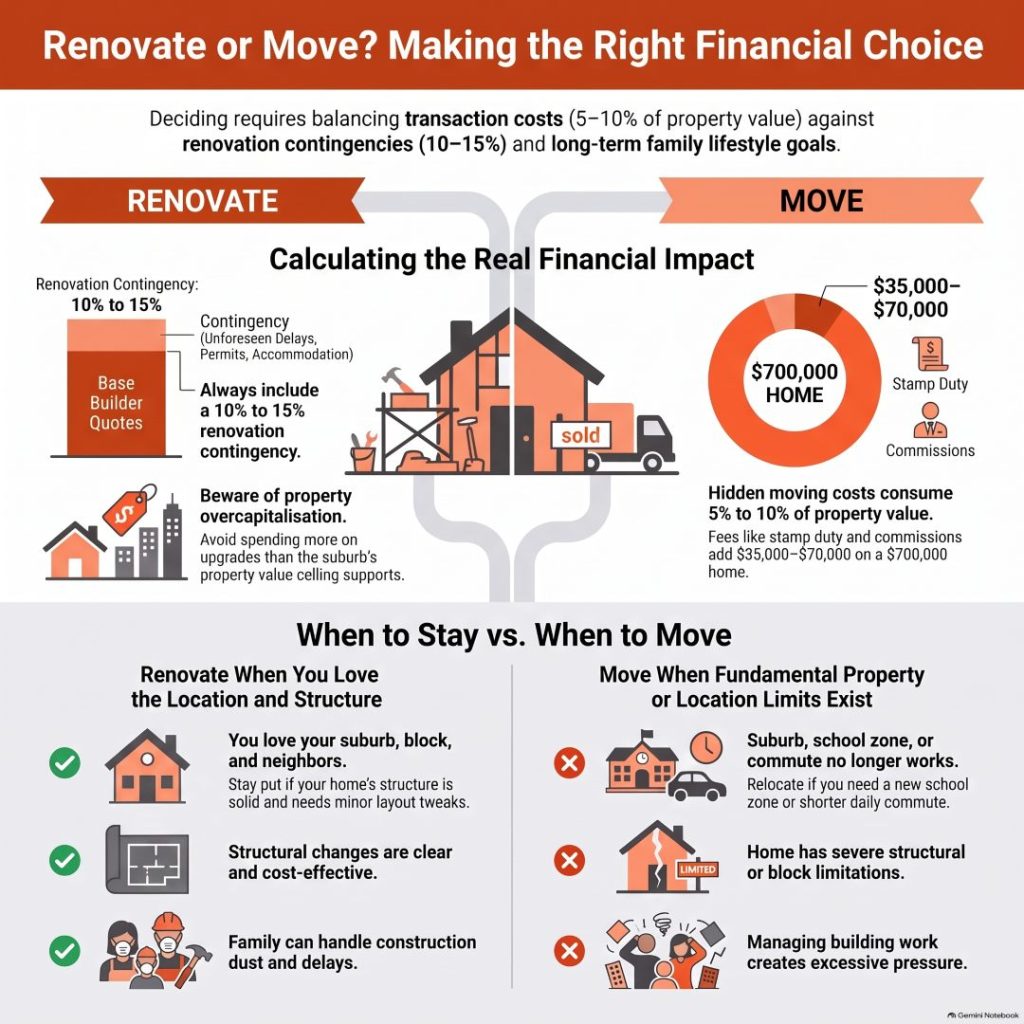
- Selling and buying can consume 5% to 10% of a property’s value, depending on your location and circumstances.
- A renovation budget should include approvals, temporary accommodation and a contingency of at least 10% to 15%.
- Borrowing capacity and monthly cash flow can determine which option is realistic, regardless of personal preference.
What Should You Compare Before Renovating or Moving?
If you are asking, “Should I renovate or buy a new home?”, start with three questions:
- What will each option really cost?
- What will each option give your family?
- What will daily life look like afterwards?
Consider a couple with two children living in a three-bedroom home worth $700,000. A $120,000 extension could provide an office, larger living area and second bathroom.
Alternatively, they could buy an $850,000 four-bedroom home nearby. However, the price difference is only part of the cost. They must also allow for stamp duty, agent commission, advertising, conveyancing, inspections, loan costs, moving and possible repairs before sale.
The home renovation vs buying new calculation must compare complete costs, not simply a builder’s quote with another property’s advertised price.
| Renovate if… | Move if… |
| You love the location and block. | The location no longer suits your family. |
| The existing structure has good potential. | The home has major structural limitations. |
| The required changes are clearly defined. | Your needs require extensive rebuilding. |
| Comparable renovated homes support the spend. | Suitable homes are available within budget. |
| Your family can manage the disruption. | Renovation would create excessive pressure. |
How Much Does Renovating Really Cost?
When calculating the cost to renovate vs buying a new house, include:
- Design, engineering and building fees
- Council permits and planning approvals
- Demolition and waste removal
- Fixtures, finishes and landscaping
- Finance and valuation costs
- Temporary accommodation or storage
- Project delays and cost increases
- A contingency of at least 10% to 15%
A quoted $150,000 renovation with a 15% contingency becomes $172,500 before accommodation or additional interest. Six months of accommodation at $700 per week adds another $18,200.
Also investigate the home renovation return on investment. If your home is worth $700,000, the renovation costs $190,000 and comparable renovated homes sell for $820,000, you could spend $190,000 to create approximately $120,000 in market value.
That does not automatically make the project unsuitable. You are also gaining lifestyle value and avoiding relocation. However, you should understand the potential $70,000 overcapitalisation before signing a contract.
What Are the Hidden Costs of Moving?
Selling and purchasing expenses can potentially consume $50,000 to $100,000, depending on the state, property price, agent, loan structure and need for bridging finance.
Common costs include:
- Stamp duty
- Agent commission and marketing
- Conveyancing and legal fees
- Building and pest inspections
- Mortgage discharge and establishment fees
- Removalists, storage and utility connections
- Styling, maintenance and repairs
- Temporary accommodation or bridging finance
As a broad planning range, selling and buying can cost approximately 5% to 10% of the property value. On a $700,000 property, that could represent $35,000 to $70,000 before paying the price difference for the upgraded home.
You should also consider whether a larger home would mean higher repayments, increased maintenance or a longer commute. A lender’s maximum borrowing capacity is not necessarily a comfortable monthly repayment.
When Does Renovating Make More Financial Sense?
Renovating is generally stronger when the location, land and structure are right, but the layout or finishes are wrong.
I started out in property by “home hopping” – buying a home, living in it, renovating to add value, then moving on. Each improvement created equity I could use to step up to the next property, helping me keep progressing even when borrowing conditions were tough. It showed me that renovating and moving can work together as part of a longer-term strategy.
A cosmetic renovation may be effective where there is a clear pricing gap between dated and renovated homes. Updating flooring, lighting, kitchens and bathrooms can improve liveability and resale appeal without the transaction costs of moving.
Renovating may also preserve your emergency buffer and future investment capacity. However, equity is not free money. Increasing your loan also increases repayments and interest costs.
When Is Moving the Better Long-Term Decision?
Moving may be the better choice when:
- Your family needs a different school zone.
- Your commute is affecting family time.
- The block cannot accommodate an extension.
- Structural problems make renovation disproportionately expensive.
- You need accessibility features the home cannot provide.
- Renovation would still leave a compromised layout.
When deciding when to renovate and when to move, consider the emotional cost too. Months of dust, delays, noise and tradespeople can place pressure on work and relationships. Sometimes protecting your family’s time and wellbeing is worth more than achieving the lowest mathematical cost.
Pros and Cons of Renovating Versus Moving
Pros of Renovating Your Home
- Remain in a community you value.
- Avoid stamp duty, agent fees and removal costs.
- Customise the design around your family.
- Potentially increase the property’s value.
Cons of Renovating Your Home
- Costs and time frames can exceed estimates.
- Construction may disrupt family life.
- Planning or structural restrictions can limit results.
- Overcapitalising may reduce your resale return.
Pros of Moving to a New Home
- Change your location, school zone or property type.
- Meet your needs without managing construction.
- Avoid building delays and unexpected renovation costs.
- Secure a better long-term property solution.
Cons of Moving to a New Home
- Transaction costs consume substantial capital.
- Higher repayments can reduce flexibility.
- Suitable properties may be difficult to find.
- Your family must leave familiar routines and neighbours.
A Three-Step Renovating vs Moving Framework
First, obtain a detailed renovation estimate covering approvals, finance, accommodation and a 10% to 15% contingency.
Second, calculate the full cost of selling and buying a suitable replacement. Include transaction costs, repayments, rates, insurance and maintenance.
Third, compare the life you would have in each property five years from now. A spreadsheet can identify the cheaper option, but it cannot measure the value of a shorter commute, preferred school or familiar community.
Conclusion: Make the Decision With Your Finance Strategy in View
The right choice is not automatically the cheapest. Renovating can be smarter when you love where you live and can create the required space without exceeding the area’s value ceiling. Moving can be better when the location or structure presents a problem that money cannot efficiently fix.
Before committing, stress-test both options against your repayments, savings buffer and longer-term property goals. Book a strategy call with us or visit the Investors Choice Mortgages Hub to explore your borrowing capacity, accessible equity and loan options with greater clarity.
Frequently Asked Questions
Is it cheaper to renovate or buy a new house?
Renovating is often cheaper when the required work is limited and your location remains suitable. Compare an all-inclusive renovation budget with the full cost of selling, buying and financing another home.
How much contingency should I allow for a home renovation?
Allow at least 10% to 15%. Older homes, structural work and projects without finalised specifications may require a larger buffer.
What renovations add the most value to a home?
Functional kitchens, bathrooms, additional bedrooms and usable living areas often have broad buyer appeal. Results depend on local demand, workmanship and the suburb’s property value ceiling.
Is it worth renovating before selling my house?
It may be worthwhile when low-cost improvements support a better sale result. Major renovations are riskier because buyers may not value your design choices enough to recover the expense.
Can I use home equity to fund a renovation?
You may be able to refinance or increase your loan if you have sufficient usable equity, income and borrowing capacity. A lender will assess your property value, existing debts, expenses and ability to service the larger loan.