

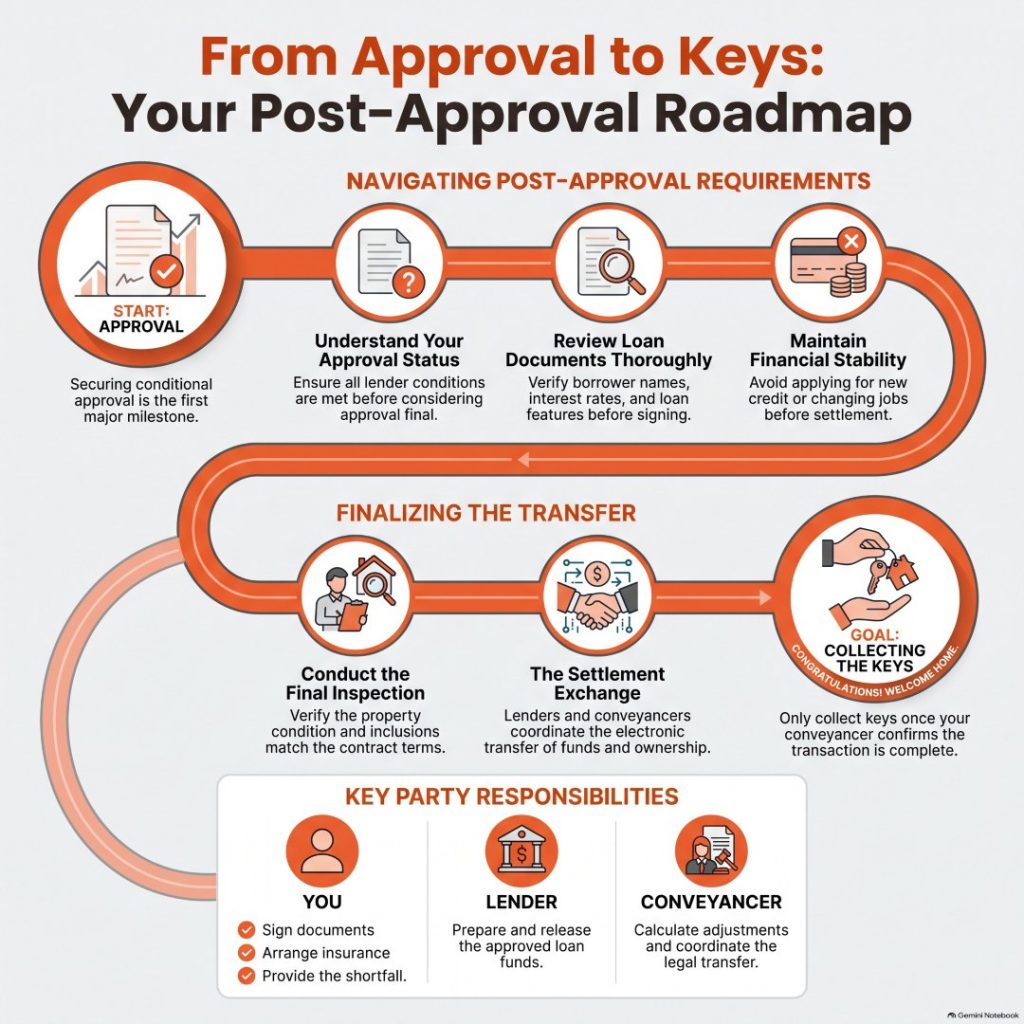
Understanding what happens after home loan is approved can turn the final weeks of buying your property from an anxious wait into a manageable checklist. Your lender issues loan documents, your conveyancer prepares the legal transfer, you arrange insurance and final funds, and the parties complete settlement. The approval is an important milestone, but you must still protect your finances and meet every remaining condition until settlement is confirmed. Knowing the home loan approved next steps can help you avoid delays, coordinate the home loan settlement process and move from unconditional home loan approval to collecting your keys with greater confidence.
Key Takeaways
- Formal approval is not the same as settlement or legal ownership.
- Check and sign your loan documents promptly, without rushing your review.
- Avoid changing jobs, applying for credit or spending your deposit before settlement.
- Arrange insurance according to your contract, state rules and lender requirements.
- Inspect the property before settlement and report problems through your conveyancer.
Is Your Home Loan Approval Conditional or Unconditional?
The first step in the home loan approval process is confirming exactly what type of approval you have received. The word “approved” can create false confidence if the lender is still waiting for documents or conditions to be satisfied.
Conditional approval means the lender is prepared to lend subject to listed requirements. These may include an acceptable property valuation, updated payslips, evidence of savings, building insurance or confirmation that another debt has been closed.
Unconditional home loan approval, also called formal approval, generally means the lender has completed its main assessment and accepted the property as security. However, you must still comply with the loan conditions and avoid significant financial changes before settlement.
If you are unsure which stage you have reached, read this guide to conditional home loan approval and ask your broker to confirm every outstanding condition in writing.
Pros and Cons of Conditional Approval
Pros
- Provides an early indication of your borrowing position.
- Helps you establish a realistic property budget.
- Identifies documents or issues that require attention.
Cons
- Does not guarantee that the lender will provide the money.
- A low property valuation may affect the loan amount.
- Changes to your income or debts may trigger reassessment.
- An unconditional property contract may expose you to serious risk.
Pros and Cons of Unconditional Approval
Pros
- The lender has completed its main credit and property assessment.
- You can progress towards settlement with greater confidence.
- The final loan amount and conditions should be documented.
Cons
- It does not mean the property has settled.
- The lender may still require pre-settlement documents or checks.
- Approval can be affected by material changes or incorrect information.
What Should You Check Before Signing Loan Documents?
Your lender will usually issue a loan contract and mortgage documents electronically or by post. Read every document and compare it with the arrangement you accepted.
Check the following details:
- Borrower names and contact information
- Approved loan amount and loan term
- Principal-and-interest or interest-only repayments
- Variable or fixed interest rate
- Estimated repayments, fees and package costs
- Offset or redraw arrangements
- Special conditions
- Property address and security details
- Direct debit account details
Imagine Jess, a 29-year-old nurse buying her first apartment for $650,000. She expected a principal-and-interest loan with an offset account, but the offset feature was missing from her documents. Finding the discrepancy before signing gave her broker time to investigate and protected her planned savings strategy.
Do not assume the displayed interest rate is permanently locked. Variable rates can change, while a fixed rate may require a separate rate-lock arrangement. Ask your broker what could change before settlement.
For the stages leading to approval, see the first-home buyer mortgage process.
What Happens During the Home Loan Settlement Process?
Settlement is the legal and financial exchange that transfers the property to you. Your conveyancer or solicitor, lender and the seller’s representative usually coordinate the transaction through an electronic settlement platform.
| Party | Main responsibility |
| You | Sign documents, arrange insurance and provide the shortfall |
| Mortgage broker | Monitor conditions and lender readiness |
| Lender | Prepare and release the approved funds |
| Conveyancer | Calculate adjustments and coordinate settlement |
| Seller’s representative | Arrange the transfer and mortgage discharge |
Your conveyancer calculates adjustments for council rates, water charges and, where relevant, strata levies. They will also confirm how much money you must contribute beyond the loan proceeds.
For example, if $617,000 is required at settlement and the lender contributes $520,000, you may need to make the remaining $97,000 available. The actual amount depends on your deposit, duties, concessions, fees and settlement adjustments.
Always verify payment instructions through a trusted channel. Call your conveyancer using a known telephone number before transferring a large amount to reduce the risk of payment-redirection fraud.
Can Your Loan Be Delayed After Formal Approval?
Yes. Formal approval reduces uncertainty, but settlement may still be delayed by incorrectly signed documents, missing insurance, late funds or a material financial change.
Until settlement, avoid:
- Applying for a car loan or credit card
- Increasing buy now, pay later balances
- Changing jobs without speaking to your broker
- Spending money reserved for settlement
- Making unexplained large transfers
- Missing repayments on existing debts
A new $25,000 car loan may change your liabilities enough for the lender to reassess your application. Respond promptly to requests and ask your broker when the lender is officially ready to settle.
If your assessment has stalled, review these common reasons home loan applications are delayed.
When Should You Arrange Building Insurance?
Arrange appropriate insurance as early as your conveyancer and lender advise. Responsibility for property damage passes to the buyer at different stages depending on the contract and state or territory.
Your lender may require a certificate of currency before releasing funds. This generally identifies the insured property and notes the lender’s interest.
For a house, you will usually need building insurance. For an apartment or townhouse, the owners corporation may insure the building, but you may still need contents insurance or cover for items outside the strata policy.
Ask your conveyancer when risk passes under your contract and confirm exactly what evidence your lender requires.
What Should You Check at the Final Inspection?
The final inspection confirms that the property remains in substantially the same condition as when you signed the contract.
Check that:
- Agreed fixtures, fittings and appliances remain
- There is no unexpected damage
- Required repairs have been completed
- Unwanted rubbish has been removed
- Lights, taps, doors and included appliances work where practical
- The property is vacant if vacant possession was agreed
I once attended a final inspection expecting the property to be empty and ready for the buyer, only to discover that it had not been vacated. The seller’s belongings were still throughout the house, making it clear that the buyer would not receive the vacant possession promised in the contract. Rather than treating it as a minor inconvenience or trying to resolve it directly with the seller, I documented the condition and immediately involved the conveyancer so the issue could be addressed before settlement. It was a powerful reminder that a final inspection is not a formality. It is the buyer’s last opportunity to identify a problem before the transaction is completed.
Take your contract, inclusions list and earlier photos. If you identify a problem, photograph it and contact your conveyancer immediately. Do not negotiate privately with the seller or delay settlement without legal advice.
What Happens on Settlement Day?
Most buyers do not attend settlement. The usual sequence is:
- Your conveyancer confirms the final figures and available funds.
- The lender makes the loan proceeds available.
- The parties complete the electronic financial exchange.
- The transfer and mortgage documents are lodged.
- Your conveyancer confirms settlement.
- The agent receives authority to release the keys.
Wait for your conveyancer’s confirmation before collecting the keys or entering the property. Banking, documentation or technical issues can cause short delays.
What Should You Organise Before Receiving the Keys?
Prepare utilities, removalists, security changes and urgent maintenance, but keep arrangements flexible until settlement is confirmed.
If you plan to renovate, obtain quotes, check council or strata requirements and create a contingency budget. Approval does not give you the right to enter or alter the property before settlement. Written permission may be required for pre-settlement trade inspections.
Take Control of the Final Steps
Approval is where preparation becomes coordination. Confirm your approval status, check your documents, protect your financial position, arrange insurance, complete the final inspection and make your settlement funds available.
For expert guidance, practical calculators and resources that help you make more confident property decisions, access the Investors Choice Mortgages Hub. The app can support you through the mortgage process with clarity, transparency and fewer surprises.
Frequently Asked Questions
How long does home loan settlement take after approval?
Settlement commonly occurs several weeks after formal approval, but the contract determines the settlement date. The home loan settlement period varies according to the transaction, location, negotiations and special conditions.
Can a bank withdraw a home loan after unconditional approval?
A lender may withdraw or change approval in limited circumstances, including fraud, incorrect information, unmet conditions or a material change in your financial position. Avoid new debts and keep your broker informed until settlement is complete.
Do I need building insurance before home loan settlement?
You may need insurance before settlement because responsibility for damage can pass at different stages. Your lender may also require a certificate of currency before releasing funds. Confirm the timing with your conveyancer and lender.
What money do I need available on home loan settlement day?
You need enough to cover the difference between the loan proceeds and the final settlement amount, including applicable duties, legal costs, fees and adjustments. Your conveyancer should provide the final figure and verified payment instructions before settlement.