

Is Investor Activity Set to Fall?
Australia's property investors are facing a double headwind in 2026 - and the latest lending data confirms the retreat has already begun....
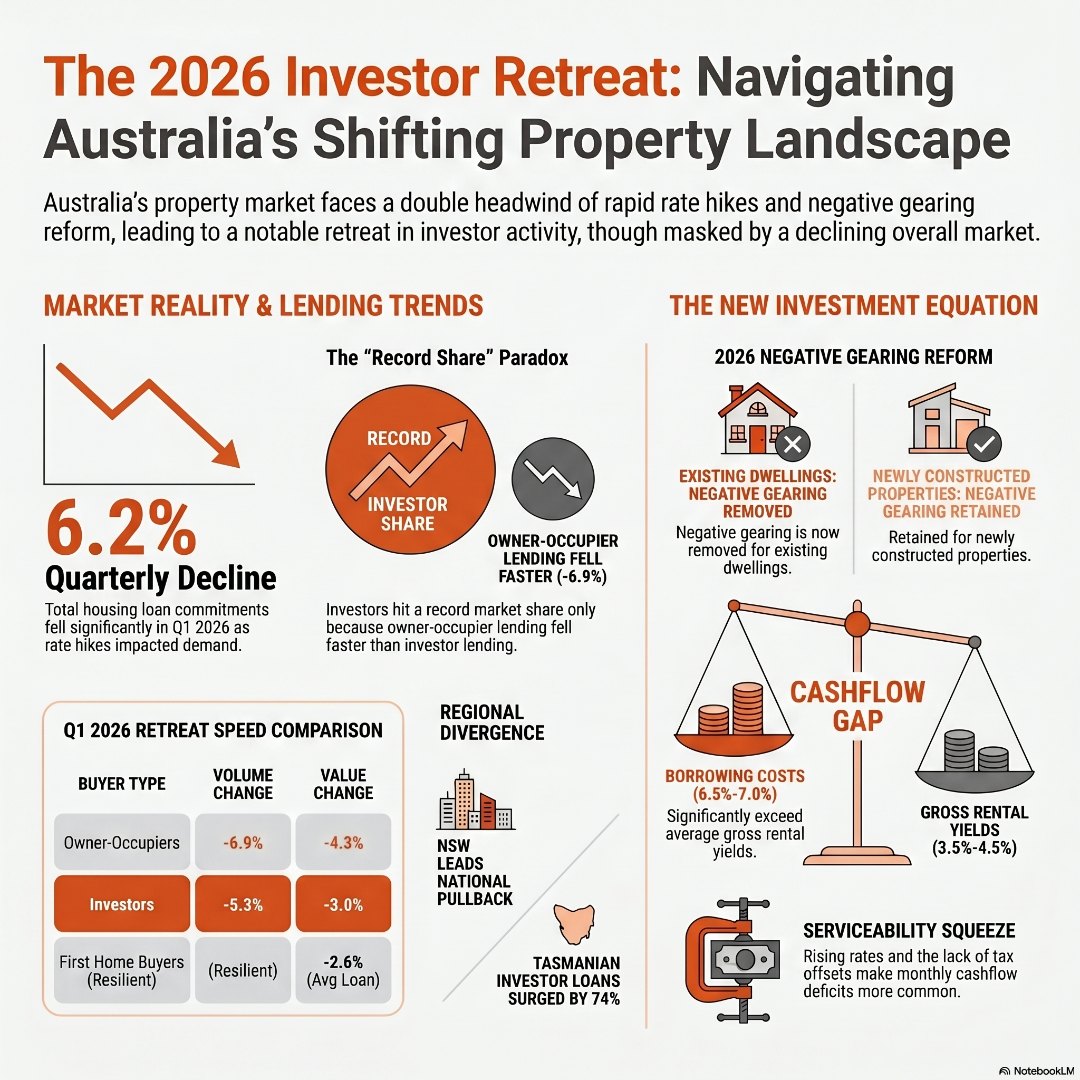
Australia’s property investors are facing a double headwind in 2026 – and the latest lending data confirms the retreat has already begun. According to ABS Lending Indicators, total housing loan commitments fell 6.2% in the March quarter, with investor activity property Australia 2026 emerging as a closely watched signal of where the broader market is heading. Yes, investor activity is declining in volume terms, but the picture is more nuanced than the headlines suggest – investors are holding a record share of total lending even as the number of loans falls, and the real question for anyone with property in their portfolio is what comes next.
The short answer is that the RBA moved faster than many investors expected.
Two of the three interest rate hikes delivered so far in 2026 landed in the March quarter alone. That kind of rapid rate movement does two things simultaneously: it makes the numbers on an investment property harder (higher monthly repayments, tighter serviceability), and it rattles consumer confidence – which is often the more powerful of the two forces.
Energy prices surged in late February following global events, and consumer confidence surveys dropped sharply. When confidence falls, people delay high-value decisions. Buying an investment property is, arguably, the highest-value financial decision most Australians ever make.
The result: total housing loan commitments fell 6.2% in volume terms and 3.8% in value terms over the March quarter. Both measures were still higher than March 2025 – a reminder that the tailwind from last year’s rate cuts has not fully dissipated – but the direction of travel has clearly reversed.
If you hold an investment property or are considering purchasing one, understanding what happens when interest rates rise on investment loans is now essential reading, not optional context.
This is the counterintuitive piece of the data that most commentary glosses over.
Even though investor lending fell in the March quarter, it fell less sharply than owner-occupier lending. Owner-occupier loan volumes dropped 6.9%, while investor loan volumes fell 5.3%. Because owner-occupiers retreated at a faster rate, the investor slice of the total pie actually grew.
In volume terms, the investor share of all new housing loans hit 41.0% in March 2026 – a record high for this data series, which goes back to September 2019. In value terms, the investor share reached 40.3%, its highest level since December 2016.
This record investor share should not be read as investor strength. It reflects the relative pace of retreat across buyer categories, not a surge of confident new capital. The underlying lending volumes are the more honest signal.
At a glance: Q1 2026 lending changes by buyer type
| Buyer Type | Volume Change | Value Change |
|---|---|---|
| Owner-occupiers (total) | -6.9% | -4.3% |
| Investors | -5.3% | -3.0% |
| First home buyers | Smaller volume fall | -2.6% (avg loan size) |
First home buyers showed relative resilience in volume terms, partly supported by the 5% Deposit Scheme. However, their average loan size fell 2.6% in the quarter, suggesting buyers are stretching less or targeting lower price points.
This is where the longer-term picture gets considerably more challenging for investors purchasing existing properties.
The 2026 Federal Budget removed negative gearing for purchases of existing dwellings. Negative gearing on newly constructed properties remains intact. This is a structural change to the investment equation that goes well beyond a rate cycle.
When an investor borrows to buy a property and the rental income is less than their interest and holding costs, the shortfall can ordinarily be offset against other taxable income – reducing their overall tax liability. Without that relief on existing properties, investors must either:
The third option is the one that concerns property market analysts most. Investors who have historically favoured established dwellings may now redirect capital to shares, managed funds, or other income-producing assets. That reduces demand for existing housing stock at precisely the moment supply is already constrained.
For a clear breakdown of how these negative gearing changes 2026 affect your specific strategy, the article on what the 2026 Budget tax changes mean for property investors is worth reading before making any decisions.
It is also worth noting that capital gains tax reform is being discussed alongside the negative gearing changes, creating what some investors are calling a “double hit” on after-tax returns from residential property investment.
There is a reason investor cashflow has become the most urgent conversation in property finance right now – and it is not just about rates.
Rental yields in most major Australian capital cities currently sit well below the cost of borrowing. If you are paying 6.5% to 7% on your investment loan but your gross rental yield is 3.5% to 4.5%, you are running a significant cashflow deficit every month. Historically, investors accepted this because negative gearing reduced the real cost, and capital growth made up the difference over time.
With negative gearing removed for existing properties, and with dwelling values already contracting in Sydney and Melbourne, both of those relief valves are under pressure simultaneously.
If you are unsure how rising rates affect your specific position, stress-testing your mortgage before making any further commitments is one of the most practical steps you can take right now.
I know the weight of what getting it wrong on rates actually costs a family. My father lost everything in the late 1980s – not through recklessness, but through a combination of rising interest rates and a mortgage company called Estate Mortgage that simply collapsed under the pressure. I watched him lose his life savings. He never fully recovered, and I believe it contributed to his death. That experience is not a footnote in my career. It is the entire reason I built one. Every time I sit across from a client who is carrying a cashflow deficit they cannot see a way out of, or who has not yet stress-tested their position against a further rate rise, I think of my dad. I am not telling you this to frighten you. I am telling you this because the investors who survive – and thrive – through periods exactly like this one are the ones who ran the numbers before the market ran them. The gap between rental yields and borrowing costs right now is not a reason to panic. It is a reason to get precise about where you stand, before the next RBA decision does it for you.
The national headline tells part of the story. The state-by-state data tells the rest.
NSW is the largest investor market by share (43.9% of investor lending in March 2026) and recorded the biggest decline in investor lending volumes during the quarter. Western Australia was the second-largest contributor to the national fall.
In contrast, South Australia and Tasmania both recorded increases in investor lending volumes. Tasmania’s figure was particularly striking – investor loan volumes in TAS were up almost 74% on the same period last year, albeit from a small base.
Victoria continues to lead first home buyer lending as a share of the total. Queensland recorded one of the sharper falls in first home buyer lending, down 5.8% in March.
The takeaway for investors is that national data can mask significant local opportunity. A market contracting at the national level does not mean every suburb in every state is experiencing the same conditions. Data-led suburb research – rather than headlines – is what separates disciplined investors from those who either over-commit or miss good opportunities entirely.
If you currently hold negatively geared properties or are considering a purchase, the policy changes announced in the 2026 Federal Budget require a genuine strategic review – not just a passing glance.
The key question is not whether negative gearing “still works” in a general sense. It is whether the specific numbers on a specific property, in a specific market, still stack up for your individual tax position and cashflow tolerance. For some investors, purchasing a newly built property and retaining negative gearing eligibility may make sense. For others, the strategy may shift toward positively geared properties in higher-yield markets, reducing reliance on tax offsets altogether.
This is exactly why the conversation about negative gearing and re-evaluating your strategy is more relevant now than at any point in the past decade.
The honest answer is: lower before it recovers.
The full impact of the May rate hike has not yet been fully reflected in lending data. If the RBA moves again, serviceability calculations tighten further. Investor demand – already softening – faces the structural headwind of the negative gearing reform layered on top of cyclical rate pressure.
Recovery will likely require a combination of rate cuts, stabilisation of policy settings, and a period of yield compression relative to borrowing costs. None of those conditions are imminent.
The investors who will perform best through this period are those running specific numbers on specific properties – not relying on broad sentiment or historical assumptions. They are pressure-testing their cashflow against further rate rises, exploring whether new construction makes more sense than existing dwellings under revised tax settings, and using reduced competition in some markets to make measured, data-backed decisions.
The starting point is getting your borrowing capacity precisely understood – knowing exactly what you can service, at what rate, and with what buffer. You can explore strategies to improve your borrowing capacity for property investment to understand where you currently stand.
The Investors Choice Mortgages Hub is your starting point for doing exactly that. Free tools, expert brokers, and the kind of genuine advice that gives our community an unfair advantage in a market that does not always play fair. Run a Suburb Snapshot, stress-test your mortgage, or ask AI Jane your most pressing property questions – all in one place, built specifically for buyers and investors who want to make decisions backed by data, not headlines.
Is investor activity in Australian property really falling in 2026?
Yes. According to ABS Lending Indicators, investor loan volumes fell 5.3% in the March quarter of 2026, and the value of investor lending dropped 3.0%. While the investor share of total lending reached a record 41.0%, this reflects the faster retreat of owner-occupiers rather than a sign of investor strength. The direction of the trend for investor activity property Australia 2026 is clearly downward, and further softening is expected as rate and policy impacts continue to flow through.
Will removing negative gearing reduce property prices in Australia?
The removal of negative gearing for existing property purchases is likely to reduce investor demand, which could ease price pressure in some markets – particularly those heavily reliant on investor activity, such as inner-city Sydney and Melbourne units. However, supply constraints and population growth remain supportive of prices in the medium term. The impact of the negative gearing changes 2026 will not be uniform across all property types and locations.
Should I still invest in property in 2026 despite the pullback?
It depends entirely on your financial position, risk tolerance, and the specific property and market you are considering. Investors with strong equity, stable income, and the ability to absorb cashflow deficits may still find well-selected opportunities – particularly in higher-yield markets or newly constructed properties that retain negative gearing eligibility. Anyone considering a purchase should stress-test their position against further rate rises before committing.
How do RBA interest rate hikes affect property investor cashflow?
RBA rate hikes increase the cost of investment loans directly. If your loan is variable rate and the RBA lifts by 0.25%, your monthly repayments increase. Combined with rental yields that are already below borrowing costs in most capital cities, each rate increase widens the cashflow gap investors must fund from their own income. With negative gearing removed for existing properties, the tax relief that previously offset this gap is no longer available for new purchases of established dwellings.
Australia's property investors are facing a double headwind in 2026 - and the latest lending data confirms the retreat has already begun....

Australia's 2026 Federal Budget has delivered the most significant tax reform for property investors in more than 25 years, reshaping the rules...