

Why Do Interest Rates Rise During Inflation?
When inflation climbs, interest rates typically rise because central banks - like Australia's Reserve Bank - deliberately make...
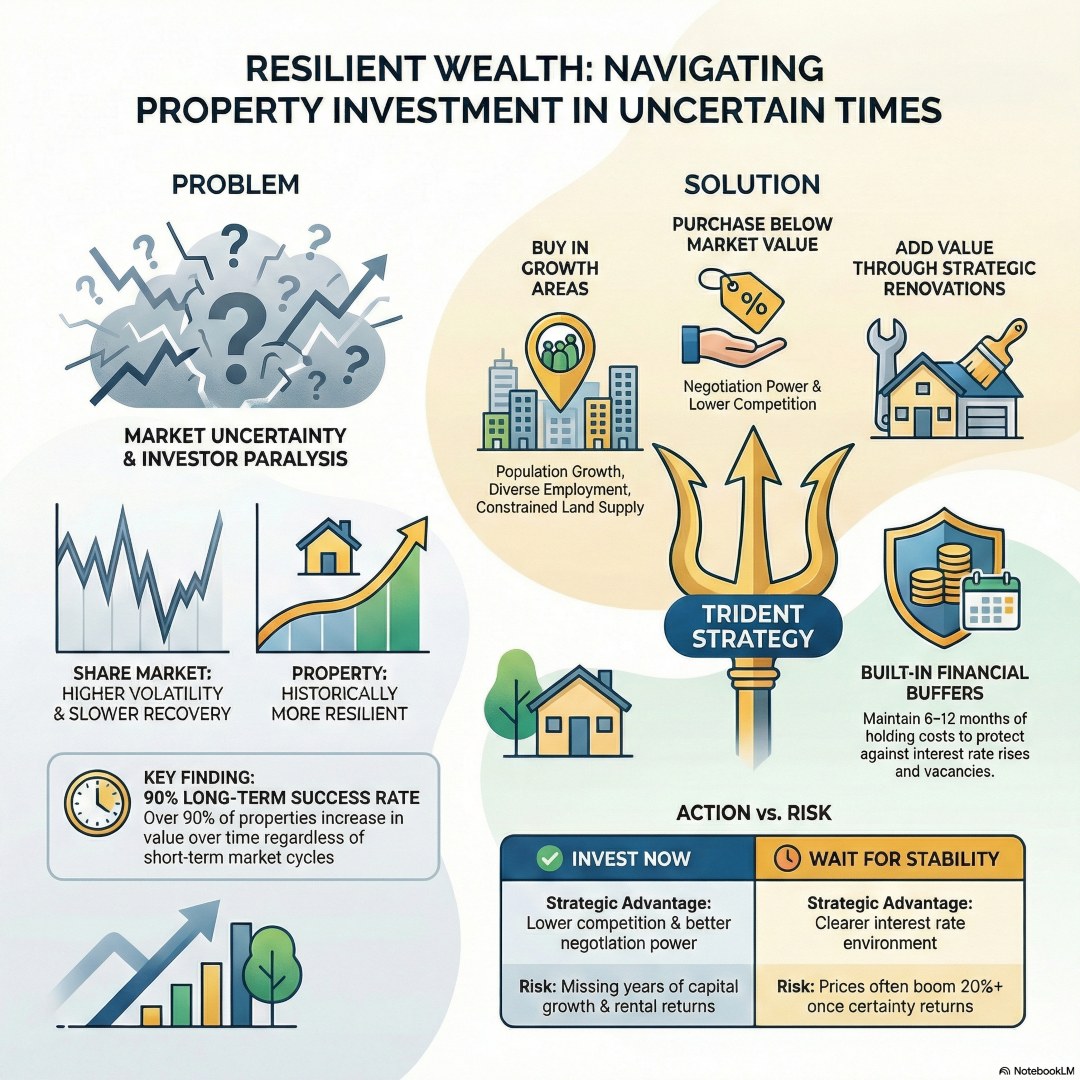
Property investment can be safe during uncertain markets, but only with the right strategy and expert guidance. While no investment is completely risk-free, data shows that over 90% of properties increase in value over time, and strategic property investment has historically outperformed share markets during economic downturns with significantly less volatility.
The key lies not in trying to time the market perfectly which is nearly impossible but in having time in the market with a well-researched, low-risk approach. Smart investors who follow proven strategies like the Trident Strategy (buying in strong growth areas below market value and adding strategic value through renovations) can navigate uncertain times successfully while building long-term wealth.
When uncertainty grips the economy, nervous investors often question whether property investment remains a safe wealth-building strategy. The historical data tells a compelling story.
During the 2008 Global Financial Crisis one of the most severe economic shocks in decades Australian property values did experience some decline. However, the recovery was remarkably swift compared to other asset classes. While the ASX 200 took years to recover its pre-crisis levels, property markets bounced back with far less volatility.
This resilience stems from property’s fundamental characteristics. Unlike shares, which can fluctuate wildly based on market sentiment, property values are anchored by real-world factors: land scarcity, population growth, and the basic human need for shelter. These fundamentals don’t disappear during uncertain times they often strengthen as people seek stability.
The wealthiest Australians those in the top 0.0008% on the rich list remain heavily invested in property despite having access to every investment vehicle imaginable. Their confidence isn’t misplaced; it’s based on decades of evidence showing property’s ability to preserve and grow wealth through various economic cycles.
The question isn’t whether property investment carries risk all investments do. The real question is whether that risk can be managed intelligently while maintaining strong long-term growth potential.
Property investment safety comes down to strategy and preparation. Markets may experience corrections expert predictions suggest potential drops of 5-10% during interest rate rises but properties in strong growth areas with above-average fundamentals typically weather these storms and emerge stronger.
Let me peel back the curtain for a moment and share what “uncertain markets” actually felt like, up close and personal. I still remember the anxiety when I bought my first investment property, right in the aftermath of the Global Financial Crisis. My friends called me crazy, the headlines screamed “DOOM,” and my stomach spent more time in knots than not. Two weeks in—after finally getting the keys and making big plans for renovations—I tore up the first floorboard and discovered a leaking, rusted pipe that had quietly flooded the subfloor for years. Cue panic. There I was: over budget, facing mounting uncertainty, and genuinely tempted to run for the hills (or at least list the property the first chance I had). But every sleepless night taught me two timeless truths about safe investing: First, the best time to act is rarely when you feel “certain”—boldness must be balanced by buffers. Second, my research and conservative borrowing saved me. Because I hadn’t extended myself to the limit (thanks to everything I preach in this very article), I was able to weather the repair costs, complete a strategic renovation, and ultimately rent out the property at a premium. Today, that “disaster buy” stands as the best-performing asset in my portfolio. Uncertainty, handled with planning and support, really does breed resilience—and, often, results you can’t imagine at the start.
This resilience stems from focusing on three critical elements:
These principles of risk minimisation form the foundation of safe property investment, regardless of broader market conditions.
Successful property investment during uncertain times requires a systematic approach rather than emotional decision-making. The Trident Strategy provides this framework through three key pillars:
Focus on locations with solid fundamentals growing population, diverse employment opportunities, and constrained land supply. These areas may experience short-term fluctuations but maintain long-term growth potential even during broader market uncertainty.
Properties in areas with multiple growth drivers often outperform the broader market regardless of economic conditions. This strategic selection forms the first line of defence against market volatility.
Buying properties below their true market value provides an immediate equity buffer. This cushion protects investors during market corrections and provides flexibility for future strategy adjustments.
Negotiation skills become particularly valuable during uncertain times when motivated sellers may accept lower offers for a quick, certain sale.
Strategic renovations that improve a property’s appeal and functionality can accelerate growth regardless of broader market conditions. A well-renovated property in a good area often outperforms the market even during uncertain times.
Cosmetic renovations with strong returns on investment can boost both rental income and capital value, creating growth even when the broader market stagnates.
This approach has proven effective across various market cycles. Investors who bought strategically during the uncertainty following the Global Financial Crisis often achieved exceptional returns as markets recovered.
Safe property investment isn’t about eliminating risk it’s about managing risk intelligently. This starts with conservative borrowing practices.
Avoid maximising your borrowing capacity. Instead, maintain a buffer for rate rises, economic changes, or unexpected expenses. This conservative approach might limit your initial purchasing power, but it protects your long-term investment strategy.
Houses often outperform units for capital growth due to land appreciation, but units can provide superior rental yields in high-demand urban areas. Your choice should align with your primary investment goal capital growth or cash flow and your risk tolerance.
Diversification within property also matters. Rather than putting all resources into one expensive property, consider multiple affordable properties in different growth areas. This strategy spreads risk and can provide more stable rental income.
Creating a formal investment plan with clear parameters for:
This disciplined approach provides a safety net that allows investors to weather market fluctuations with confidence.
One of the biggest mistakes uncertain investors make is trying to time the market perfectly. Waiting for the “perfect” moment often means missing years of potential growth.
Property investment works best as a 7-10 year minimum strategy. This timeframe allows you to ride out short-term volatility and benefit from long-term appreciation. Markets may stagnate or decline 2-4% in challenging periods, but they often boom 20%+ afterward. The smart money buys when others panic.
Current uncertainty might actually present opportunities. Lower competition from nervous investors can mean better purchase prices and more negotiating power. Properties that might have been overpriced during boom times become available at more reasonable valuations.
The financial freedom framework focuses on long-term wealth creation rather than short-term market fluctuations. This patient, strategic approach has consistently outperformed attempts at market timing.
Today’s uncertain markets are characterised by rising interest rates, inflation concerns, and global economic instability. These factors create both challenges and opportunities for property investors.
Higher interest rates increase borrowing costs but often lead to reduced property prices as fewer buyers compete. For well-prepared investors with pre-approved finance and adequate buffers, this environment can offer excellent purchasing opportunities.
The key is stress-testing your investment strategy. Can you handle a 2-3% increase in interest rates? Do you have reserves for several months of vacancy? If your answer is yes, uncertain markets shouldn’t derail your property investment plans.
Consider these questions when assessing your readiness:
Answering these questions honestly helps determine your readiness to invest safely during uncertain times.
The benefits of buying property often outweigh the risks when approached with proper research and strategy, even during uncertain markets.
Uncertain markets require more expertise, not less investment activity. The difference between success and failure often comes down to having the right guidance through the process.
Professional mortgage brokers who specialise in investment property understand current market dynamics and can structure loans to protect your interests during volatile times. They can help you stress-test different scenarios and ensure your borrowing remains sustainable even if conditions worsen.
The current environment rewards prepared investors who act strategically while others remain paralysed by uncertainty. With proper research, conservative borrowing, and professional guidance, property investment can remain a cornerstone of wealth building even during challenging times.
Don’t let market uncertainty prevent you from taking action toward your financial goals. Instead, use it as motivation to invest smarter, with better preparation and expert support.
Book a mortgage review call today to discuss how current market conditions might actually work in your favour for strategic property investment.
Should I wait for property prices to drop more before investing during uncertain markets?
Trying to time the market perfectly is extremely difficult and often counterproductive. Historical data shows that time in the market generally beats timing the market for property investment. Focus on buying quality properties in strong locations at reasonable prices rather than waiting for the perfect bottom. Investors who stayed on the sidelines after previous market corrections often missed the strongest recovery phases of the market cycle.
How much emergency buffer should I have when investing in property during uncertain times?
Aim for at least 6-12 months of holding costs (loan repayments, rates, insurance, maintenance) in addition to your standard emergency fund. This buffer should account for potential vacancy periods and interest rate increases of 2-3% above current levels. Conservative investors should consider increasing this buffer to 12-18 months during particularly volatile market conditions, providing peace of mind and protecting against forced selling.
Are houses or apartments safer investments during economic uncertainty?
Both can be safe with proper research, but houses typically provide better capital growth potential due to land value appreciation. Houses also offer more control over maintenance and improvement decisions. Apartments may offer better cash flow in premium locations but come with body corporate fees and less control over common areas. The safest approach is selecting properties with strong fundamentals regardless of type, focusing on location quality, tenant appeal, and structural condition.
How do rising interest rates affect the safety of property investment?
Rising rates increase borrowing costs and may temporarily suppress property prices. However, they also reduce buyer competition and can create opportunities for well-prepared investors. The key is ensuring your investment strategy remains cash-flow positive even with rate increases of 2-3%. Fixed-rate loans can provide short-term certainty during volatile interest rate environments, allowing you to lock in current rates while markets adjust.
When inflation climbs, interest rates typically rise because central banks - like Australia's Reserve Bank - deliberately make...

Market volatility is inevitable in property investing, but it doesn't have to derail your wealth-building plans. Most successful...